TheJournal.ie uses cookies. By continuing to browse this site you are agreeing to our use of cookies. Click here to find out more »
Dublin: 10 °C Wednesday 22 May, 2013

Bahrain’s king criticises investigation distancing Iran from Arab Spring

The king of Bahrain says the investigator charged with probing the government’s crackdown on civilian protests uncovered “real shortcomings” from state institutions.

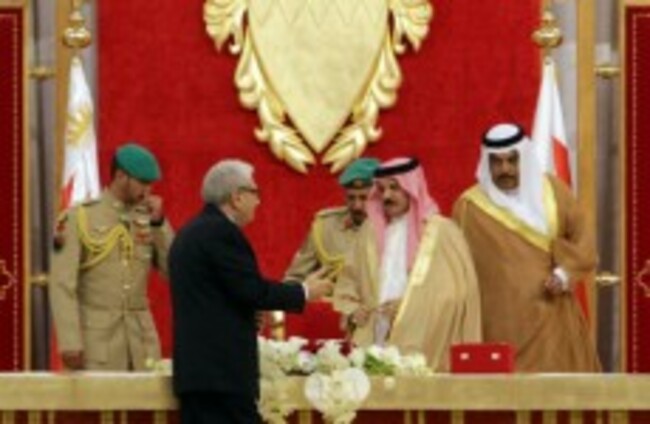
Investigator Cherif Bassiouni, in black, presents his report to Bahrain's king today.
Image: Hasan Jamali/AP/Press Association Images

WITH BAHRAIN’S king watching, the chief investigator asked to probe his government’s crackdowns gave a blow-by-blow reckoning today of torture, excessive force and fast-track justice in attempts to crush the largest Arab Spring uprising in the Gulf.

The investigator, Mahmoud Cherif Bassiouni, also said there was no evidence of Iranian links to Bahrain’s Shiite-led protests.

Gulf leaders have accused Tehran of playing a role in the 10-month-old showdown in the Western-allied kingdom.

The 500-page study — authorised by Bahrain’s Sunni rulers in a bid to ease tensions — marks the most comprehensive document on security force actions during any of the revolts that have flared across the Arab world this year. It also displayed a stunning image of a powerful Arab monarch facing a harsh public reckoning, as King Hamad bin Isa Al Khalifa listened somberly to a bullet-point summary of the report’s conclusions.

Bassiouni’s summary read like a checklist of complaints by rights groups since February: Middle-of-the-night raids to “create fear”, purges from workplaces and universities, jail house abuses including electric shocks and beatings and destruction of Shiite mosques that “gave the impression of collective punishment.”

Further clashes

At least 35 people have been killed in violence related to the uprising, including several members of the security forces.

It appeared unlikely that even the strong criticism would satisfy opposition forces, who accused the Sunni monarchy of using all methods at its disposal to avoid sharing power with the nation’s Shiite majority. Just hours before the long-awaited report was released, security forces used tear gas and stun grenades in the latest of nearly daily clashes on the strategic island, home to the US Navy’s 5th Fleet.

“What is really needed is to hold the perpetrators responsible and bring them to justice,” said Khalil al-Marzooq, a senior official with the biggest Shiite opposition party, Al Wefaq, which pulled out of parliament this spring to protest the harsh tactics against protesters.

Response

There were no immediate signs of escalating street protests after the report was issued. In one area, protesters blocked roads and chanted slogans against the ruling family.

In Washington, the White House commended the king for appointing the commission and said in a statement that it is “incumbent upon the government of Bahrain to hold accountable those responsible for human rights violations and put in place institutional changes to ensure that such abuses do not happen again.”

The inquest was seen as a bold step in a region of monarchs and sheiks who rarely acknowledge shortcomings or face uncomfortable criticism in public.

Bahrain’s government promised “no immunity” for anyone suspected of abuses and said it would propose creating a permanent human rights commission.

“All those who have broken the law or ignored lawful orders and instructions will be held accountable,” said a government statement, adding that the report notes that the “systematic practice of mistreatment” ended shortly after martial law was repealed on 1 June.

Bahrain’s Shiites comprise about 70 per cent of the island nation’s 525,000 citizens. They have complained of widespread discrimination such as being blocked from top government or military posts. The monarchy has offered some concessions, but refused to bow to protest demands to surrender control of all top positions and main policies.

“A number of detainees were tortured … which proved there was a deliberate practice by some,” said Bassiouni, whose report covered the period between 14 February and 30 March.

The report also was highly critical of a special security court created under martial law that “overtook the national system of justice” and issued harsh sentences — including life in prison and death row rulings — that “denied most defendants elementary fair trial guarantees.”

Abuses

The document spotlighted abuses at the island’s main hospital, the state-run Salmaniya Medical Center. The authorities saw its mostly Shiite staff as opposition sympathisers. Dozens of doctors and nurses who treated injured protesters were detained during crackdown. Many were sentenced to five to 15 year prison sentences. Their appeal will be heard in a civilian court.

“All reports indicated that there were protests, and indeed chaos, in the SMC,” the report says. It adds, “The hospital generally continued to function normally” through the unrest.

Bahrain has abolished the security court. Bassiouni urged Bahrain to review all the security court verdicts and drop charges against all those accused of nonviolent acts such as joining or supporting the protests.

“You found real shortcomings from some government institutions,” Bahrain’s king told Bassiouni, an Egyptian-born professor of international criminal law and a former member of UN human rights panels.

But the king lashed back at finding that Iran did not influence the uprising, saying his government could not provide clear evidence but insisting Tehran’s role was clear to “all who have eyes and ears.”

Bahrain is a critical US ally, and Washington has taken a cautious line because of what’s at stake: urging Bahrain’s leaders to open more dialogue with the opposition, but avoiding too much public pressure.

In a statement today, US Senate Foreign Relations Committee Chairman John Kerry said the report is an important moment for Bahrain that has lived through a year of events that were “highly traumatic.”

“Political reform in Bahrain will not come easily, but it is critical for the healing process,” Kerry said.

For Gulf leaders, led by powerful Saudi Arabia, Bahrain is seen as a firewall to keep pro-reform protests from spreading further across the region. Sunni Gulf rulers have rallied behind the kingdom’s embattled monarchy and sent in military reinforcements during the height of the crackdowns and Saudi-led units still remain.

Read: Bahrain to retry medics jailed for treating protesters >

Read more: F1 to return to Bahrain in November 2012 >

Read next:

Comments (2 Comments)

  • Hamad and your Government you dogs run while you can to Saudi , your thieves and fat rats will follow – Up the Arab Spring freedom and democracy for all !

    Reply
  • Very very sickning … We suffered the same abuse in the North of Ireland from the 1920’s through to the 1980’s. The Stormont Administrataions refusal to build an environment where Nationalists and Unionists were treated equally under law and then in the 191960′s/ 70′s the British Governments use of force to put down peacful civil rights protests, through murder and thuggery, lead to emergence of the Provisional IRA. I hope that the Bahraini Government pay heed to history and embard immediately on allowing every citizen equal access to jobs (public and private sector), education, Policing (No Shi-ite is allowed to jon the Police force… does anyone remember that in 1970, only10% of the Police force in the north was Catholic??) … But most importantly, this is almost 2012, there is no room for a monarchy ruling a state. In England, the Queen is a figurehead and signs off laws.. that is their choice. In Bahrain, the King and his brothers control Parliament, all the monistries, and tell the Politicians what laws to introduce etc. This is the ruling Sunni family. Its an absolute disgrace. The Saudi Government sent in tanks, and armoured vehicles when the Shiites fstarted protesting en masse. Saudi Arabia ruling family and the Bahraini ruling families are being propped up by the Americans and the British. How stupid are these countries to support opporession. They have no right to condemn Syria on one hand, while supporting these ruling families on the other.
    There is major trouble brewing, and as usual, it will be the civilian populations that suffer as a result of the mis-governance of corrupt regimes, supported by western powers. Look at Israel, the same is happening there. 1.5million people living in the worlds largest open-air prison. Again, supported by the US. How can these countries try and tell the rest of the world, what is decent and what is not, when they pile arms, heavy weapons, military aircraft into a powder keg region of the world….. grrrrrrrrrrrrrrrrrrrr

    Reply

Add New Comment