Sign in. It’s quick, free and it’s up to you.
An account is an optional way to support the work we do. Find out more.
Sign in. It’s quick, free and it’s up to you.
An account is an optional way to support the work we do. Find out more.
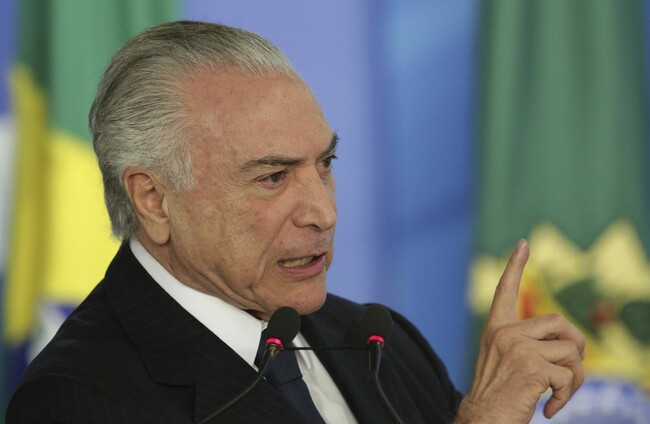
BRAZIL’S TOP PROSECUTOR has charged President Michel Temer with bribery, plunging Latin America’s biggest country into what could be prolonged new political turmoil.
The bribery charge filed by Prosecutor General Rodrigo Janot swept Temer into the forefront of a giant graft scandal that has engulfed Latin America’s biggest country over the last three years.
Although several past Brazilian presidents and scores of other politicians are currently being investigated for corruption in the “Car Wash” probe, Temer is the first leader in the country’s history to face criminal charges while still in office.
Temer acted “in violation of his duties to the state and to society,” Janot wrote, citing “abundant” proof that the president received bribe money.
For Temer to go on trial, the lower house of Congress must first approve Janot’s charge by a two-thirds majority. Temer would then be suspended for six months for the trial.
Janot is also probing Temer for alleged obstruction of justice and membership of a criminal group. He could file those charges at a later date, guaranteeing a sustained legal assault.
However, Temer’s aides say they are confident he has sufficient support in Congress to get the charges thrown out.
In his first comments since returning from a trip to Russia and Norway, the president was defiant.
“There is no plan B,” he said at a ceremony to sign a new bill in the capital Brasilia. “Nothing will destroy us — not me and not our ministers.”
The Eurasia Group risk consultancy said there was a 70 percent chance of Temer lasting to the end of his term through 2018.
“Temer still enjoys enough support in congress (at least one-third, or 172 votes) to defend himself against the charges,” Eurasia Group’s analysis said.
“For most lawmakers, while there are now fewer incentives to openly support the Temer government, there are even fewer incentives to remove Temer from his seat.”
Most unpopular
Temer’s latest approval ratings are just seven percent, lower than his deeply unpopular leftist predecessor Dilma Rousseff, whom he replaced last year after she was impeached by his center-right congressional allies for breaking budgetary rules.
He took over promising to restore political stability and to steer Brazil out of its deepest recession in history with market reforms.
Yet the political capital he needs for those reforms, including the hugely unpopular proposal to cut back generous pensions and to free up labour laws, is rapidly slipping away.

To embed this post, copy the code below on your site












have your say