Sign in. It’s quick, free and it’s up to you.
An account is an optional way to support the work we do. Find out more.
Sign in. It’s quick, free and it’s up to you.
An account is an optional way to support the work we do. Find out more.

JANE DOE, AN anonymous woman from the United States, was just 16 when a man filmed a sexually explicit video of her.
In a second incident later, she claims the same man drugged and raped her in Tuscaloosa, a city in western Alabama, in an attack that was also filmed.
Both videos were uploaded to the pornography website Pornhub, where the woman discovered them in 2020, including one which had a title that included the word “Lil”, a term used to signify her youth.
She believed that people had personally saved the videos because MindGeek, which owns Pornhub and other adult video websites, had placed an easy-to-find download button beside them.
Alongside the trauma of the abuse, she feared the recordings would keep circulating online, including on the sites where they first appeared.
Jane Doe also believed that her alleged rapist stood to profit from the video because he was a member of MindGeek’s Modelhub programme, which offered uploaders a share of revenue from their content – though he disputed the claim that he uploaded the video.
In February 2021, she took legal action.
In a case filed in the northern district of Alabama, she and another plaintiff launched a class action lawsuit against a network of companies associated with MindGeek for allegedly profiting from the dissemination of child sex-abuse videos.
Behind the familiar Pornhub name, there was a labyrinth of companies stretching across national borders.
Two of the defendant companies in the US case were Irish-incorporated; Jane Doe’s lawyers came before the Irish High Court in 2023, seeking to pursue companies and assets here.
The Irish proceedings were adjourned this week pending developments in a proposed $120 million settlement (€105.5 million) of the US litigation.
MindGeek rebranded as Aylo in August 2023, five months after its acquisition by Ethical Capital Partners.
“We heard from our colleagues that they needed a fresh start,” Sarah Bain, the investment firm’s vice-president of public engagement, said at the time.
But the five-year legal battle has exposed the greasy machinery behind some of the world’s biggest adult websites – and allegations that a sprawling corporate network, which includes those Dublin-registered companies, helped turn recordings of abuse into a source of revenue.
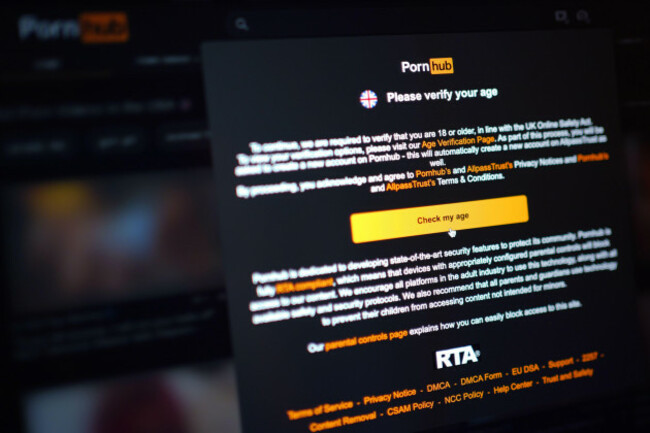
Jane Doe has made two claims: that the companies she sued knowingly benefited from participating in a venture they knew, or should have known, involved sex trafficking; and that they received and distributed child sexual abuse material.
She is seeking compensation and other remedies for how they allegedly handled and profited from the recordings.
“MindGeek proclaims Pornhub to be its flagship website,” the original Alabama complaint states.
But the website is part of a much larger operation.
A US judge described the companies as a network that “own or operate several of the most-visited pornographic websites in the world”, including Pornhub, YouPorn, RedTube, Tube8 and WTube.
Jane Doe’s complaint alleged that Pornhub was alleged to have garnered more web traffic than both Amazon and Netflix in 2019.
These ‘tube’ sites are video-sharing platforms and streaming platforms that are built on the same structural model as YouTube.
They contain millions of clips that visitors can watch for free, without having to create an account.
Before a major purge in December 2020, Pornhub reportedly hosted around 13.5 million videos.
That year, it suspended millions of videos from unverified uploaders following reporting about child sexual abuse material and non-consensual content on the site (though the suspension of those videos did not mean that every one of them was identified as illegal).
In the later Jane Doe case, the plaintiffs alleged that videos could be uploaded anonymously without the uploader having to verify the age or consent of everyone depicted, and that visitors could also download them.

The business surrounding those videos extended from their production to the sale of advertising around them.
Some of the companies who supplied material to the websites as so-called “content partners” – including major pornography producers Brazzers, Digital Playground and Reality Kings – were themselves owned by the group associated with MindGeek.
Other suppliers were outside businesses, including GirlsDoPorn, whose operators were later found to have deceived and coerced women into appearing in videos distributed online without their consent.
That became the subject of a separate, major US criminal case.
In December 2023, Aylo Holdings, formerly MindGeek SARL, entered a deferred prosecution agreement over receiving proceeds from the operation.
According to the US Department of Justice, the company received money between 2017 and 2019 that it knew, or should have known, came from sex trafficking.
Women had sent the companies requests to remove the videos, explaining that they had been deceived.
Aylo sought assurances from the producers of GirlsDoPorn videos, but did not independently verify whether they consented or remove all the videos identified.
“Motivated by profit, Aylo Holdings knowingly enriched itself by turning a blind eye to the concerns of victims who communicated to the company that they were deceived and coerced into participating in illicit sexual activity,” said James Smith, then the FBI’s assistant director-in-charge in New York.
But Jane Doe’s case involved a different structure to these production companies.
Another feature of MindGeek’s activities is that individual uploaders have opportunities to earn money from their videos and subscriptions from the company’s websites through an avenue called Modelhub.
Free videos could generate advertising revenue, while uploaders could also sell content directly.
Industry publication XBIZ reported in 2018 that Modelhub offered creators 65% of custom-video sales after an introductory promotion.
There was even a 40-page “Pornhub Playbook” that offered users advice on how to make money from the site.
The playbook encouraged longer uploads: a separate US regulatory complaint later quoted its advice that videos lasting at least 10 minutes would attract better viewing results, stating that “users are far more likely to click longer videos”.
Pornhub’s then vice-president Corey Price outlined to XBIZ how important metadata like tags and other descriptions were for individual users who uploaded content.
“Accurate, well-formulated metadata means more views and more earnings,” he told the publication.
That metadata was key to the Jane Doe case, in which the plaintiffs alleged that the same tools helped abusive material find an audience.
They claimed that titles, tags and suggested searches organised the vast catalogue of videos on the sites, that thumbnails provided previews of the videos, and that timelines indicated the intensity of activity, allowing viewers to skip to particular moments.
These were allegations the court was required to take as true when deciding whether to dismiss the case; however, their inclusion in the February 2022 judgment did not establish that every claim had been proven.
Nevertheless, the alleged gap between the sophistication and size of the business compared to its safeguards was striking.
While the sites organised content and advised uploaders on attracting viewers, the Alabama complaint alleged that moderators assessed performers’ ages by appearance, typically flagging someone only if they looked younger than 12.
And the sheer volume of material being uploaded on MindGeek’s websites led to concerns about how thoroughly moderators could check what was on those sites.
As the litigation progressed in the Jane Doe case, the court began to examine this.
It drew on employees’ emails and exchanges about the material they encountered, and the systems that were designed to catch anything that shouldn’t be online.
In his December 2024 ruling, US District Judge L Scott Coogler described an employee exchange about a detection tool that had unearthed a video of abuse that had remained online for years.
One employee is also reported in that ruling to have referred to “a full on cp [child pornography] video” remaining online for 11 years (which was a video dating from 2009, was separate to the recordings at the centre of Jane Doe’s claim).
Other messages outlined in court highlighted the pressures faced by moderators.
In one email, a moderator for the company said their team had been required to prioritise speed and numbers.
“Our team, considering its 20 different tasks, was focused on speed, numbers and multitasking which has proven now that it is not effective,” a passage quoted in the judgment said.
The correspondence also described insufficient staffing among moderators and a substantial backlog of videos to work through.
“We have been understaffed, always negotiating how many people to get and are receiving less personnel than what we actually needed to follow the right procedures and avoid mistakes,” a moderator was quoted as saying.
“We adapted with what manpower we were given and applied multitasking.”
The removal of certain videos did not always stop them from circulating either.
In another instance, Judge Coogler recounted an exchange about apparent child sexual abuse material that was uploaded through a different account the day after its removal.
One employee asked whether the video had been digitally fingerprinted by moderators, a process that is used to help identify the same material if it gets uploaded again.
The colleague replied that it had not, explaining that they had reserved that step for material they considered particularly bad.
A separate complaint filed by the US Federal Trade Commission and Utah’s consumer protection division in September 2025 alleged that, in 2019, each moderator reviewed an average of 750 videos and 1,400 photo albums during an eight-hour shift.
Even leaving photographs on the website aside, that allowed just 39 seconds per video.
The complaint said the head of moderation had boasted in an employee evaluation that he typically reviewed about 1,200 videos per shift, while praising colleagues who reviewed 850 and 1,290 videos.
Those figures describe reported workloads, rather than a universal formal quota, but the regulators alleged that the company’s policies prioritised speed over meaningful review, leaving moderators watching only portions of videos and sometimes unable to understand the language that was spoken in them.
That separate regulatory action also resulted in a settlement and a court order imposing safeguards.
For Jane Doe, the possibility that recordings could return was part of the harm she was asking the courts to address.
A judgment in her case also recorded the introduction of additional detection tools over subsequent years, though this was not a final verdict on liability: Judge Coogler refused both sides’ applications for summary judgment, leaving issues unresolved.

The ability for the court to peer under the hood of MindGeek’s business involved years of litigation.
By March 2024, the company had produced more than 95,000 documents in the Alabama and California cases, while witnesses had been questioned in the United States and Canada.
In December 2023, Judge Coogler certified a class in the Alabama action, allowing survivors to pursue common claims about the companies’ practices collectively
There were common questions about the companies’ operations and moderation practices. There were also the costs, resources and personal consequences of litigation.
“Discovery would be intrusive and bring to light highly sensitive material and likely cause CSAM [child sexual abuse material] victims to relive past traumas,” Judge Coogler wrote.
He contrasted the defendants’ substantial resources with the potentially limited means of individual survivors, explaining that collective proceedings could enable more vulnerable people to come forward.
The ruling allowed their claims to be heard together, though it did not establish that the companies were liable.
Pursuing the companies also meant Jane Doe had to follow a business that was spread across several jurisdictions – and multiple continents.
The amended Alabama complaint described MindGeek SARL as incorporated in Luxembourg, with its principal place of business in Montreal.
MG Freesites, named as trading as Pornhub, was incorporated in Cyprus, while MindGeek USA was incorporated in the state of Delaware.
But two defendants in the US action were Irish-incorporated: MG Billing and MindGeek Content RT, something that led to litigation being taken in the High Court.
The US complaint associated the former company with subscription services, while it alleged that the latter owned, operated or managed websites.
The plaintiffs alleged that these companies formed a commonly controlled enterprise.
Establishing responsibility within that network was part of their case, though the incorporation of the companies in a particular country did not, by itself, establish what each company had done.
For Jane Doe’s lawyers, Ireland was also a place to pursue assets.
In October 2023, High Court Judge Mark Sanfey allowed the complainant to proceed under a pseudonym after hearing concerns about her safety and the consequences of being identified.
Her proposed Irish action sought damages for alleged breaches of duty, data protection rights and privacy, and alleged conspiracy, alongside orders concerning the removal of abuse imagery and identification of uploaders.
Five companies named in the Irish proceedings had registered addresses in Dublin: Aylo Billing, Mirmay, Nutaku Publishing, Appatomic and Liquidum.
The purpose of the proceedings extended beyond those claims.
As The Currency reported last year, Jane Doe’s barrister Jarlath Ryan SC described the Irish case as “in aid of and complementary to” the Alabama litigation and “specifically aimed at preserving assets and resources” of the companies based here.
Now a proposed $120 million settlement, mentioned in the High Court this week, is on the table: it covers the Alabama and California cases and requires approval in California.
Alabama’s proceedings have been administratively closed but can reopen if the agreement fails.
Bloomberg Law has reported that the proposed class covers people depicted while under 18 in material viewable on the defendants’ sites between February 2011 and December 2024.
The agreement would require government-ID checks for those depicted, technological and human moderation, and staff training.
Aylo has said that the settlement involves no admission of wrongdoing. In a statement reported by XBIZ, it said only verified creators could publish and that uploads underwent technological checks and human review.
In Dublin this week, Judge Brian Cregan adjourned the proceedings until March pending developments in the US settlement.

To embed this post, copy the code below on your site














have your say