Sign in. It’s quick, free and it’s up to you.
An account is an optional way to support the work we do. Find out more.
Sign in. It’s quick, free and it’s up to you.
An account is an optional way to support the work we do. Find out more.
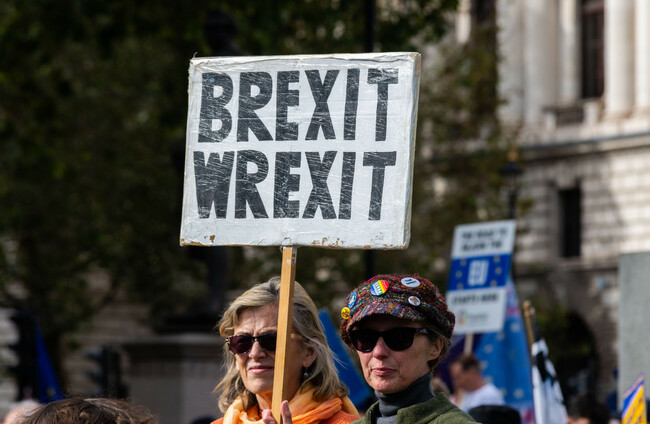
BRITISH PRIME MINISTER Andy Burnham has said in recent days that he may propose that the UK rejoin the European Union.
Brexit, he said, has done “more harm than good”.
This has understandably ruffled a few feathers, and has generated quite a few headlines across the globe.
It’s now 10 years since the UK voted to leave the EU, and many polls show that people are regretting the decision.
A recent YouGov poll found that 52% of Britons would vote to rejoin the EU, while 27% would vote to remain out of the bloc. Further, 22% of those who voted to leave in 2016 would now vote to rejoin.
However, rejoining the EU after an acrimonious divorce could prove to be a long and complicated process.
The Journal spoke to several experts on Europe to sense-check Burnham’s comments and to assess the possibility, the likelihood and the ins and outs of rejoining the EU.
Michael Leigh, former director-general for enlargement at the European Commission and lecturer at Johns Hopkins University, told The Journal that such comments should be regarded as “largely symbolic”.
“In practice, they will amount to closer cooperation, made necessary by the current international climate. This is to be welcomed. But both sides should be careful about raising expectations that will not be fulfilled in the foreseeable future,” he said.
Anand Menon, professor of European politics and foreign affairs at King’s College London, told The Journal that Burnham’s comments need to be taken with a pinch of salt.
“He didn’t commit to anything,” Menon said, noting that “a lot of that speech was quite carefully phrased”.
“I think he probably underestimated the sort of shitstorm that he would unleash,” he said.
He added that he did not know whether Burnham’s comments formed part of a “deep political strategy”, or were said to please his audience.
However, the Brexit – or Bre-joining – debate is not “a genie that you can put back in the bottle”, according to Menon. “I think whether he really wanted to or not, he has started a major debate.”
Menon added that this could serve to help Burnham politically, and could help “stymie” supporters of the Greens or the Lib Dems, who are typically Eurocentric. It would also help to “take some of the ammunition from the nationalists”, he said.
Leigh told The Journal that it is “highly unlikely” that the UK would rejoin the EU in the near future.
“The UK and the 27 EU countries would all have to agree on the start of membership negotiations, their content and the resulting treaty. This would involve sensitive, complex issues affecting the national interests of all involved.
“Britain could not expect to recover the opt-outs from the euro or from the free movement of people across internal EU borders that it had as a member.
“Britain has a left of centre government whereas much of Europe is moving to the right, often tinged with anti-EU and pro-Russian sentiment.
“This is hardly a propitious situation for a new membership bid.”
Leigh said that one of the main things to be resolved is the question of trust, which “needs rebuilding after the setbacks caused by Brexit”.
Menon also said that, despite the polls which indicate an appetite to join, that support could prove to be “quite soft”.
Menon said that rejoining the EU would be “politically overwhelming” and “costly in all sorts of terms”, including “political capital”.
“We’re talking about a situation where we’re asking the prime minister to burn political capital on something he probably won’t see the benefit of for 5, 10 years,” he said.
While “Britain has fewer of the governance challenges faced by many of the existing candidates for EU membership,” Leigh said, “it carries the burden of the past, which is to say an uneven, oscillating degree of support for European integration.
“It would take considerable time and effort to persuade all existing EU countries that Britain has become irrevocably committed to what it renounced less than a decade ago. The process would be long and challenging, both politically and economically.”
There is a queue to join the EU, and all member states need to agree to the idea of the UK (re)joining.
Menon said that the accession process is “nasty”, and would not be a “negotiation” with the EU. Rather, it would just be “one set of demands after another from the EU”.
“The EU will say: ‘No, you fulfil this criteria, or you can’t join. It’s up to you.’
“It’s a very humiliating process. It tends to be states that are desperate who join.”
Menon also said that while there is no need to hold another referendum, there would be “huge pressure to do so”.
The YouGov poll found that 64% of Britons think there should be a referendum if the government negotiated a deal to rejoin the EU, while 23% say the government should be able to make the decision without a referendum.
For Menon, none of the “middle ground” is sustainable for Burnham.
“We can make a principled decision to stay where we are…[which is] a loose economic relationship. We can tinker a bit with the trading cooperation agreement, but essentially stay where we are.
“But everything more than that, short of membership, is really unappealing.”
He said a customs union doesn’t really help much with the economics of Brexit, as it leaves the UK’s trade defences in the hands of the European Union at a time when “trade wars are looming”.
As for a single market, Menon said that this means “being a rule taker across the board”.
He said that neither of these is particularly appealing, and so the decision quickly becomes a “binary” one: staying in the same place, or seeking full membership.
For Dr Barry Colfer, head of research at the Institute of International and European Affairs (IIEA), while full EU membership for the UK is “out of reach for now”, there is a “political window” to strengthen ties between the two.
Colfer told The Journal that the relationship has become more pragmatic and technical, which is to be welcomed.
“There is definitely scope now for the UK to become the first among equals in terms of third countries that have a very close relationship with the EU among the likes of Norway, Switzerland, and potentially Canada in the future.”
He said that bringing the EU and UK closer together again is something that “everybody would benefit from”.
He also emphasised areas for further integration, which include aspects of trade, security cooperation, and international development.
When asked how the UK’s devolved nations, including Northern Ireland, may respond to the UK rejoining the EU, Menon said “there’s nothing they could do. They’d just have to put up with it.
“Brexit is so inextricably linked with sectarian tensions in Northern Ireland that it won’t help,” he said, adding that “arguably it might be a way of tamping down support for Plaid [Cymru] and the Scottish nationalists”.
For Colfer, “anything that amounts to the betterment of relations between the UK and the EU including Ireland, and especially anything that brings these places closer together in terms of regulation, person-to-person contact, and aspects of our collective security, would be very well received in Ireland.”
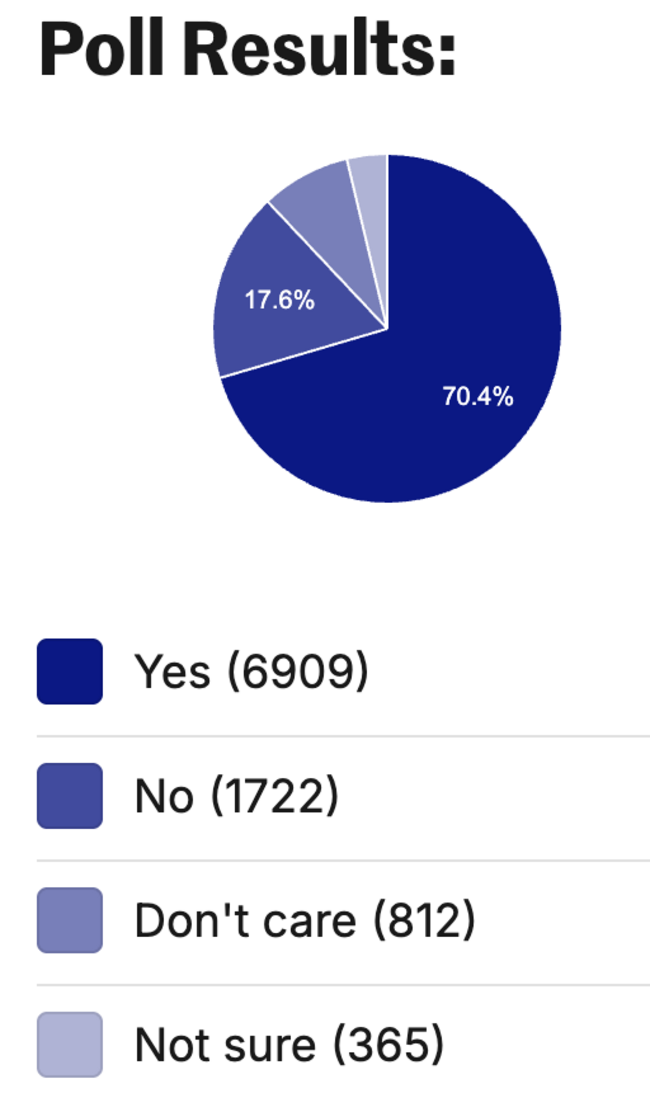
When asked in a poll about the matter, 70% of The Journal readers who responded think that the UK should rejoin.
To embed this post, copy the code below on your site

















have your say