Sign in. It’s quick, free and it’s up to you.
An account is an optional way to support the work we do. Find out more.
Sign in. It’s quick, free and it’s up to you.
An account is an optional way to support the work we do. Find out more.
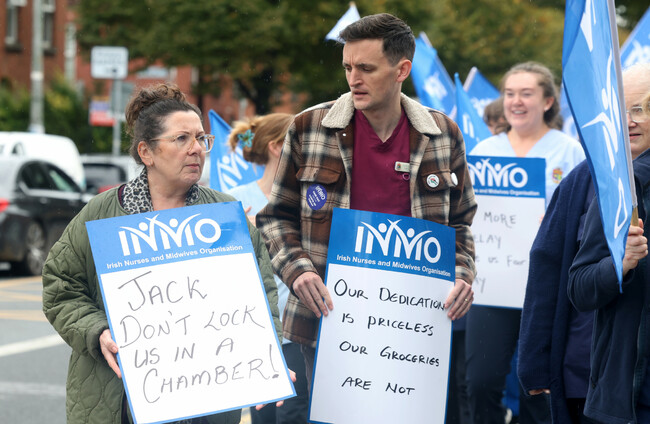
PUBLIC SERVANTS IN sectors across the country will take part in a large-scale strike on Wednesday 14 October that will cause widespread closures and disruption.
The strike is part of wider industrial action which began on 30 September amid a dispute over pay after the collective pay agreement covering public sector workers expired. A second strike day is scheduled for Wednesday 21 October if required.
Many workers are engaging in an all-out strike where workplaces will be closed; however, some have been given a derogation – a strike exemption – to allow them to carry out essential work such as emergency care.
Some union figures have warned that 400,000 workers could be striking; 385,000 workers are covered by the now-expired pay agreement, but not all are legally entitled to strike.
Ireland’s largest public sector trade union Fórsa has said it will be the biggest public sector strike since the height of the financial crisis in 2009.
From firefighters and prison officers to dentists and paramedics, here’s who’s going on strike.
In the health sector, 11,000 workers across 30 hospitals will engage in the strike, which the HSE has warned will cause “significant and widespread disruption” to many services.
The planned action will affect hospitals across the country, including Beaumont Hospital, Cork University Hospital, University Hospital Galway, University Hospital Limerick, St James’s Hospital and University Hospital Waterford.
Consultants and public and community health doctors will be striking, as announced by the Irish Medical Organisation.
Nurses and midwives will also take part in the strike, the Irish Nurses and Midwives Organisation has said.
Trade union Siptu has confirmed that its members in the sector, including all support staff and the Ambulance Service, will take part. Fórsa members in the sector are also to strike.
Dentists working in the HSE will also join the stoppage. This is the first time in history the Irish Dental Association has served notice of industrial action.
An HSE spokesperson told The Journal that the HSE is planning for the cancellation of all non-urgent healthcare services across hospitals and community settings.
This includes routine hospital procedures, outpatient appointments, community-based services, such as day services, clinics in primary care services and other scheduled care services. HSE administrative services will also be impacted by the strike.
They said healthcare teams have begun to contact affected patients directly.
Emergency departments and other critical, time-sensitive healthcare services, such as urgent cancer treatment and dialysis, will continue. Ambulance services will continue with a curtailed service.
GPs, GP out-of-hours and pharmacists remain available in the community.
Primary school teachers, secondary school teachers and lecturers will take part in the strike.
The Irish National Teachers’ Organisation (INTO), which represents about 50,000 teachers at primary level in the Republic of Ireland, said the vast majority of their members are to engage in a full strike with no members working on Wednesday.
An INTO spokesperson said some schools may remain open to staff, but that depends on the decision of the board of management of each individual school.
Ireland’s main second-level teachers union, the Association of Secondary Teachers in Ireland, has said that up to 20,000 second-level teachers will participate in the strike.
The strike will be a full-day work stoppage and schools will be closed. Pickets will be placed outside schools.
The Teachers’ Union of Ireland (TUI), which represents over 22,000 teachers and lecturers in Ireland, said members will engage in the all-out strike action with pickets operating outside workplaces.
The Irish Federation of University Teachers is also to take part in the strike.
Siptu and Fórsa members working in education will also take part in the strike.
Administrative staff across government departments, state agencies and local council workers will take part in the strike.
Fórsa said over 93,000 of its members, including those in local and municipal authorities and the civil service, will take part in the strike.
The trade union said local authorities will provide cover in the event of emergencies such as storm damage or flooding.
The Association of Higher Civil and Public Servants (AHCPS) said that 5,000 members will take part in the strike. Members working in human resources, industrial relations and buildings or facilities management have been granted a derogation.
There will also be a picket line at Leinster House, where the Dáil is currently scheduled to sit, and the Oireachtas may not be able to operate as usual.
The Oireachtas Service had requested a number of derogations from Fórsa and the AHCPS so that the Dáil could continue to operate on Wednesday, but today they received a response saying a derogation would not be granted for key staff.
The Department of Social Protection said it has sought a derogation from unions and will finalise which offices will remain open early next week.
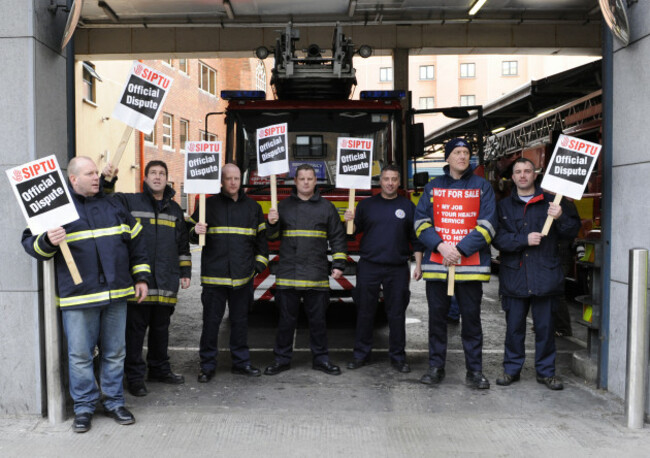
Siptu has said fire brigades will operate with reduced services on Wednesday.
Prison officers will be mounting pickets outside individual prisons, while the Prison Officers Association is to escalate various work-to-rule measures.
The Road Safety Authority (RSA) has confirmed that some driving tests scheduled for Wednesday have been cancelled. It said affected customers will be contacted directly.
The National Driver Licence Service (NDLS), National Car Test (NCT), Driver Theory Test and Commercial Vehicle Roadworthiness Testing (CVRT) services will operate as normal.
The strike is also expected to have widespread effects across the court system.
All heritage sites, parklands and gardens operated by the Office of Public Works (OPW) will remain closed to the public and visitors on Wednesday.
The only exception is the Phoenix Park, where roads will be open; however, visitor facilities in the park will be closed.
Those that have an existing booking to visit an OPW heritage site for 14 October will be contacted to arrange a refund.
The National Library has said there will be some closures and restrictions to services for the duration of the industrial action, including for strike days.
The National Concert Hall rescheduled a performance of The Song of the Singing Horseman originally scheduled for Wednesday in light of the strike.
An Garda Síochána and the Defence Forces cannot legally engage in strike action and therefore will not be involved in next week’s industrial action.
However, rank-and-file gardaí are to launch industrial action on five days in October and protest at the gates of garda headquarters because of what it calls intolerable treatment of its members by garda management.
Commercial semi-state companies such as An Post and the ESB will not be part of next week’s strikes. Section 39 organisations, which are charities and voluntary bodies that receive funding from the state, are also not striking as they are employed under different terms to public service workers.
State bodies that are not considered part of the public service will also not be impacted, including the Dublin Airport Authority.
Public transport services across the Transport For Ireland network, which includes buses, Dart, Luas and rail, are also expected to operate as normal on Wednesday.
The Public Service Agreement 2024–2026 – a pay agreement covering public sector workers – expired in June and a new agreement has not yet been reached.
Fórsa has said talks on a replacement agreement have yet to deliver a credible approach to pay.
The Journal spoke to civil service union sources who said that it is unlikely that the dispute will be resolved. One source said that workers are committed to strike action.
One representative explained that any pay settlement from the government side will have to be more than inflation, which is currently running at 4.1%.
Funding of €1.2 billion was allocated in Budget 2027 for a new agreement, and the government has said it remains committed to engaging in substantive talks with unions.
Speaking to The Journal on Friday, Minister for Foreign Affairs Helen McEntee said that the money allocated in the budget is not the sum total, adding that there are reserves available.
“We just need to get around the table because when one benefits, then everybody benefits from the overall decisions that are being made,” she said.
With additional reporting from Niall O’Connor

To embed this post, copy the code below on your site















have your say