TheJournal.ie uses cookies. By continuing to browse this site you are agreeing to our use of cookies. Click here to find out more »
Dublin: 11 °C Saturday 18 May, 2013

Companies cease development of Alzheimer’s drug after failure in late-stage trials

Pfizer Inc and Johnson & Johnson said the drug did not work better than placebo in two late-stage clinical trials.

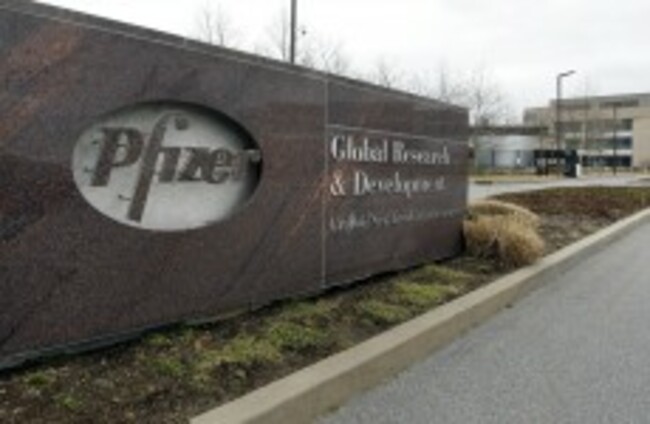
Pfizer is one of the companies which has ceased trials on the drug
Image: Elise Amendola/AP/Press Association Images

LEADING PHARMACEUTICAL COMPANIES Pfizer Inc and Johnson & Johnson have said they are ending development of an intravenous formulation of a drug to treat Alzheimer’s disease after the treatment failed in two late-stage clinical trials.

The companies said bapineuzumab intravenous did not work better than placebo in two late-stage trials in patients who had mild to moderate Alzheimer’s disease.

The drug is designed to prevent the buildup of plaque in the brain. J&J said it is not discontinuing development of the compound and noted it has ongoing studies including a mid-stage neuroimaging study with bapineuzumab delivered subcutaneously.

Bapineuzumab showed promise

Johnson & Johnson made a big bet on bapineuzumab in 2009, agreeing to invest up to $1.5 billion initially. The two companies said July 23 that the drug had failed in a different trial.

Johnson & Johnson, based in New Brunswick, New Jersey, said it will take a charge of $300 million to $400 million in the third quarter.

Dublin-based Elan Corp. PLC, which licensed the drug to Johnson & Johnson in 2009, said it will take a $117.3 million charge of its own.

US-traded shares of Elan lost 10 per cent, or $1.34, to $11.91 in after-hours trading. Shares of New York-based Pfizer lost 2.7 per cent, or 66 cents, to $23.60. Johnson & Johnson stock edged down by 84 cents, or 1.2 per cent, to $68.

Current treatments for Alzheimer’s can only temporarily ease symptoms of the disease, which include increasing memory loss, confusion, wandering and aggression.

35 million people worldwide have dementia

In the latest trial, bapineuzumab was tested on about 1,300 patients who lacked a gene that is associated with a greater risk of Alzheimer’s. Last month the companies said the drug also didn’t work on patients who do have that gene. Pfizer and Johnson & Johnson were running two other late-stage trials as part of a very large testing programme for the drug.

Worldwide, about 35 million people already have dementia, of which Alzheimer’s is the most common type. Finding a drug that could at least slow the disease has become a sort of Holy Grail in the pharmaceutical industry.

Read: Rare gene mutation might defend against Alzheimer’s disease>

Read next:

Comments (14 Comments)

  • Alzheimer’s and Dementia are such terrible diseases.. Not knowing where you are, hallucinating, what I can only describe as time travelling (they think they’re back in their 20s or 30s in their head), they start wandering, inadvertantly stealing things, and then they get to a point where they can’t communicate anymore and just talk total gibberish or become silent..
    It’s all very confusing and distressing for the patient, and they can become quite agressive in the early stages as they desperately try to hold onto their independence (which when they’re convinced they are much younger and more capable than they are can be a nightmare). Their loved ones can do nothing but watch them disappear slowly into themselves.. It’s heartbreaking.

    Here’s hoping we can find something to halt these awful afflictions. I don’t think jokes about people “forgetting the formula” are appropriate, there’s a lot more to these diseases than that.

    Reply
    • @Shanti, thank you for pointing out some of the most horrendous signs of alzsheimers & dementia, it’s a very deceiving illness and I witnessed it first hand with my Mother, one day they are here the next day there gone and it goes on like this for a long time in some cases, I was in denial also because I didn’t want to believe she had this illness. I found the Doctors took so long to diagnose her as suffering from Dementia, when they are having a good day you think they will be fine.
      I hope they find some drug that will slow it down for every patient. They are a long way from finding the wonder drug..

      Reply
    • You have no need to thank me.
      I’m sorry to hear of your mothers diagnosis, I hope that her progression is really slow so she can stay “her” for longer, and that you have a good support network in place for yourself in this difficult time. Wishing you strength :)

      Reply
  • With an ageing population drugs that effectively treat this terrible disease are a real priority. This is a set-back but let’s hope it’s not the end of this line of enquiry.

    Reply
  • Elan (Irish company) lost 10%
    The others lost 1 or 2 %each.
    But the headline doesn’t mention this.
    Is the Journal.ie missing the real story here?
    There was a time Elan flew the flag for Irish biotech. Maybe a more interesting article would be ‘where are all the Elan jobs gone, where is all the share value gone…and why is none of it in Ireland’?(except the losses).
    Elan have nice new offices in San Francisco, new labs, new cafe, they’re even hiring….what’s left of Elan in Athlone, in Ireland ?
    Did they say ‘thanks guys’ before they bolted?

    Reply
    • Yes I totally agree.Not alone has the Journal missed the point but so have all the people that have commented so far.

      Reply
    • At the risk of pointing out the obvious – it’s a question of two related things: firstly scale, and secondly where the stock value lies. The simple fact is that the two US firms massively dwarf Élan, now Alkermes, and therefore the impact of the potential lost or at least delayed earnings would by simple maths be to the greater detriment of Élan shareholdings. Secondly, the makeup of share value for the larger firms includes significant cash reserves, hard infrastructural assets, long term fully developed & commercialised (read bankable) therapies & contract manufacturing positions, at least relative to Elan. A lot of the smaller innovative firms with smarter, more attractive development portfolios, like Élan, avoid the pitfalls of infrastructure development & operational costs by licensing out molecules as is the case here to larger organisations. Some form of royalty or fee arrangement applies, and when this becomes the dominant source of revenue you live & die by the reputation of your pipeline. Just like Tysabril then, share value yoyos with good/bad news. That said, 2 or so full % point movements for the likes of Pfizer represents a significant amount of investment dollars.

      Reply
  • What was being studied, trialled and tested has, unfortunately led to nothing. Despite shares, monies or values of a pharmaceutical company they all led to a dead end. I strongly believe that’s just for now. The studies done will be used by others and in the future hopefully help further improve chances of a remedy for Alzheimer’s disease.

    There is no doubt that if the ‘pharmaceuticals’ had found a remedy they’d have gone into mass production immediately. (In a split second nearly). Don’t think they’ve given up. They want to make money out of this. That is a certainty.

    Every so often in my own line of work I meet families and sufferers of AD and I see the upset, anger and confusion on both sides. So to those who have to experience ‘the long goodbye’ my heart goes out to you. You are very strong people and you have to be admired for it.

    Hopefully there will be something more positive in the future. There are educated and talented people doing their best everyday to find cures and remedies for all sorts diseases and illnesses. We can only hope they find them sooner rather than later.

    Reply
    • The molecule & therapy are far from dead,just this application in this context. The ‘technology platform’ as it’s called in the business is solid and will yield results for patients in time – the question for both investors and patients alike is when, and in what presentation.

      Reply
  • I’d say the just “forgot”the formula

    Reply

Add New Comment