TheJournal.ie uses cookies. By continuing to browse this site you are agreeing to our use of cookies. Click here to find out more »
Dublin: 13 °C Wednesday 22 May, 2013

Bodies of suspected WW2 victims exhumed from mass grave in Croatia

The victims were thought to have been cadets in a Croatian military academy.

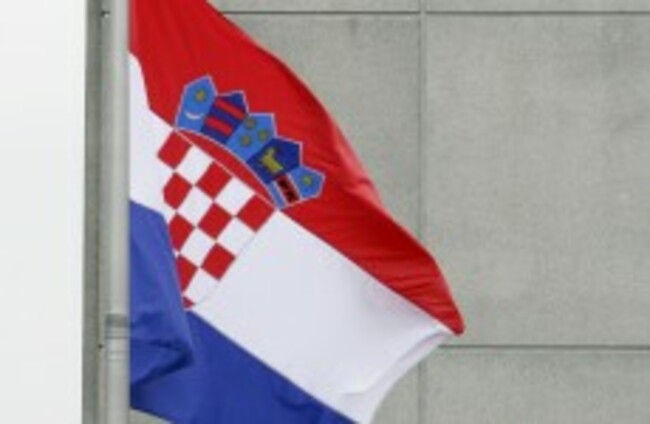
Image: Virginia Mayo/AP

AUTHORITIES HAVE EXHUMED the remains of 30 people executed at the end of World War II who were found in a mass grave near the capital of Croatia.

The victims were believed to be cadets of a military academy run by pro-Nazi Croatia’s regime during the war.

“The grave was quite shallow, some bones were found only 35 centimetres below the ground,” the national bureau charged with searching for communist-era victims said in a statement.

The remains were found in a grave in the forest region of Gracani, north of the capital Zagreb, while the victims were probably executed in May 1945, it added.

“Irrefutable evidence of execution” were also found in the grave, notably a large amount of bullets and cartridges, the statement said. Several skulls had traces of bullet holes, while some of the victims had their hands tied up with metal wire, it added.

In July, 36 victims of the communist regime were found in another grave found in the same area.

During the war, hundreds of thousands of Serbs, Romas and Jews were killed by Croatia’s pro-Nazi regime, which was eventually defeated by Yugoslav partisans led by communist leader Josip Broz Tito.

According to the bureau, an institution established last year by Croatia’s parliament, some 600 graves with around 90,000 victims of the communist regime are scattered around the country – a figure that has been dismissed as “manipulation” by a group representing former anti-fascist fighters.

Read next:

Comments (29 Comments)

  • I think none of us will really be able to fully understand what it must of been like to live in occupied Europe during WW2. Truly terrifying.

    Reply
  • ptriley 25/10/12 #

    nothing surprises me of what human beings are capable of doing to fellow human beings

    Reply
  • Mjhint 25/10/12 #

    I think none of us will truely understand what it was like in Yugoslavia in the 90′s.

    Reply
  • I’m living in the us and most people I know here thing world war two only involved the American British and German armies.

    Reply
  • It was Slovakia I think Reg. Josef Tiso was his name, despicable man.

    I hardly think there was a “communist regime” in place by May 1945 by the way. I’d put this one down to revenge for the genocide of Serbs, Jews and Roma on Croatian soil during world war II. Hardly one to pin the blame on Tito. This doesn’t excuse any subsequent political executions by the Yugoslav communists once they were in power of course.

    Reply
  • Reg 25/10/12 #

    I will also add that the leader of another country, not sure which one, Hungury or Romania possibly was a catholic priest who worked with the SS to deport tens of thousands of Jews (and others) to the death camps.

    Reply
  • Mjhint 25/10/12 #

    Plus 1 Reg. But remember the christian orthadox & muslims played their part as well. All conflict in the balkins has been religious masked by politics.

    Reply
  • The different nations of the former Yugoslavia should never have been formed into a country. But the British and the French couldn’t help themselves from meddling after WW1. Croatia and Slovenia belonged to the old Austro-Hungarian empire, Bosnia was part of the Ottoman empire and the Serbs owed alliance to the Russians. And because the first two empires we the enemies of the allies the victors wanting to break up the old empires forced these traditional enemies together. And we all know what happened next.

    Reply
    • In all fairness it was a very successful and peaceful country for the next 40 years… post communism and especially post war they’re all worse off now… some more than others obviously

      Reply
    • The peace was enforced by the iron grip of Marshal Tito. Lets not be fooled because he wouldn’t join with Stalin and join the Warsaw pact. His grip on power was as strong as any of the contemporary communist leaders of his time. And the peace only started to crack and break down after his death.

      Reply
    • Peace was enforced by the iron grip of Marshal Tito. Don’t be fooled just because he didn’t join the Russians in the Warsaw pact .His grip on power was as strong as any of the contemporary communist leaders of his time. And only after his death when the party started to loose its grip on power did the cracks in the peace start.

      Reply
    • Mick, not exactly. I have lived in the former Yugoslavia for quite a while now, and Serbia (parts of, but notably Belgrade) was also Austro-Hungarian,and Ottoman, at different times, Northern Serbia such a Vojvodina is clearly Austro-Hungarian in its make up. The Serb’s owed no allegiance to the Russians, more so to the Partizans, which is why Tito didn’t join the Warsaw pact, and instead, spurned the USSR by forming the non-aligned movement.

      Reply
    • Completely agree with you Elvedin. Yugoslav’s (most of them) had a quality of life far far better than Irish people had over the course of Tito’s rule.

      Reply
    • I would have thought what you (Mick) say is indisputable. Once the people had a choice, the country fell apart.

      Most people here disagree. That says more about them than Yugoslavia though…

      Reply
    • Padraic, this is like saying that it’s better to have one leg bitten off by a shark than two. While Yugoslavia was doing better than some of their neighbours and perhaps Ireland (although I would question this assertion) it was still an economic basket case. The countries that succeeded Yugoslavia are not doing much better these days. They never had a proper economy and have had no chance of developing one. At the end of WW1 they were plunged into an orient-like kingdom (Serbs leading the show knew no better having spent 800 years under Turks). And then after WW2 they went for a faulty economic model. Now they are joining another project on the verge of failure – EU.

      Reply
    • Padraic in your time living in the region… how many people had positive things to say about “the good old days” ?

      There was a quality of life and employment levels which none of the six countries will reach for a long time..

      My grandmother lived through poverty after ww1 period… through world war 2 and through the latter years of her life in communist Yugoslavia… she moved to Ireland in 96 after the yugo war ended… until she died she had a portrait of Tito on her wall… which is still in the house… simply because the happiest and most peaceful days of her life were in that time… both periods before and after were characterised by war, exile, etc…

      Whether you agree with communism (I don’t) is irrelevant here… but coming from people who lived in that time my grannies and my parents generation… those were the days…. no one cared who was Croatian Serb Bosnian or who was Orthodox Christian, Catholic or Muslim… it was irrelevant my dads best friends growing were a mixture of these people… this alone leaves a huge legacy for Tito from people from that region…

      Irrelevant of how it appeared to the rest of the world… all former Yugoslavians get nostalgic and talk and sing of the good old days! And why wouldn’t they?

      Also Dom in terms of economy and employment… communist Yugoslavia was nearly a self sufficient country… everything from matches to cars was manufactured at home and exported not imported like these days which happens to result in large percentage of employment… which is the other around now

      Reply
    • Elvedin, I do not care whether a country is self sufficient or nt. That only matters in times of war and in fact looking at the history the ties when more countries strived towards being self sufficient were usually leading to wars.

      As to your rosy picture of former Yugoslavia, my memories are quite different. I remember crappy products like washing machines from Montenegro and cars from Serbia which were constantly breaking down. Home electronics whrom Croatia were not any better. The only reason we had this junk in our homes was that it was impossible to import anything decnt.The fact remains that the entire eastern block failed to produce a single toaster that someone would buy out of their free will. I also remember hyper inflation towards the end of this failed experiment.

      Finally, my grandma also had a picture of Tito until the day she died. But she was a semi-literate country girl probably just like yours. Comrade Tito had special appeal to this particular audience and also to Bosnians who will be eternally grateful to Tito for creating them as a nation state. In fact, Bosnians were so crazy for Tito and all things Yugoslavian that they were still singing praise to the Yugoslav Army in Sarajevo while that Tito’s beast was already killing them on the outskirts of Bosnia.

      Reply
    • @Dom

      I am speaking of quality of life and yes is was better. It’s pretty much what everyone here says. Regardless of the economic model (which was unsustainable) I am speaking of quality of life.

      As for poorer, yes, Slovenia is the exception, but you comments about Croatia are wrong. Outside of Zagreb, and maybe the more affluent tourist driven coastal areas, most of the country is much poorer, Croatia is broke and they are selling their motorway network to the Chinese as we speak. I drive about the countryside quite a bit here and also speak Serbian/Bosnian well so, I am pretty clued in as to what is going on here. I also work in the private sector, so I am genuinely participating in the real life economy here, not some NGO international ogranisation ‘project’.

      As for Yugoslavia, on Tito’s birthday, Sarajevo hosts a huge party with fireworks. Yugo nostalgia is rife.

      Reply
    • @ Padraic,

      I am not sure where exactly is that you live / work, sounds like it’s Bosnia. No surprise there about their nostalgia for the ex-Yu because today they’re worse off.

      Croatia did not have a motorway system (except the Zagreb-Belgrade route which was crappy and semi-finished) during ex-Yu so it’s a great achievement that they built one in the last 10 or so years. All the economic data today is better than it was during ex-Yugoslavia so it is not true that the quality of life was better. You will find few Croats crying for the old days. But you will find plenty of Bosnians and Serbs who miss the old federal transfers.

      Reply
  • I also lived in YU – SRB and HR during the latest wars and after. Of course there are always one or two here or there who don’t like this or that one for one reason or another – in Ireland too – but generally speaking people there are quite ok: hospitable friendly and by and large respectable. Now much poorer than before the 1990’s. To understand the politics – which I have studied carefully – requires time, effort and reveals some ugly realities. But these realities are not peculiar to the former YU by any means, everywhere neighbour fights neighbour such things happen. FYI look at en.wikipedia.org/wiki/Usta?e and BTW oddly enough since the discussion shifted to Slovakia, ahead of invasion by the red army in 1944 the insurrection against the facist government was orchestrated and lead by Yugoslav partizans from Croatia

    Reply
    • Mark, to claim that the citizens of ex-Yu countries are much poorer than they were before Yugoslavia broke apart is a blanket statement correct in some cases and incorrect in others. For sure Bosnians, Macedonians and some parts of Serbia are poorer but Slovenia and Croatia are doing better than before, Slovenia quite a bit better. Southern countries no longer benefit from federal transfers and their standard of living has been reduced. Bosnia was ravaged by war (Croatia too but to a lesser extent) and still suffers from divisions which hamper economic efforts. Bosnia today has GDP per capital levels of a Third World country. All ex-Yu countries still suffer from rather excessive bureaucracies, red tape and huge state involvement in economic activities. But let us not be fooled with pre-breakup GDP per capita figures. Those who trust statistics of former communist countries, do so at their own peril. This is largely so due to the way the output was calculated in planned and semi-planned economies.

      Reply
  • padraig 26/10/12 #

    Tito was just good getting aid from both sides of the Iron Curtain, and importantly access to banking and credit, the lack of which severely hampered the Soviet Bloc.

    Reply

Add New Comment