Sign in. It’s quick, free and it’s up to you.
An account is an optional way to support the work we do. Find out more.
Sign in. It’s quick, free and it’s up to you.
An account is an optional way to support the work we do. Find out more.
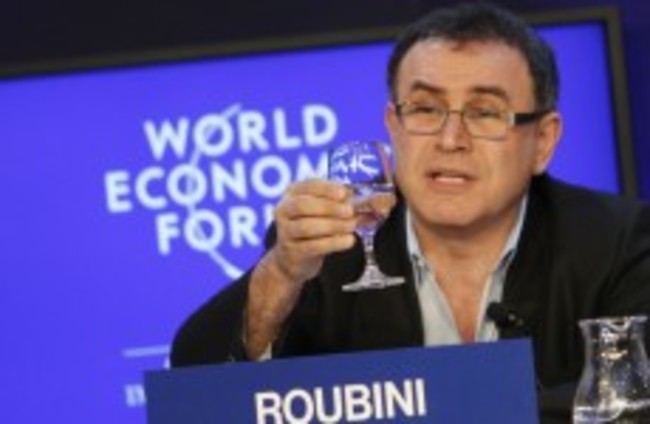
ONE OF THE WORLD’S leading economists has warned that the ECB’s plans to raise interest rates over the course of 2011 could force weaker members like Ireland into ‘double dip’ recessions.
Speaking on BBC Radio 4′s Today programme this morning, Professor Nouriel Roubini said the ECB was “tightening too much, too fast, too soon” in its attempts to bring its interest rate from 1.25 per cent to 2 per cent by the end of the year.
“The trouble is that in the periphery of the Eurozone, there is still a recession,” Roubini – also known as ‘Doctor Doom’ for his predictions of the American housing crisis – said. “there is still economic retraction.
“They are also undergoing a financial crisis; [and as a result] some of these countries have lost their market access” – resulting in three Eurozone countries having to ask for overseas assistance to fund their states.
“Unfortunately now the ECB has started to increase interest rates, and these increasing interest rates are leading to a strengthening of the euro,” he said.
But while a strong currency could be thought of a sign of confidence in the Eurozone, it also makes it more difficult for weaker countries to export – because the price of their goods is comparatively overinflated in other countries.
“These are countries that are not competitive,” Roubini said. “They have large trade deficits.
The Euro now becoming gstronger and stronger is hurting further this competitiveness, and is preventing the resumption of economic growth.
If such weak economies were unable to naturally expand and trade their way out of recession, the unsustainable levels of both public and private debt could never be tackled.
Put simply, Roubini said, “there is a risk of a double dip.
“This rise in interest rates by the ECB is going to choke any possibility of a recovery of economic growth because borrowing costs for the private sector are going to be rising.”
The ECB yesterday decided not to increase rates, with a post-meeting conference from president Jean-Claude Trichet apparently indicating that an increase in interest rates should not be expected until July.
Do you think the ECB is acting in the best interests of smaller countries like Ireland?

To embed this post, copy the code below on your site













have your say