Sign in. It’s quick, free and it’s up to you.
An account is an optional way to support the work we do. Find out more.
Sign in. It’s quick, free and it’s up to you.
An account is an optional way to support the work we do. Find out more.

THE ISSUE OF who should cover the cost of employee sick pay is a thorny one.
Many people were surprised earlier this year when Minister for Social Protection Joan Burton first mentioned that the State pays for employee sick leave.
The Minister used two main facts when she began discussing the issue of sick pay: firstly, that the number of people claiming illness and disability payments has risen by 40 per cent in the past ten years – and secondly, the amount the State has to spend on sickness benefit has almost tripled to €876 million over the same period.
Since then, the Minister has made it clear that it’s one of the things that she wants to target in next week’s Budget, with reports suggesting that the government plans to make companies liable for the first two weeks of an employee’s sick leave, with the State picking up the tab for anything longer than that.
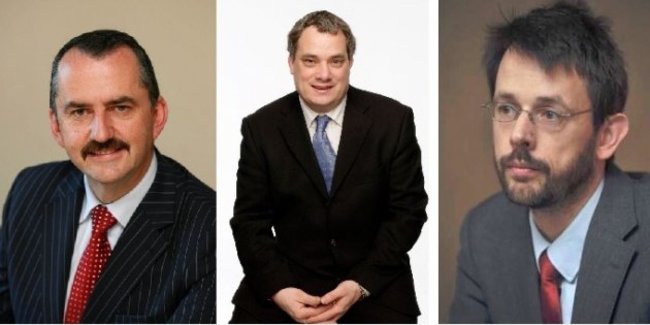
Needless to say, not everyone is happy with the suggestion – not least some other members of the government. But what are the alternatives? We’ve asked three people – Sinn Féin TD Aengus Ó Snódaigh, head of think-tank TASC Nat O’Connor, and Brendan McGinty, the head of IBEC. Here’s what they suggested.
Brendan McGinty, Aengus Ó Snodaigh and Nat O’Connor
“This is a cutback dressed up to look like a positive development” – Aengus Ó Snodaigh, Sinn Féin.
“Social Protection Minister Joan Burton’s statutory sick pay proposal is an €89 million cutback dressed up to look like a positive development for workers.
“The minister proposes to transfer an €89 million burden from her department onto employers without taking account of their ability to pay and ignoring the fact that employers and employees both pay into the social insurance fund with a reasonable expectation that it will pay out when needed.
We all know that many businesses are struggling to stay afloat. The live register figures tell us that many have failed. If the minister pushes ahead with her sick pay proposals many more will be pushed over the edge costing even more jobs.
“At a time when small and medium sized businesses are struggling for their very survival it is incomprehensible that the government would heap yet another financial burden on their shoulders without even the slightest concern for their ability to pay or for the jobs they are putting at risk.
“Sinn Féin has an alternative proposal that takes account of the employers’ ability to pay and of the economic consequences of getting this proposal wrong.
“We propose to raise the employers’ PRSI contribution made on pay exceeding €100,000 to 15.75%, which would raise €91.5 million.
It would target businesses which can afford to pay some workers €100,000 or sums in excess of that. At 10.5 per cent, the standard employer PRSI rate is very low by international standards.
“In Austria the rate is 21.6 per cent, in Belgium 34.5 per cent, Finland 23 per cent, Sweden 31.4 per cent, France 40 per cent on the first €100,000 and Italy 32 per cent on the first €90,000.
Many businesses are struggling but some are not. As with all taxes, it is those who can afford to pay more that should be asked to do so.
“I think any business that continues to pay wages in excess of €100,000 to individuals can hardly be described as struggling and can demonstrably afford to contribute a little more.”
“The norm in the rest of the EU is for employers to contribute – why should Ireland be different?” – Nat O’Connor, TASC
“The first thing to note is that the government’s proposal for employers to cover some sick pay costs is not an unreasonable demand at this time. The social insurance fund ran dry in 2010 and, as a result, we had to put around one and a half billion euro from tax revenue into the fund in 2011 and we will have to top it up again this year, which is a major problem.
Part of the reason why the fund is running low – and why welfare entitlements here in Ireland are generally low – is because we pay a low level of social insurance. Irish levels of social insurance are less than half the EU average – just 5.8 per cent of GDP compared to 12.7 per cent in 2010, according to Eurostat.
“In total, Ireland has the lowest social insurance rates in Europe. When you look at the specific contribution made by employees and employers, employees contributions were 83 per cent of the European average level of social insurance in 2010 – but employers’ contributions were incredibly low: just 3.2 per cent of GDP compared to an EU average of 7.3 per cent. That is, employers’ contributions in Ireland are around 44 per cent of the EU average. The norm in the rest of the EU is for employers to contribute a lot more towards social insurance than in Ireland.
Lower social insurance rates means that labour costs are lower as a result, but it also means that there’s less money in the social insurance fund – hence it’s not unreasonable for employers to pay more costs directly, like sick leave, rather than draw from the fund.
“For this budget, TASC has proposed increasing employers’ PRSI, but only on employee salaries over €100,000. A third band introduced at 15 per cent wouldn’t reduce people’s take home pay but could raise nearly 78 million per annum for the social insurance fund.
“TASC would like to see self-employed people brought into the loop so they would contribute more to the fund but also be entitled to receive full benefits, as everyone should have the basic safety net of the social insurance system. The lack of benefits right now can make people afraid to set up in business as self-employed.
We need a national debate on the future of social insurance. Too much emphasis in the current economic crisis is on balancing the state’s finances, but there’s not enough of a focus on the model of social insurance system we want to have at the end of the day.
(Tupungato/Shutterstock)
“This is the last thing the economy needs” – Brendan McGinty, IBEC
“The planned €3.5 billion adjustment in the budget is about right, given the gap between what the Government is spending and taking in, but it needs to be done in way least damaging to growth and job creation. The focus must be on cutting expenditure, not raising taxes.
“Any increase in labour costs, through the introduction of a statutory sick pay scheme, would make companies less likely to take on new staff and would push already struggling firms out of business. It would reduce Ireland’s attractiveness as an investment location and undermine hard won competitiveness gains of recent years.
OECD research suggests that an increase in taxes on labour of 1 per cent reduces an economy’s employment rate by about 0.4 per cent. Based on this calculation a statutory sick pay scheme would cost at least 3,500 jobs, both directly and indirectly, in the economy.
“A recent IBEC survey further highlights the very damaging consequences should the Government choose to proceed with the proposal. Almost half (49 per cent) of the 450 respondents with an occupational sick pay scheme said such a move would affect their company’s ability to recruit new employees; a similar number (47 per cent) said it would affect their ability to retain existing staff; and 42 per cent said it would affect the sustainability of their business in Ireland.
It should also be remembered that employees and employers already make obligatory PRSI contributions to support social welfare provision. Employers alone pay €5 billion a year into the Social Insurance Fund, which is 75 per cent of the total fund.
“Adding to employment costs at a time when many businesses are struggling is the last thing the economy needs.”

To embed this post, copy the code below on your site













have your say