Sign in. It’s quick, free and it’s up to you.
An account is an optional way to support the work we do. Find out more.
Sign in. It’s quick, free and it’s up to you.
An account is an optional way to support the work we do. Find out more.

A NEW SURVEY suggests that Irish teenagers are practicing certain illicit behaviours a good deal less than their European counterparts.
The results of the latest European School Survey Project on Alcohol and Other Drugs (ESPAD) indicates that smoking and drinking are showing signs of decline in 15 and 16 year olds across the continent, while concerns remain over newer drugs and other addictive behaviours.
The project, which has been running at four year intervals since 1995, surveyed 96,043 15 and 16-year-old students in 35 European countries in 2015.
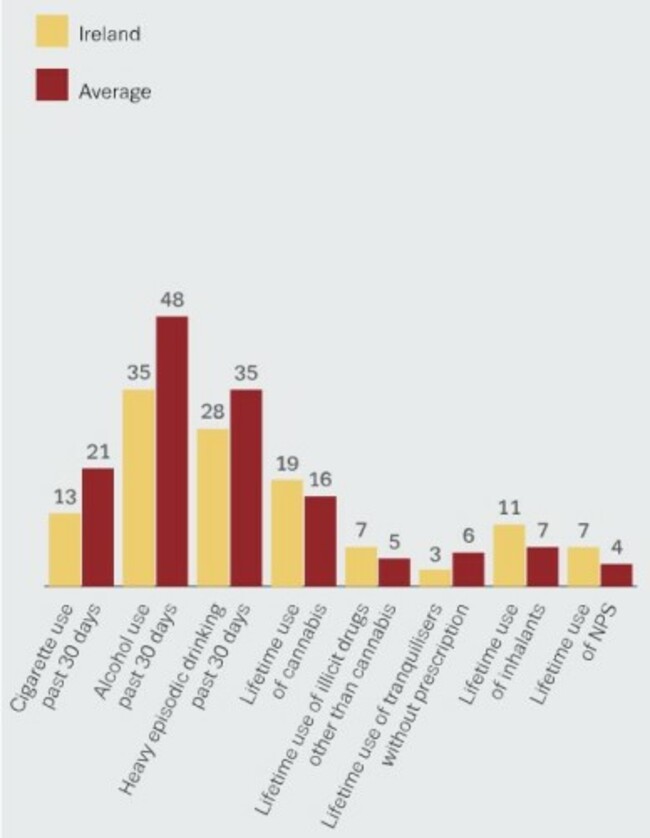
In Ireland’s case, in three of the eight categories surveyed Irish teenagers showed slightly above average levels of prevalence.
Those categories are: lifetime use of new psychoactive substances (NPS), lifetime use of inhalants, and lifetime use of illegal drugs other than cannabis.
Click here to view a larger image
NPS drugs include the likes of 25I-NBOMe, commonly known as an N-bomb, the ingestion of which resulted in the death of Cork teenager Alex Ryan in January of this year.
In more positive news, the Irish teenagers surveyed were well below the European average for cigarette use in the last 30 days (13% against an overall average of 21%), alcohol use in the last 30 days (35% versus 48%), and heavy episodic drinking in the last 30 days (28% versus 35%).
Alcohol use
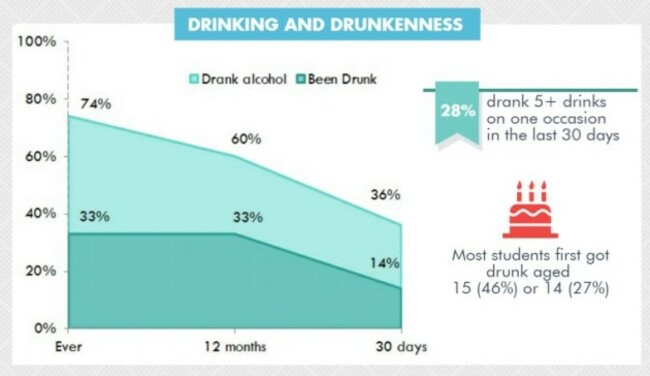
Some of the specific findings of the report regarding Irish teenagers and alcohol use meanwhile include:
Click here to view a larger image
Speaking in reference to the survey, Conor Cullen of Alcohol Action Ireland said that the “positive trends” seen in the results are “very welcome”. However, he added that one of the categories in which Ireland is not below the European average is the number of teenagers who have been intoxicated in the last 30 days.
“This reflects the trend of heavy episodic drinking, or drinking to the point of drunkenness, which is commonplace throughout all age groups and responsible for a large burden of alcohol harm in Ireland,” Cullen said.
When children and young people are consuming large volumes of alcohol in a short space of time then they are putting themselves in immediate danger, not just in terms of alcohol’s direct impact on their physical and mental health, but also the poor decision-making, accidents and the other forms of risky behaviour that we know go hand-in-hand with binge drinking.
Overall, the report found 54% of respondents across Europe had never smoked, while lifetime use of alcohol had decreased from 89% to 81% among those surveyed in the 20 years between 1995 and 2015.
The Espad report also suggests that “close monitoring” is needed regarding gaming, gambling, and teenagers’ use of the internet.
You can view the full report here, and the Ireland-specific version here.

To embed this post, copy the code below on your site












have your say