TheJournal.ie uses cookies. By continuing to browse this site you are agreeing to our use of cookies. Click here to find out more »
Dublin: 6 °C Saturday 25 May, 2013

Over 26 million people unemployed across the EU

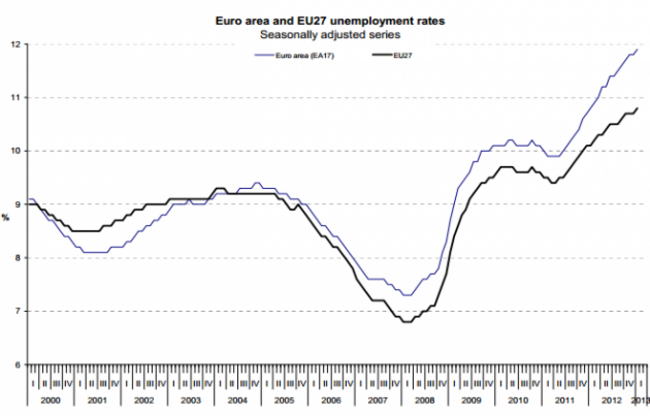
Meanwhile, eurozone unemployment hit a record 11.9 per cent in January with just under 19 million now out of work in the 17-member bloc.

People queue to enter on an unemployment office in Madrid, Spain
Image: Daniel Ochoa De Olza/AP/Press Association Images

THERE ARE NOW over 26 million people unemployed across the 27-member European Union according to new statistics out today.

The Eurostat agency has said that the seasonally-adjusted unemployment rate in the eurozone countries – comprising of 17 nations including Ireland – is at 11.9 per cent for January of this year, a record high of nearly 19 million people.

In the wider EU the rate is at 10.8 per cent which is up from 10.1 per cent in January 2012. Eurozone unemployment is up from 10.8 per cent in the same month last year.

Some 201,000 joined the jobless queues in the eurozone in January, and 222,000 in the EU, when compared with December.

The highest rates were in Greece whose unemployment rate is at 27 per cent – though this figure is from November – and in Spain, on 26.2 per cent.

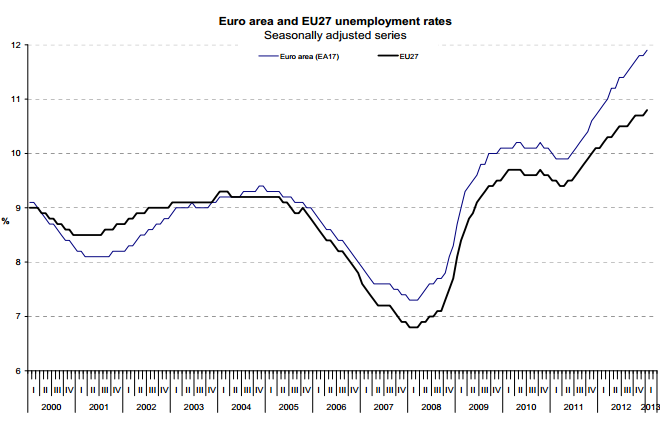
This graph (click here for a larger image) charts unemployment in the eurozone and European Union since the turn of the century:

europe unemployment

Ireland’s unemployment rate is recorded at being at 14.7 per cent – based on data at the end of the third quarter of 2012 – although figures released by the Central Statistics Office this week showed the Irish unemployment was at 14.2 per cent at the end of 2012.

The lowest unemployment rates are in Austria with 4.9 per cent, and Germany and Luxembourg, both with 5.3 per cent.

Compared with a year ago the unemployment rate increased in 19 member states and fell in seven while it remained stable in one, Denmark.

The largest falls in unemployment were in Estonia (11.1 per cent to 9.9 per cent), Latvia (15.5 per cent to 14.4 per cent), Romania (7.4 per cent to 6.6 per cent) and the United Kingdom (8.3 per cent to 7.7 per cent).

While the biggest increases were in Greece (20.8 per cent to 27.0 per cent), Cyprus (9.9 per cent to 14.7 per cent), Portugal (14.7 per cent to 17.6 per cent) and Spain (23.6 per cent to 26.2 per cent).

Eurozone youth unemployment is put at 24.2 per cent in January, up from 21.9 per cent in January 2012. In the EU, under-25 unemployment rose to 23.6 per cent from 22.4 per cent.

For Greece, the youth unemployment rate in January is at 59.4 per cent, with Spain on 55.5 per cent and Italy 38.7 per cent.

More: Number of people at work rises for first time in over four years

Column: 15 tips to help you get a job

Read next:

Comments (22 Comments)

  • Including the refiguration of numbers due to enforced Skills courses and back to school programmes throughout Europe id say its much higher than 23 million look at the Figures in Spain Greece alone .

    Reply
  • europes failing and only the politicians,rich and the bankers see otherwise if we cant help each other as one united group or in europes case a smoke screen of so called unity when its really run by a group of mafia style countries telling everyone else what to do then its time we went our separate ways

    Reply
  • the biggest increases in unemployed are in the bail out countries while the countries with the lowest unemployed are Germany & surrounding countries..a clue there somewhere as to who is faring out best with the current austerity policies

    Reply
    • and as the periphery falls further in to chaos and poverty, it weakens the Euro. Which further drives German exports.

      European solidarity is only a chat show slogan.

      Reply
    • The German figures are a bit misleading, as they’ve significantly narrowed the range of people who are entitled to receive unemployment benefit, ie, there are a lot more people in Germany without work than people in Germany who are officially unemployed, and Germany still had not legislated and introduced a minimum wage. So, more employment in Germany but a lot of people are in full time work but earning less than € 1000 a month. Low rate of unemployment = high rate of “working poor” ( people in employment but dependent on state subsidies and/charity to stay afloat ). Germany is massaging their unemployment figures and will keep doing so until after the autumn 2013 federal elections..

      Reply
  • Neoliberalism has failed miserably

    Reply
    • Not for the Neoliberalists !
      They see it as a massive success and are living the high life .
      While the rest of us are slowly drowning under the flood of debts
      imposed on us .
      I just feel so angry !

      Reply
  • For every 1 job advertised in Ireland there are over 300 applying. Very difficult to get a job, its like trying to win the lotto.

    Reply
  • Where is the light at the end of this tunnel or can anyone see that corner yep austerity is really working

    Reply
  • Does that statistic indicate success for the whole EU ‘experiment’? Not for you and I. But this was never about you and I. High unemployment reduces inflationary pressures on wage demands. So this situation suits the employers. The same effect is achieved if the Eu allows other poor nations to join the group.

    Reply
  • MOD 01/03/13 #

    There needs to be a serious debate on whether Europe is working or not

    Reply
  • Youth unemployment in the 2013 first quarter of 2013 is in the region 29-33%! That’s higher than Spain’s! You know in the past once youth unemployment passes 30% revolutions sometimes occurs! The only reason it didn’t happen in Saudi Arabia was the Saudiazation programme. Yes a hierarchical system with major systemic racism with many inequalities rampant.. But they took care of their own!! Would Ireland or the EU do that!!! I don’t think so! A very sad day in EU leadership seeing these results! They artificially kept the EU currency high with all exports decreasing and imports increasing!.. They really need to devalue for a while to increase trade! Just my take on the EU Fiasco!

    Reply
  • As long as Germany has its foot on the troth of Europe there won be any improvement in unemployment figures or a let up in austerity, and with this brown nosing government we have its going to continue here for as long as Frau Merkel wants, remember she is getting a salary of € 4,400 a week

    Reply
  • New jobs are a bad thing. All change is bad. Hoping for improvement is bad.

    Reply

Add New Comment