TheJournal.ie uses cookies. By continuing to browse this site you are agreeing to our use of cookies. Click here to find out more »
Dublin: 9 °C Sunday 19 May, 2013

Flemish separatist party gains big in Belgium election

The separatist NV-A party won the the city elections in Antwerp on Sunday – and vowed to use the power base to seek wider autonomy for Belgium’s wealthy Dutch-speaking region of Flanders.

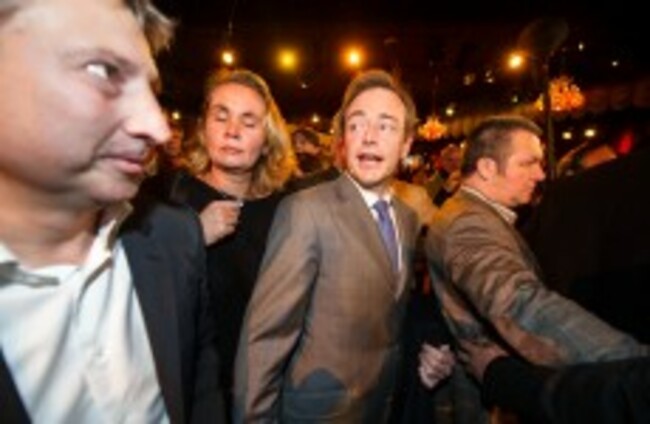
Leader of the NV-A party Bart De Wever, center, arrives at the NV-A election party after they won the city elections in Antwerp, Belgium, on Sunday Oct. 14, 2012.
Image: AP Photo/Geert Vanden Wijngaert

THE LEADER OF a separatist party won the race to become mayor of Antwerp, Europe’s second biggest port city, and vowed Sunday to use the power base to seek wider autonomy for Belgium’s wealthy Dutch-speaking region of Flanders.

Bart De Wever’s NV-A party made sweeping gains throughout northern Flanders and immediately called on French-speaking Belgian Prime Minister Elio Di Rupo to give more rights of self-rule to Flanders.

De Wever said “we want to give Flemings the government they want at all levels. That is why I call on Elio Di Rupo and the Francophone politicians. Take up your responsibility” and work for more regional autonomy.

He says he will work for even bigger gains for separatists at the 2014 national elections.

Flanders and Wallonia

De Wever has been at odds with Belgium’s economically ailing French-speaking Wallonia for years, saying he is fighting over the fate of the 6 million Flemings in the kingdom of 11 million.

With all but 2 percent of votes counted, De Wever was leading Antwerp’s incumbent Socialist mayor Patrick Janssens 37.7 percent to 28.6 percent.

De Wever has made it no secret he is looking for national impact during the municipal elections. He has criticized French-speaking Socialist Di Rupo over tax policies he says tap too much money from Flanders.

“Your taxation government without a majority in Flanders is not backed by Flemings. Let us work together on a reform that gives Flemings and francophones the government that they deserve,” De Wever said in his victory speech.

Di Rupo immediately dismissed the suggestion, saying there was no reason to change national policy. “These are municipal elections. Each is free to declare what he wants on an election night.”

In municipal elections six years ago, the NV-A was a nascent party with few votes across northern Flanders, but by 2010 national elections it had become the biggest party in the region. Sunday’s elections confirmed it.

‘Black-and-yellow Sunday’

“We not only do as well as our monster score of 2010,” De Wever said. “We do even better, and no one could have expected this. It is incredible. It is a black-yellow Sunday,” he said, referring to the colours of the Flemish flag.

Because of the fragmented nature of municipal elections, precise voter percentages were still hard to come by late Sunday, but the sweeping victory of NV-A was beyond doubt. Di Rupo’s socialists also had strong results in several Francophone cities, including his home bastion of Mons.

After the 2010 elections, De Wever was the main reason that Belgium had the longest period without a government on record — at 541 days — because he sought extensive concessions for Flemish autonomy.

He failed and ended up in opposition against Di Rupo, a staunch defender of the Belgian nation-state.

While De Wever’s NV-A surged on Sunday, the extremist anti-foreigner Flemish Interest party crashed. “We saw our voters flee to the NV-A,” Flemish Interest lawmaker Gerolf Annemans said.

“Our city was the European base of the radical right wing for two decades. This era ends today,” a triumphant De Wever said.

Moves toward separatism in the European Union have been getting a bigger stage during the continent’s economic crisis. Spain’s Catalonia is grousing that it has to pay for others in its crisis-hit country, and Scotland is seeking a referendum on breaking away from the United Kingdom.

Read: Belgian premier apologises for WWII deportation of 25,000 Jews>

Read next:

Comments (12 Comments)

  • Stoopid sexy Flanders…

    Reply
  • Belgium’s internal wrangling really won’t have any implications for the EU at all. This dispute is nothing new and has been simmering away for decades.

    The situation in Belgium’s very complicated. Effectively it’s a bit of an artificially constructed state with a large Dutch speaking, a large French speaking and a small German speaking area all bolted rather crudely together by circumstances that came about during various European wars.

    It’s actually a far more complicated situation than the UK or Spain in many respects and actually more hostile (although thankfully mostly just verbally / politically and not an armed conflict).

    Wallonia (the French speaking part) became very wealthy during the industrial revolution due to access to natural resources and its location. It was 2nd only to England in terms of industrialisation at its peak. At that time, Flanders was predominantly agricultural and not very developed. The French-speaking part also exerted a lot of control over the Flemish and basically tried to turn the whole country French-speaking.

    The 20th century saw a backlash against this, and the country split into two independent states along linguistic lines with a federal capital (Brussels) which is officially bilingual.

    Since the 1970s Wallonia declined as the heavy industries it depended on collapsed (much like the North of England / NE France) while Flanders prospered around services industries and the high tech economy. The result was a role reversal where the previously undeveloped Flemish part is now much more prosperous than the French speaking part and also bears a huge grudge against it due to the way it had been treated in the past.

    It would be more like if England had gone into decline and Scotland was now much more prosperous and populous than it.

    The German-speaking bit is part of Wallonia and is largely just ignored from what I can see. Although, it does get its language rights protected.

    The battle between the two sides tends to be waged in terms of things like bureaucracy, public services and politics rather than actual conflict but it can be very divisive and nasty in many respects, particularly around the outer suburbs of Brussels. Everything’s divided up by language and bilingualism is just not accommodated (other than in Brussels) at all. This can be pretty serious if you cannot send your kids to school in the language you speak at home or if you can’t speak to / write to your local authority because they will not deal with requests other than in their official language.

    They had a linguistic-based argument a couple of years ago that resulted in them having no Government for 541 days. Although, much as you’d expect over here, mostly nobody actually noticed!

    The big negative for Belgium is that all this argument tends to create a lot of political stagnation on practical issues because so much time and effort goes into language-border disputes.

    The most likely outcome will be a big load of ranting and posturing and some concessions towards a more formalised federal setup and then business as usual.

    It’s a very odd situation over there, and perhaps totally ignored by a lot of people because it’s just ‘one of those quirky European situations’. However, it’s actually in many respects every bit as bad (if not worse in some respects) than the relationship between England and Scotland or even Madrid and Catalonia.

    I’d liken it to Northern Ireland, only with the divide being between language groups rather than republican/nationalist / catholic/protestant and without the armed violence, but with all the psychological and verbal nastiness.

    Reply
  • Belgium is in reality 2 countries as is. The “national” Govt. has no real power, no authority and is ignored by both sides. The only debate at this stage is whether the country should be pout out of its misery. The Flemish Govt. is at this stage a functioning body of state, has been for a long time.

    Reply
  • The Benelux countries are the original heartland of the eu.

    Reply
  • The bigger issue would be where Brussels would end up. It’s a bilingual, shared, federal capital. While it’s physically surrounded on all sides, it’s majority French-speaking.

    I can’t really see Brussels fitting cleanly into either state.

    Reply
  • In August 1830, stirred by a performance of Auber’s La Muette de Portici at the Brussels opera house La Monnaie (Dutch: De Munt), the Belgian Revolution broke out, and the country wrested its independence from the Dutch, aided by French intellectuals and French armed forces. The real political forces behind this were the Catholic clergy, which was against the Protestant Dutch king, William I, and the equally strong liberals, who opposed the royal authoritarianism, and the fact that the Belgians were not represented proportionally in the national assemblies. At first, the Revolution was merely a call for greater autonomy, but due to the clumsy responses of the Dutch king to the problem, and his unwillingness to meet the demands of the revolutionaries, the Revolution quickly escalated into a fight for full independence.

    The major European powers of the time, (Britain, Russia, Prussia, Austria) were fearful of Belgium either becoming a republic or being annexed to France, and so found a monarch invited in from the House of Saxe-Coburg and Gotha in Germany by the British. On July 21, 1831, the first king of the Belgians, Leopold of Saxe-Coburg was inaugurated. This day is still the Belgian national holiday. Even though the Belgian Revolution violated the accords made in 1815, the Belgians received the sympathy of the liberal governments of both Great Britain and France. France itself had undergone a liberal revolution that year. The other major powers of Europe – Austria and Prussia – took a much dimmer view of Belgian independence but they were disinclined to take any action, being preoccupied with the November Uprising in Poland.

    The Netherlands still fought on for eight years, but in 1839, the Treaty of London (1839) was signed between the two countries. Belgium thereafter became a sovereign, independent state with a liberal constitution (constitutional monarchy). The constitution did however, limit voting rights to the haute-bourgeoisie and the clergy, if they were fully French speaking, in a country where French was not the majority language; all together less than 1% of the adult population.

    By the treaty of 1839, Luxembourg did not fully join Belgium, and remained a possession of the Netherlands until different inheritance laws caused it to separate as an independent Grand Duchy. Belgium also lost Eastern Limburg, Zeeuws Vlaanderen and French Flanders (Dutch: Frans Vlaanderen) and Eupen, four territories which it had all claimed on historical grounds. The Netherlands retained the former two while French Flanders, which had been annexed at the time of Louis XIV remained in French possession, and Eupen remained within the German Confederation, although it would pass to Belgium after World War I as compensation for the war.

    The Belgian Revolution had many causes:

    At the political level:
    The Belgians felt significantly under-represented in the Netherlands’ elected Lower Assembly.
    The low popularity of Prince William, the later King William II, who was the representative of King William I in Brussels.
    The treatment of the French-speaking Catholic Walloons in the Dutch dominated United Kingdom of the Netherlands.
    At the religious level:
    The difference of religion between the Catholic Belgians and their Protestant Dutch king.
    At the economic level:
    The Belgians had little influence over the traditional economy of trade centered in Amsterdam.
    The Dutch were for free trade, while industries in Belgium called for the protection of tariffs.
    Low-taxed imports from the Baltic depressed agriculture in Belgian grain-growing regions.
    At the international level:
    French July Monarchy’s support.
    The passive agreement of the British.

    Reply
  • Jim Walsh if Belgium split (which probably isn’t going to happen any time soon by the way) do you think both flanders and wallonia would automatically become members of the EU?

    Reply
  • beginning of the end for the eu.

    Reply
  • Paddy does this really have to be explained to you? Scotland is a country within the UK. The UK is not a country. Whereas Belgium is a country that was at the forefront of european unity. If this country can no longer even support unity within their own country, what does this mean for the EU.
    This realistically is about Nationalism. Its worrying for us all that issues that reared their head over the last few hundred years are becoming popular again.

    Reply
    • This has nothing to do with the EU at all. There has been an linguistic/national divide in Belgium since its creation by the Great Powers in 1830 after the French-speaking provinces of the Netherlands rebelled. At the time the French wanted those provinces to become part of France but the other Powers wouldn’t allow that because they feared that it would make France too strong. So they created a buffer state made up of two different nationalities instead. Since then the tension between the two groups has erupted at numerous times irrespective of what has been happening in Europe. This latest round has been ongoing in some way since the 1970s.

      The NV-A are not a Eurosceptic party and therefore even if Belgium did end up in a split there is no indication that a new Flemish nation led by the NV-A would contemplate leaving the EU.

      Reply

Add New Comment