TheJournal.ie uses cookies. By continuing to browse this site you are agreeing to our use of cookies. Click here to find out more »
Dublin: 10 °C Thursday 23 May, 2013

Former IRA members will not give evidence to Smithwick Tribunal

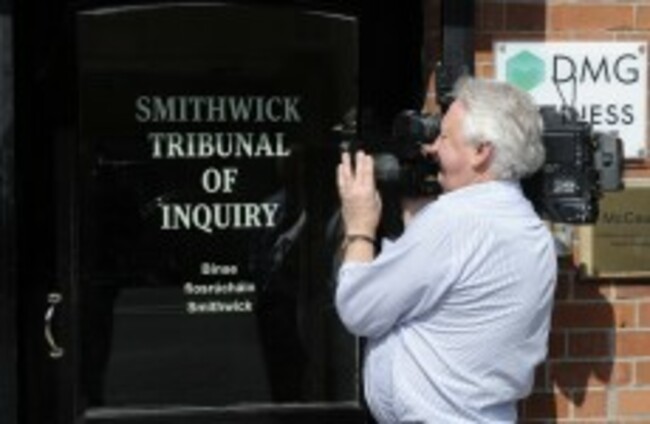
The Smithwick Tribunal says three members of the Provisional IRA have ruled out giving oral evidence.

Image: Sasko Lazarov/Photocall Ireland

THE SOLE MEMBER of the Tribunal investigating alleged Garda complicity in the murder of two RUC officers by the Provisional IRA in 1989 has said that talks with former members of the IRA, on encouraging them to take the stand and give evidence, have been unsuccessful.

In an update to the Oireachtas sent today, retired justice and Tribunal chairman Peter Smithwick said his Tribunal had been in discussions with three former members of the IRA, one of whom claimed to have have direct knowledge about operation on March 20, 1989 that resulted in the deaths of the two officers.

Members of the Tribunal’s legal team had met with the members in April 2011, and had been trying to secure further co-operation since then – but the former IRA members pulled out of a meeting late last year to discuss the prospect of putting forward a witness to give evidence at a hearing.

In his letter, Smithwick said the engagement with the IRA members “reached a definitive conclusion” last week, when it was declared that none of the former IRA members were willing to give oral evidence.

This was in spite of assurances that the Tribunal would undertake “extensive safeguards” to protect the security and identity of any former members willing to give evidence.

There will be no further meetings between the Tribunal and the members, though the members have offered a supplemental statement in response to the agenda for the cancelled meeting of late 2012.

This statement is to be read into the public record when the Tribunal holds a public sitting tomorrow.

“While I am grateful to the former members for providing the Tribunal with their version of events, and in particular for meeting with the Tribunal’s legal team in April 2011, I am very disappointed that oral evidence will not be given,” Smithwick wrote in his letter to the Oireachtas.

Corrigan health

The letter also includes an update on the health of retired Detective Sergeant Owen Corrigan, a key witness who underwent a coronary bypass last month, and for whom the Tribunal’s deadline has been extended.

Though there have been “some complications in his recovery”, Smithwick said he remained hopeful that Corrigan’s evidence could be concluded in the spring. This would mark the conclusion of the Tribunal’s public hearings.

Smithwick said he was also in contact with the Northern Ireland Office in London about assessing intelligence passed on by the PSNI last summer.

Chief Superintendent Harry Breen and Superintendent Bob Buchanan were killed in an ambush outside Jonesborough, Co Armagh. The two were returning from a meeting with their equivalents in Dundalk, where they had discussed an upcoming cross-border operation against IRA smuggling.

The Tribunal is investigating claims that Gardaí had colluded with the IRA, with a rogue ‘Garda X’ informing the IRA of the time of the meeting and of the route that the two RUC officers would be taking on their return to Northern Ireland.

Read: Shatter to request July 2013 as new deadline for Smithwick Tribunal

Read next:

Comments (36 Comments)

  • I didn’t know Smithwicks sponsored tribunals

    Reply
  • Harry Breen was a covert dirty war operative linked to people like Billy Hanna and Robin Jackson. Ironic then that someone who colluded with the perpetrators of the Dublin / Monaghan bombings and the Miami Showband massacre could himself have been a victim of collusion.

    Reply
  • They haven’t gone away you know!

    Reply
  • @Richard: It’s Sinn Féin. You can drop the IRA bit.

    Reply
  • In 1052 Dublin became the capital, taking over from Tara..
    In 1171 Rory O Connor of Connaught was High-King, having succeeded Muirchertach Mac Lochlainn of the northern O Neill, in 1166. Mac Lochlainn succeeded Turlough O Connor of Connaught in 1156.. He had ruled since 1119. Before him, Brian Boru’s great-grandson, Muirchertach O Brien, ruled from 1086 to 1119, and before him, Brian Boru’s grandson, Turlough O Brien, ruled from 1072 until 1086.
    The ruling dynasty at the time of the Norman “arrival” would have been the O Connor clan.
    “Parliament” as such, alternated between Tara and Dublin at this time.
    The vikings brought coinage to Ireland in the 9th century, but the Irish continued to trade in cattle for many centuries afterwards.
    Embassies and ambassadors weren’t really the done thing in the 12th century, but delegations representing Kings would have met at various times in various locations, depending on the situation.

    Reply
  • Obviously,it was a war that is.it would be stupid to start nit picking now

    Reply
    • There are laws for conducting wars that are very clear about targeting civilians and civil authorities. If the Brits have to account for shooting civilians then it should work both ways or it’s hypocrisy.

      Reply
    • A war would normally be carried out by a Sovereign State and the IRA don’t qualify. It is not surprising that they are not cooperating with the Tribunal as their Leadership in Dail Eireann continues to deny the evidence that he was a Senior Officer and Commanded the execution of a young mother while ordering the bombing of civilian targets in London.
      Ah the Great Democrats and their need to be our Government!
      Be very afraid.

      Reply
    • Richard I would interested on your views on Syria. Do you think that their is a war in Syria, or how would you describe it. You seem to know so much I am surprised you haven’t been called by the tribunal to give evidence. Surely you have loads of evidence to give.

      Reply
    • I think the whole point is that the IRA sees (or at least, saw) itself as the legitimate national army of a country that continued to exist.

      The theory is that the Irish Republic declared by the Proclamation in 1916 was a legitimate national state, which represented all 32 counties. While the Rising was quickly defeated, it still set off a chain of republicanism that led to Sinn Fein winning most of the Irish seats in the House of Commons election in 1918. In that election, SF ran on the platform that they would not recognise Westminster and instead set up their own national parliament in Ireland. That met for the first time on January 21, 1919 (“Independence Day” in the eyes of some republicans) and declared the creation of a new country, the Irish Republic, which backdated its existence to 1916. This country was governed by their parliament, the ‘First Dáil’.

      Britain, which still claimed to rule Ireland, passed the Government of Ireland Act 1920 to create two separate Irish states, Northern Ireland and Southern Ireland, and called elections for each of those for May 1921. Sinn Féin adopted the same stance as before, and considered the elections in Southern Ireland to be elections for the ‘Second Dáil’. Sinn Féin won 124 of the 128 seats (the other four were won by unionists standing in the University of Dublin constituency – as in, Trinity College).

      It’s at this point that things begin to differ. The Second Dáil (or House of Commons of Southern Ireland, depending on which side you were on) was the one which narrowly approved the Anglo-Irish Treaty – which created an Irish Free State with the King of England as its head of state. This led to De Valera and half of the Sinn Féin party pulling out of the Dáil, declaring that the Irish Republic and the Anglo-Irish Treaty were totally incompatible (as the Irish Republic could not, by its own right, be part of any treaty that meant it answered to a foreign monarch). Dev set up his shadow government – the “Emergency Government”, as he called it – with the IRA as its army. This fought against the Irish National Army (the “official” army, if you will) in the civil war.

      To cut a long story short, the theory is that some members of the IRA refused to recognise its ceasefire (again, believing that they couldn’t admit defeat to an army of an illegitimate government) and began to consider themselves as the true IRA, the only surviving part of the government of the Irish Republic. Those who subscribe to this theory believe that because the Irish Free State (and the creation of Northern Ireland itself, under the terms of the Treaty) were illegitimate, any elections held to either of those chambers were also illegitimate. Therefore the Second Dáil, in their eyes, was never dissolved – and any surviving members of the Second Dáil were the only legitimate government. In 1938 some of the few remaining anti-Treaty members issued a statement passing their “power” to the IRA Army Council, which therefore began to see itself as the only legitimate government of Ireland.

      You can read more about this on Wikipedia: http://en.wikipedia.org/wiki/Irish_republican_legitimism

      Of course, it’s entirely up to the reader to decide for themselves whether they share that view – I’m just putting this in to explain the logic behind the use of the word “war” to describe the Northern Ireland conflict in some quarters.

      Reply
    • Nice informative distinction Gavin that some people should know before they comment on this site. It the so called troubles was a war against an army of occupation. That army was the British army.

      Reply
    • Gavan

      Reply
    • Civilians? They were in the RUC, that would make them legitimate targets if I’m not grossly mistaken. Given the nature of the conflict at the time.
      Not that it makes murder excusable.

      Reply
    • Listen Steve ’twas a war when the Provos did the murdering,when innocent people got caught up in their nasty world, they were casualties of war, but,when one of their own was killed they were ” murdered ‘ by the British, their propaganda section wanted it both ways.

      Reply
  • We shouldn’t be surprised by this! It’s them they killed & that’s why they are guilty.

    Reply
  • I see the troll has destroyed yet another thread with it’s verbal tripe.
    Oh well !

    Reply
  • IRA thugs love to use the word war to describe their blood lust. There was no war.

    Reply
  • You cannot sit on both sides of the fence. There was no war. The Irish army represents the people of the Republic of Ireland. We have not been at war with anybody. Some people believe that blowing innocent people to bits using the likes of car bombs is a legitimate tactic in order to further their own selfish aims. This is not war these are the actions of derranged sub human beasts. No amount of reasoning could persuade these terrorists that they are wrong because they are too stupid to understand the consequences of their own actions.

    Reply
    • Patrick, Ireland has been in a constant state of war with the English/British crown since they usurped our sovereignty in the early 1170’s.. It’s the longest running war of independence on the planet. Are you a democrat Patrick? Just wondering because I’ve yet to hear you condemn the illegal riots in Belfast..

      Reply
    • Like it or not Patrick, the Provisional IRA did have a huge support base in the north and would’ve been seen as the legitimate defenders of the nationalist community when countless Irish governments ignored them. Terrible atrocities we’re carried out not just by the IRA but by the British Army and loyalists. I have relations who were involved. They are not sub human Patrick. Neither are they stupid. Their friends were murdered on Bloody Sunday and they fought back.

      Reply
    • Jamie, if you are going to go all the way back to 1170 we will never reach a conclusion on the troubles. Can we move on?

      Reply
    • mcbab 01/02/13 #

      Where is Cal now with his constant talk of a truth and reconciliation commission? It just won’t work , see above article. A la carte truth!

      Reply
    • Hi …. Miss me much ?

      Reply
    • mcbab 01/02/13 #

      Nothing constructive to say? Too busy brown nosing Gerry ?

      Reply
    • As per my comments on the truth and reconciliation program, I don’t see how this article and this tribunal detracts from my position. It only enhances it. Putting in place, a hierarchy of victims, is ridiculous. Like it or not, the RUC officers killed in this ambush, are the same ones he supported the shot to kill policy that ran for years in the north.
      I condemn every single civilian murder, and the murder of Gardai in the south, as they were and are, an unarmed force.
      Any IRA members, British security force members that died in the conflict, died fighting for their individual causes. They were not innocent victims.
      I feel sorry for the pain and suffering for every family in the conflict. But, I think tribunals investigating the deaths of individual warring factions, are a complete waste of time.
      A full truth and reconciliation program, is primarily aimed at the victims, so that they can move on. Until we are able to move on, there will always be a real and constant risk of a return to all out conflict. Why some people find that so hard to understand is beyond me.

      Reply
    • Out of interest
      What was our capital in the 1170s
      Who were the last five kings?
      What was the ruling dynasty called?
      Where were regular parliaments held?
      What currency was minted?
      What other countries did we send embassies to, where did foreign countries send their embassadors to?

      The answers will give you an idea about Irish sovereignty

      Reply
  • Stop all these tribunals NOW….waste of money , waste of time etc

    Reply

Add New Comment