Sign in. It’s quick, free and it’s up to you.
An account is an optional way to support the work we do. Find out more.
Sign in. It’s quick, free and it’s up to you.
An account is an optional way to support the work we do. Find out more.
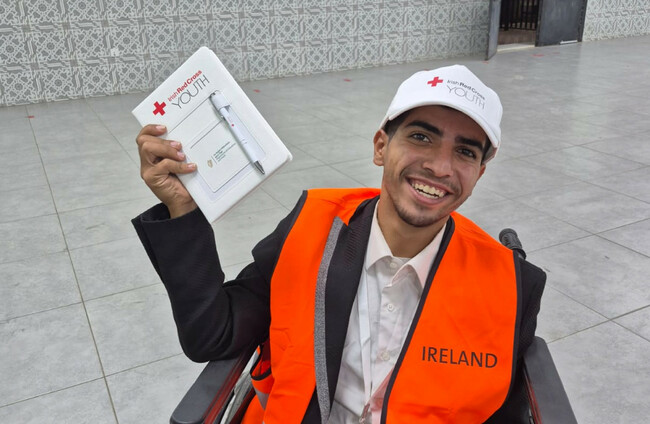

A GAZAN FAMILY brought to Ireland under the government’s medical evacuation programme say they face imminent eviction from their Dublin accommodation and relocation to rural Kilkenny, despite the complex medical needs of their two sons.
Amir Wali (22) arrived in Ireland through a government-supported evacuation scheme designed primarily for seriously ill children from Gaza. Both he and his 15-year-old brother suffer from severe hereditary haemophilia.
While his brother was one of the 27 paediatric patients evacuated to Ireland, Amir was able to come through family reunification. However, his family say that his medical needs are more severe, and he would be badly impacted by the proposed relocation.
The Wali family, alongside five other families, were issued notice at the end of May requiring them to leave their accommodation on the Merrion Road by Friday 26 June.
The Irish Red Cross (IRC), which operates accommodation for families under the programme, has offered the family of seven a place in a centre in rural Kilkenny, more than a 25-minute walk from the nearest bus stop.
For Amir, who also has a complex knee injury sustained during an Israeli strike near his family’s tent in Deir al-Balah, the move would mean a significant disruption to ongoing specialist treatment at St James’s Hospital and the National Coagulation Centre in Dublin.
The Irish Red Cross said that the housing for all the 27 families that travelled to Ireland for medical treatment was always going to be temporary, noting that they were initially located in Dublin to allow for medical supports.
A spokesperson said that the families were always told that the accommodation would be temporary and there would eventually be a move elsewhere due to the lack of affordable options in the capital city.
“We understand relocation is a big change, and the emotions and uncertainty it can bring,” a spokesperson told The Journal.
“That is why we have focused on finding sustainable and suitable accommodation where the families can stay together, feel part of a community and have access to essential services – medical care, schools, grocery shops, halal food outlets, and places of worship.”
However, Sinn Féin spokesperson on foreign affairs Donnchadh Ó Laoghaire told The Journal that it is “appalling” that the department of health had not worked with the other agencies to ensure that there was a long-term plan for the families.
He urged the department to engage with agencies to ensure they can be kept in the community where they have made connections.
Ó Laoghaire added these families had come to Ireland “fleeing genocide, requiring immediate emergency care, going through the most appalling things we’ve seen anywhere in the world, to face potentially being put on the street or being uprooted from the communities in which these children are located”.
It is believed that a number of the families were initially offered accommodation in the north-west of the country, but they did not wish to proceed with the relocation and suggested Kilkenny as an alternative.
The accommodation offered in Kilkenny is a three-bedroom apartment with one bathroom for seven people, including two children. The IRC is proposing to cover rent for a maximum of 12 months.
Despite having formally appealed the relocation, the family were informed by the IRC that remaining in Dublin beyond the deadline would be considered “unlawful”.
A letter also warned that refusal of the offer could leave them at risk of “becoming homeless” and stated: “The IRC will be obliged to notify Tusla, the child and family agency, giving that children will be involved.”
Amir says the correspondence has left the family distressed as the deadline approaches.
He told The Journal they have contacted political representatives, including the office of the Tánaiste and Minister for Justice Jim O’Callaghan, but “no one has engaged with our letters”.
Councillor John Hurley, who has been supporting the family, said that if the state offers refuge and a medevac program to people coming from a war zone, then “surely some amount of forward planning would identify accommodation for them close to the medical services they need”.
Hurley added: “For families who have had their homes destroyed, been subject to multiple forced displacement and been separated through war this triggers anxieties from traumas previously experienced.”
Amir has secured a place to study computer science at University College Dublin (UCD), while his 12-year-old sister has a school place arranged in Dublin from September. He says daily travel from Kilkenny would not be realistic given his condition and reliance on his parents as carers.
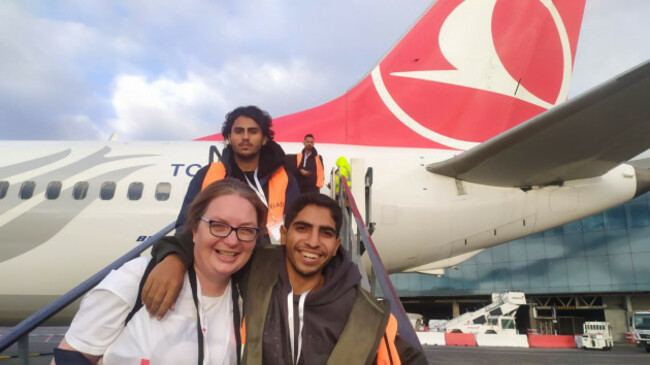
Amir says that living in Gaza under daily bombardment from Israel has had a long-lasting impact on his physical and mental health, as he has endured starvation, and has “escaped death several times”.
“I was about 37 kilograms [just under 6 stone] when I arrived in Ireland, basically just skin and bone.
“I’d had a bad bleed after the explosion, and there were many times then when we’d get a warning that the whole area was going to be bombed, so we would have to get up and run, and I was trying to run on my injury. They were truly horrific days at the end,” he said.
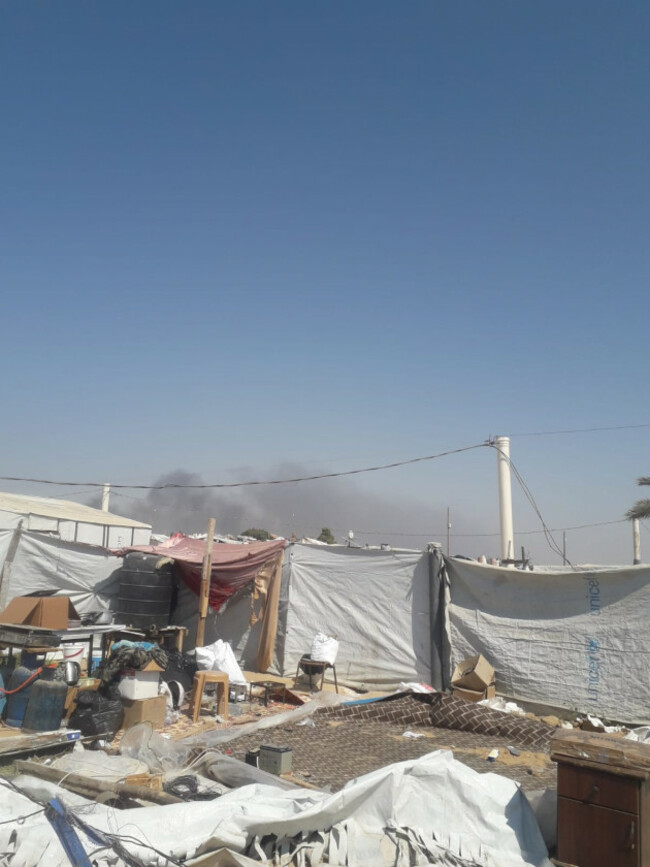
Amir crossed from Gaza to Jordan in an evacuation process that was overseen by the Israeli Defence Forces.
“They refused to make my evacuation easier by giving me a wheelchair. We had to walk to the Israeli side from Gaza when we got to the crossing point. It was 30 minutes, a very long walk. I did it because I had to stay alive,” he said.
Amir spent several weeks in St James’s Hospital after arriving in Ireland in October 2025. He is now awaiting a full knee replacement and continues to attend hospital several times a week.
Fatima, his mother, has argued in her appeal that relocation outside Dublin would make ongoing treatment unworkable. The National Coagulation Centre has also advised against Amir travelling to appointments by public transport.
The Irish Red Cross has previously told families that patients in Ireland commonly travel to Dublin hospitals for treatment.
The IRC ceased funding taxi transport for medical appointments earlier this year, moving instead to reimbursement of public transport fares.
For Amir to get to St James’s from the Kilkenny location, he will need to walk for half an hour, board a bus, and then take a Luas, in a journey that will take up to three hours.
A spokesperson for the Department of Health told The Journal that its priority is ensuring that the children receiving care under the medical evacuation initiative are in “safe” accommodation and have “uninterrupted” access to healthcare.
They added that while the Department “understands” that some families would prefer to remain in Dublin, an extensive search for longer-term accommodation has not identified any possible locations.
They added that the Irish Red Cross will provide transport for the first month of the relocation, which will be a shuttle bus into the city centre.
The spokesperson for the Irish Red Cross said that there had been significant progress in the health of the 27 children who came to Ireland as part of the medical evacuation programme.
“We are delighted to see so much positive progress with the children’s health and have proudly witnessed many of the families make a new life and integrate to welcoming communities around the country.”
To embed this post, copy the code below on your site













have your say