Sign in. It’s quick, free and it’s up to you.
An account is an optional way to support the work we do. Find out more.
Sign in. It’s quick, free and it’s up to you.
An account is an optional way to support the work we do. Find out more.

IN THE PLAÇA de Catalunya, one of Barcelona’s main thoroughfares, shoppers file eagerly into Zara and Primark. Opposite, chairs adorn the pavement, filled with people sipping espressos outside a Hard Rock Café.
Cars and motorbikes traverse the roundabout, tooting their tinny horns. A horde of pigeons takes to the air in pursuit of a man throwing handfuls of crumbs. And in the centre, some 200 people sleep in tents to protest the cost of housing.
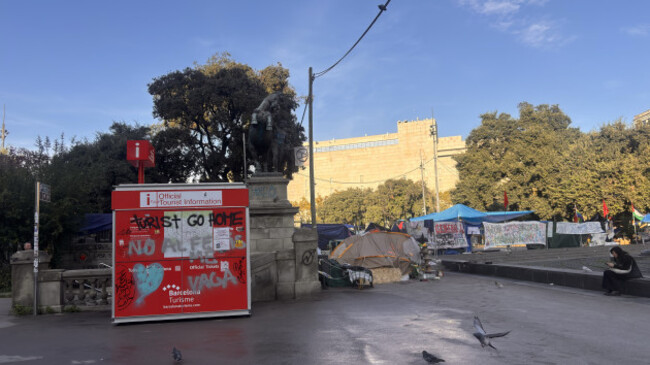
On the corner, a tourist information board bears the scrawl of graffiti: “Turist go home”. Signs adorn the metal barricades that encircle the camp.
Ni Gent Sense Casa. Ni Cases Sense Gente. No people without a home, no homes without people.
Rendistes culpables. Govern responsable. Landlords guilty. Government responsible.
Construïm l’alternativa revulolucionària. Let’s build the revolutionary alternative.

Tourists approach the encampment, boxed in by metal barricades, curious, phones at the ready.
“No photos.” William Gomes Dos Santo, one of the protesters sitting watch at the entrance, waves them back with a stern rebuke.

Gomes Dos Santo, a 45-year-old Brazilian, has been sleeping in the Plaça de Catalunya for just over a week, having come to Spain 18 months ago to seek better opportunities.
“We’re not to waste time,” he says. “We’re here for social things. A place to sleep is the minimum that a human being needs.”

The encampment in one of Barcelona’s main squares began on 30 September, sparked by the eviction of 87-year-old Maricarmen Abascal, who was carried out of the home she had lived in for over 70 years on a stretcher. She died in hospital a few days later.

Since then, hundreds of thousands have taken to the streets to demand more affordable housing, while many have occupied central locations in several cities in Spain to draw further attention to the country’s housing crisis.
In Madrid’s Puerta Del Sol, campers were dispatched around five weeks after they began their sit-in, but so far, the campers in Barcelona’s main square have been left largely in peace.

Maria Galin (26) from Barcelona has been camping out for a few weeks, and thinks that the protesters have a good chance of staying in situ until the general election in a few weeks’ time.
Prime minister Pedro Sanchez called the snap election, which had been scheduled for 2027, in response to the parliament’s failure to pass decrees that included greater protection for tenants against evictions and the automatic renewal of tenant contracts.
On Thursday, the day after the country’s first national strike in over a decade, parliament passed the decrees, but the leading opposition party, the right-wing Popular Party, has said that it will repeal these if it takes power on 29 November, which polls indicate could happen.

Galin lives with her family in Barcelona, and like many others, feels strongly about the direction that her country is heading in.
“They’re killing us slowly,” she says. “Today you can’t pay for a house. Tomorrow they humiliate you taking you out of your home.
“I’m not asking for a mansion in the middle of Plaça Catalunya… I’m asking for the minimum.”
She says that her city has changed hugely since her childhood. Her neighbourhood, she used to be a “village”, but has now turned into a place where she doesn’t “recognise faces”.
The locals – those who do the ‘castellers’, human towers that mark Catalonia’s October festival, and the ‘sardanas’, a Catalan folk dance – are being pushed to the periphery, she says.

And while the protests began to demonstrate against housing costs, they have now grown into something much bigger.
“In the end it’s not just housing, it’s everything – it has to be everything. This [protest] is everything, it’s like the sum of all the struggles, you know?” she says.
“We’re fed up with being treated like morons and idiots, with our rights being taken away bit by bit.

“It’s not just housing, it’s food, it’s petrol… they’re drowning us.”
Part of the issue is the low salaries in Spain, which are roughly 20% lower than the EU average. Around 40 to 50% of people’s income is spent on housing, and in cities like Barcelona and Madrid, up to 70% can be spent on rent.

For Daniel Nattes (33), an electrician from Colombia, the high cost of housing in Spain, combined with bad salaries, means that people are not getting what they deserve.
People deserve a “dignified life” for having worked hard their whole life, he says.

The encampment, home to around 200 to 300 people, is well kitted out. In the centre, a makeshift food truck stands, where people queue with tin bowls and tupperware for their lunch.
There’s a bookshop, too, as well as several portaloos.
People’s bikes are propped up outside their tents, unlocked.
Many of the tents are now on pallets, after the heavy rain that racked the country a few weeks ago, flushing people out of their tents.
People of all nationalities are camping out, including those from Senegal, Romania, Palestine, Spain, Colombia, Brazil and more. People hail from all walks of life.

Victor Martinez, an activist from Spain, camped out in Madrid’s Puerta del Sol and then Valencia’s Plaza del Ayuntamiento before coming to Barcelona.
He is writing an account of the protests across Spain, and as we speak, he gets into a heated discussion with a teacher, a well-dressed woman with straw-coloured hair, who leans on the metal barricades and debates the main problems that the country is facing.
The discussion draws in a young man with a hoop earring carrying a pack of tobacco, who complains about the cost of living in Cadiz.
While other camps have been dismantled – including those in Madrid, Valencia, Seville and Malaga – Barcelona’s camp has drawn more sympathy, including previously from the city’s mayor, Jaume Collboni, who said in an interview with local media last week that protesters were exercising legitimate rights to peacefully protest.

However, after 52 people were arrested in Barcelona following Wednesday’s national, Collboni hinted that the camp may be cleared before Christmas.
But what is clear is the national mood of discontent, with a survey finding that 60% of Spaniards support the general strike that happened on Wednesday, and 64% see the housing situation as an incentive to go vote on 29 November.
As we’re speaking, a blind man walks into the back of my chair, probing with his stick, trying to find the exit.
A man from Romania, Jordi, circles our gathering, dressed in high-vis and wearing a Mexican sombrero.
And a young man wearing a bomber jacket comes and offers to buy them coffee.

Atu (29) from Senegal, gives him his card, saying it’s only got €1.90 on it otherwise he’d treat them all to coffee.
Atu works in construction, and commutes back to his home in Piera, about an hour from Barcelona, at the weekends to find work, after spending the week camping out in the Plaça de Catalunya.
While their numbers have depleted during the six weeks of protest, those who remain are strong in their resolve.
“There are lots of people who want to fight, but not everyone is willing to sacrifice the comfort of home for this,” says Galin.
“We’ll try to hold on until the election,” she says. “And then after that I don’t know what will happen.”
“I’ll be here until the end,” says Atu.
To embed this post, copy the code below on your site















have your say