TheJournal.ie uses cookies. By continuing to browse this site you are agreeing to our use of cookies. Click here to find out more »
Dublin: 19 °C Wednesday 19 June, 2013

Italian scientists face manslaughter charges over Italy earthquake

Seven seismologists are facing manslaughter charges in Italy over their alleged failure to warn the public about a devastating earthquake in 2009, which killed 300 people.

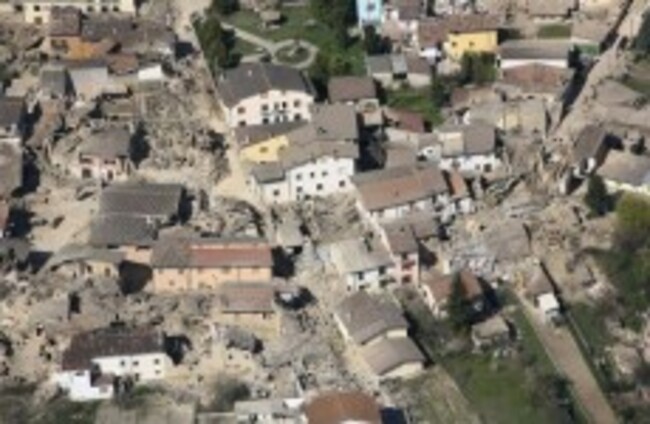
hoto released by the Italian Guardia Forestale (Forestry Police Force) showing an aerial view of the destruction in the city of L'Aquila, central Italy, Monday, April 6, 2009.
Image: AP/Press Association Images

SEVEN SCIENTISTS AND other experts went on trial on manslaughter charges yesterday for allegedly failing to sufficiently warn residents before a devastating 2009 earthquake that killed more than 300 people in central Italy.

The case is being closely watched by seismologists around the globe who insist it’s impossible to predict earthquakes and dangerous to suggest otherwise, since seismologists will be discouraged from issuing any advice at all if they fear legal retaliation.

Last year, about 5,200 international researchers signed a petition supporting their Italian colleagues. The Seismological Society of America wrote to Italy’s president expressing concern about what it called an unprecedented legal attack on science.

The seven defendants are accused of giving “inexact, incomplete and contradictory information” about whether smaller tremors felt by L’Aquila residents in the six months before the April 6, 2009 quake should have constituted grounds for a quake warning.

“We all know well that earthquakes cannot be predicted. This is not in the point here,” said Vincenzo Vittorini, a relative of a victim, who attended the trial.

Rather, he said, because of the failure of the scientists to say a significant quake could be possible, victims and their relatives missed a chance to take preventative measures.

Major termblor ‘improbable’

Prosecutors focused on a memo issued after an expert commission meeting on mounting concerns about the months of seismic activity in the region. Released a week before the big quake, it concluded it was “improbable” that there would be a major temblor, though it added that one couldn’t be excluded.

Commission members also gave largely reassuring interviews to local media after the meeting which “persuaded the victims to stay at home,” the indictment said.

The defendants’ lawyers have insisted on their clients’ innocence and stressed the impossibility of predicting quakes.

The 6.3-magnitude temblor killed 308 people in and around the medieval town of L’Aquila, which was largely reduced to rubble. Thousands of survivors lived in tent camps or temporary housing for months.

Tuesday’s hearing was largely taken up with procedural details to inscribe the dozens of plaintiffs in the civil portion of the case, which will be heard alongside the criminal case. The plaintiffs are seeking some €50 million in damages, the ANSA news agency said. The judge set the next hearing for 1 October.

Experts stressed to local media the impossibility of predicting quakes and saying that even six months worth of low-magnitude temblors was not unusual in the highly seismic region.

In one now-infamous interview included in the prosecutors’ case, Bernardo De Bernardinis, then-vice chief of the technical department of Italy’s civil protection agency, responded to a question about whether residents should just sit back and relax with a glass of wine.

“Absolutely, absolutely a Montepulciano doc,” he responded, referring to a high-end red. “This seems important.”

The indictments sent shudders throughout the international earthquake community, which responded to a call for support by Italy’s geophysics institute with 5,200 signatories of professors, seismologists, postdocs and researchers from New Zealand to Costa Rica, Japan to Martinique.

‘A misunderstanding of the science of earthquakes’

“Pursuing legal action against members of the seismological community after an earthquake is unprecedented and reflects a misunderstanding of the science of earthquakes,” the president of the Seismological Society of America, Rick Aster wrote President Giorgio Napolitano.

Efforts should instead focus on working to better communicate earthquake risks to the public and boosting preparedness by retrofitting old and dangerous buildings, he said.

A lawyer representing families of the victims denied that science was on trial.

“The science is not on trial here, as they say, this is not the trial of Galileo Galilei, but it is a trial to judge if there were responsibilities, mistakes, or incorrect behavior by those scientists who held the meeting in L’Aquila before the earthquake happened,” said lawyer Wania della Vigna.

Many of the structures that collapsed in the 2009 quake were not properly built to standards for a quake-prone area like the central Apennine region of Abruzzo. Among the buildings which cracked and crumbled was L’Aquila’s hospital, just as it was struggling to treat about 1,500 injured.

Nobody inside the hospital, which was built in the 1970s, was killed or injured in the quake.

Manslaughter charges are not unusual in Italy for natural disasters such as quakes, but they have previously focused on violations of building codes in seismic regions.

In 2009, for example, an appeals court convicted five people in the 2002 quake-triggered collapse of a school in southern San Giuliano di Puglia that killed 27 children — including the town’s entire first-grade class — and a teacher. Prosecutors had alleged that shoddy construction contributed to the collapse of the school.

  • Share on Facebook
  • Email this article
  •  

Read next:

Comments (12 Comments)

  • People living in earthquake-prone areas should, and generally do, know that a large one is always a possibility regardless of the recent seismic activity. In fact, the most powerful earthquakes tend to happen when the area has been relatively calm prior.

    An invitation to “sit back and relax” doesn’t constitute an assurance that no earthquake will happen, especially since nobody in the world is qualified to give such an assurance. Neither is it a valid reason to abandon common sense, though it’s now being used as a pretext for exactly that.

    This trial is a sad exercise in blame shifting by people who should be looking at their own complacency. Allowing wishful thinking to substitute reality is always a personal choice.

    Reply
  • I’m all for accountability but….

    Reply
  • CJ Ryan 21/09/11 #

    What rubbish. Why don’t they sue God for all ‘Acts of God’. OH WAIT HE DOESN’T EXIST.

    Reply
  • The only thing that could come about as a result of a successful manslaughter charge against seismologists is that they will just stop attempting to predict them. They can be charged for economic damage by predicting one that doesn’t occur and now they’ll be charged for failing to predict one that does occur. Why would they bother getting involved any more? Those in earthquake prone zones should instead focus on ensuring all structures are earthquake-proof, as they do for the most part in Japan, rather than seismologists who are simply doing the best they can with the information they have.

    Reply
  • What next? Can I sue the weatherman if it rains when he said that it was going to be sunny.

    Reply
  • If they get charged for manslaughter your gonna see a serious extension to duty of care and the neighbour principle. Still feel like the Italian courts are trolling.

    Reply
  • What a corrupt little country. So glad Ireland isn’t corrupt like that…

    Reply
  • Haha wut not sure if srs.

    Reply

Add New Comment