Sign in. It’s quick, free and it’s up to you.
An account is an optional way to support the work we do. Find out more.
Sign in. It’s quick, free and it’s up to you.
An account is an optional way to support the work we do. Find out more.
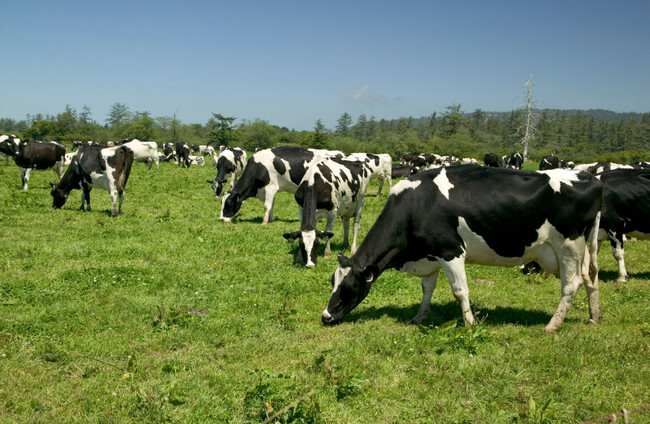
GENETICALLY MODIFIED FOODS have been the subject of much debate, with some people portraying them as a Frankenstein-esque violation of the natural order.
However, a popular video by an Irish farmer has raised a question with a verifiable answer: are there stricter safety standards for food given to organic livestock than for human beings?
In short, no. All the GMO foods that are sold as food are tested for safety and can also be fed to animals.
“Try and make sense of this. GMO foods are completely banned to feed to any animal under organic standards deemed unsafe to their health,” an Irish organic farmer says to camera.
“Me and you can eat as much as we like and there’s no issue.”
The video has been watched more than 449,000 times since being posted on 14 May.
GMOs refer to genetically modified organisms, whose DNA has been altered in some way.
So, what are the rules on GMOs, what are the safety standards for humans and animals, and where do organic food standards come into it?
Humans have been altering the crops they cultivate for thousands of years, creating varieties of crops and animals that are far more productive than their wild counterparts. However, until recently this was done through selective breeding rather than direct manipulation at the genetic level.
Since the 1980s, scientists have had the power to directly alter the DNA of plants and animals as part of attempts to change their characteristics.
“Scientists can now identify, isolate and manipulate individual or groups of genes that are responsible for specific physical or metabolic traits,” the Food Safety Authority of Ireland (FSAI) says.
“With this knowledge, plants, animals or microorganisms can be directly altered (engineered),” it continues. “This technology is routinely used for the contained production of pharmaceuticals and medicines, and in the development of GM plants, animals and microorganisms.”
The FSAI gives examples of foods approved in the EU that use GMOs, including soya beans, corn and cotton, which have all been modified to be resistant to certain pests and herbicides.
“There are no GM animals yet used in food production,” the FSAI sheet says, “though a number are in development at research facilities around the world, with some undergoing safety assessment for possible food use.”
GMOs are mostly evaluated and regulated on an EU level, which is considerably stricter than many countries in the Americas. Only one GMO, a type of corn, can be grown in the EU.
However, more than 90 other GMO products are available for sale, imported from other countries.
Before being sold in the EU, GMO products undergo risk assessments for human health, animal health and the general environment. This includes seeing whether the genetic modification might cause allergic responses or if it might transfer to bacteria, causing antibiotic resistance.
In other words, there are no known health risks associated with EU-approved GMO foods.
And individual countries also have an opt-out, meaning that just because the EU approves a certain GMO for use, each member state can still ban their cultivation.
Ireland does not produce any GMO food or feed, according to official information updated in early May.
However, aside from cultivation, there are also rules over how the approved GMOs from abroad are sold.
In short, any product where more than 0.9% of any individual ingredient is a GMO has to be labelled, either on the ingredient list or on the labelling. So, for example, if soya is a minor ingredient in a snack bar, and 0.9% of that soya is from GMOs, it has to be labelled even though it might only be a tiny proportion of the whole product.
In products that aren’t pre-packaged, or are too small to fit the relevant information on the package, the displays in shops where they are sold must say it’s made with or contains a GMO.
Generally, this means that products can be made of nearly 0.9% GMO and not be required to have any labels identifying them as such.
And while the EU does regulate the use of the term “GM free” on meat, milk and eggs, there is no rule that requires animal products from creatures that were fed on GMO foods to be labelled as such.
Figures released in 2022 showed that in 2021, “42% of the total animal feed production” was genetically modified, according to then-minister of agriculture Pippa Hackett.
But that figure was for animals on the whole. What about those that are being sold as “organic”?
Organic agriculture is a term that’s generally used to refer to any food that was grown without the use of artificial chemicals such as fertilisers or pesticides.
Nowadays, this definition has broadened to include concepts of environmentalism and animal welfare.
The term is regulated in the EU, with the legal text saying that the use of GMOs is “incompatible with the concept of organic production”.
In Ireland, this means that producers who want to label their produce as organic must be certified by groups like the Irish Organic Association or the Organic Trust, which inspect farms to make sure they meet certain standards.
“GMOs, products produced from GMOs, and products produced by GMOs shall not be used in food or feed, or as food, feed, processing aids, plant protection products, fertilisers, soil conditioners, plant reproductive material, microorganisms or animals in organic production,” reads both the EU and Irish organic farming standards.
Exceptions are made for veterinary medical products, and producers are explicitly allowed to rely on packaging when determining whether the food is made with GMOs or not — meaning that the same rule allowing up to 0.9% of an ingredient in food products is in effect for animal feeds.
And while there are numerous references to safety throughout these documents, none of them are about GMO feeds, or how they might affect animals.
“Organic food is subject to the same stringent food safety regulations as all food consumed, distributed, marketed or produced in Ireland and is thus considered as safe as any other category of food on the market,” the FSAI says.
The prohibition on using GMO foods with the organic label appears to be more a matter of philosophy than health.
“We believe that food should be produced as naturally as possible,” the website of the Irish Organic Association reads. “We stand firm in our belief that genetically modified foods have no place in either human or animal food.”
Unlike what the video by the Irish organic farmer said, GMO animal feed is not banned under organic standards because it is deemed to be unsafe to their health.
Animals in Ireland can, and often do, consume GMO foods. Their meat, milk and eggs simply can’t be sold as “organic” if they do so.
And as GMO foods in the EU are assessed for health risks and regulated, GMO foods are only “banned” for organic animals for reasons of proper labelling, not safety.
The Journal’s FactCheck is a signatory to the International Fact-Checking Network’s Code of Principles. You can read it here. For information on how FactCheck works, what the verdicts mean, and how you can take part, check out our Reader’s Guide here. You can read about the team of editors and reporters who work on the factchecks here.

To embed this post, copy the code below on your site















have your say