We need your help now

Support from readers like you keeps The Journal open.

You are visiting us because we have something you value. Independent, unbiased news that tells the truth. Advertising revenue goes some way to support our mission, but this year it has not been enough.

If you've seen value in our reporting, please contribute what you can, so we can continue to produce accurate and meaningful journalism. For everyone who needs it.

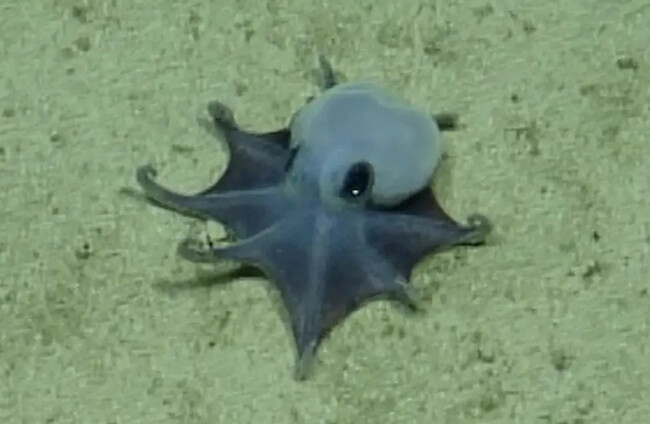
The new species of octopus, 5,800 feet deep in the ocean near Darwin Island Charles Darwin Foundation.

Tiny, blue, golf ball-sized octopus confirmed as new deep-sea species

The tiny octopus was discovered in the Galápagos Islands off the coast of Ecuador.

A TINY BLUE octopus that could curl up and fit in the palm of your hand has been confirmed as a new deep-sea species.  

The new species, Microeledone galapagensis, has been announced in a paper in the journal Zootaxa.

The octopus was first spotted in 2015 during a deep-sea expedition of the Galápagos Islands off the coast of Ecuador.

The Galápagos Islands are home to more than a thousand plant and animal species found nowhere else on Earth, such as marine iguanas and giant tortoises.

Back in 2015, the crew on board the E/V Nautilus used a remotely operated underwater robot to explore the ocean floor near Darwin Island.

Darwin Island is at the northern edge of the Galápagos archipelago and named after the biologist whose work there helped him formulate the theory of evolution.

As the remotely operated vehicle (ROV) camera moved over the sea floor near an underwater mountain, 5,800ft below the water’s surface, the researchers noticed a tiny blue octopus.

The crew was able to collect the octopus and captured footage of two others that looked like it.

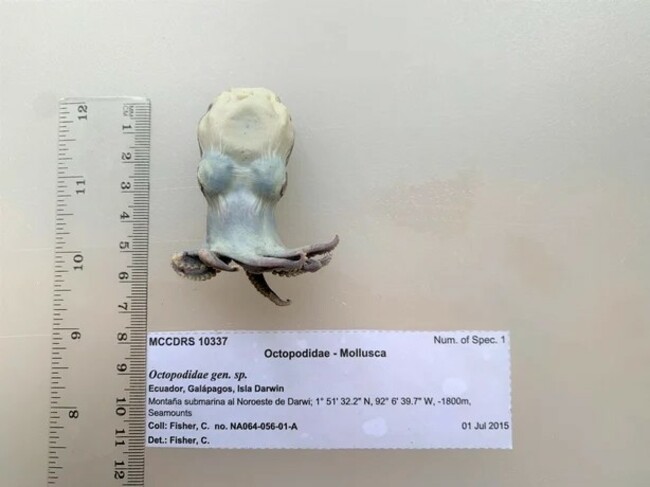
They brought the tiny blue octopus, which is about the size of a golf ball, to the Charles Darwnin Research Station, but the crew was unsure which species it belonged to.

The crew contacted Janet Voight, who is curator emerita of invertebrates at the Field Museum in Chicago and the lead author of the study describing the new species. 

The research team in Galápagos had preserved the octopus’s body in alcohol and formalin and sent the specimen to Chicago for Voight to examine.

Voight said she knew it was “something really special right away”.

“I’d never seen anything like it,” she added.

But the one-of-a-kind specimen posed difficulties for Voight, who wanted to keep the octopus intact.

“When you describe a new species of octopus, you have to look at all the parts, including the mouth, the beak, and the teeth,” explained Voight.

“And to see those things, you have to cut the specimen open. We only had the one specimen, so I didn’t want to take it apart.”

Voight used Field’s Museum’s X-ray computed tomography laboratory to create micro CT scans of the octopus and “virtually open” it instead.

With CT imaging, thousands of X-rayed slices of an object are digitally compiled to create a 3D model of that object, inside and out.

This allows researchers to reveal what’s inside an object without cutting it open.

ct scan CT scans were used to allow researchers to reveal what’s inside the octopus without cutting it open. Charles Darwin Foundation Charles Darwin Foundation

In the case of the tiny blue octopus, the researchers were able to see fine details of its internal organs, including its mouth, that helped provide the information needed to declare it a new species.

Across her four-decade career in studying octopus evolution, this is the first new octopus species that Voight has officially led a team of scientists in describing.

“These are little octopuses that live in the deep sea, and hardly anybody on Earth has ever got to see them,” said Voight.

“I just feel lucky that I got to work with them.”

She noted that there are still vase expanses of the sea to discover.

“If you took all the land on Earth and pieced it together, you would not cover the Pacific Ocean,” said Voight.

“The oceans are so big, and there’s so much left to explore.”

Salome Buglass, co-author of the paper, remarked that “getting the specimen to Janet was a long process”.

“But one I would gladly repeat,” he added, “if it means getting to know the most precious parts of our ocean just a little bit better.

“Discoveries like these remind us how much of the deep ocean in Galápagos remains unexplored.

“Every new species helps us better understand these hidden ecosystems and why protecting them matters.”

Readers like you are keeping these stories free for everyone...
A mix of advertising and supporting contributions helps keep paywalls away from valuable information like this article. Over 5,000 readers like you have already stepped up and support us with a monthly payment or a once-off donation.

Close
9 Comments
This is YOUR comments community. Stay civil, stay constructive, stay on topic. Please familiarise yourself with our comments policy here before taking part.
Leave a Comment
    Submit a report
    Please help us understand how this comment violates our community guidelines.
    Thank you for the feedback
    Your feedback has been sent to our team for review.

    Leave a commentcancel

     
    JournalTv
    News in 60 seconds