Sign in. It’s quick, free and it’s up to you.
An account is an optional way to support the work we do. Find out more.
Sign in. It’s quick, free and it’s up to you.
An account is an optional way to support the work we do. Find out more.
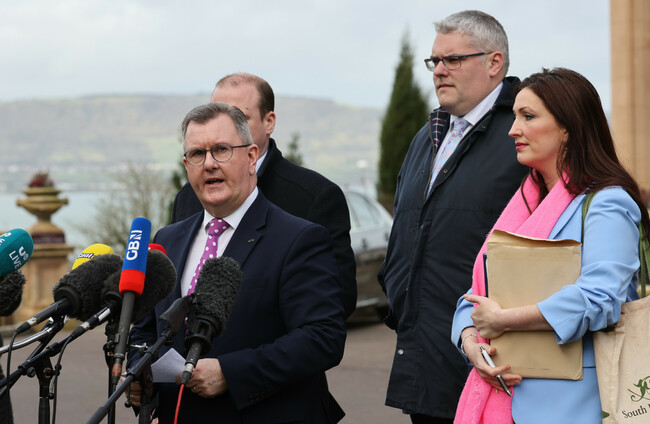
AFTER MONTHS OF backdoor negotiations, a deal on the Northern Ireland Protocol appears to be in sight.
Last minute trips by the UK Prime Minister and the Foreign Secretary to Belfast and Brussels respectively seem to indicate that a deal between the UK and EU appears to be inching closer to completion.
Yesterday, Rishi Sunak landed in Belfast and held late night meetings with political leaders in Northern Ireland, with the DUP acknowledging that progress was being made.
DUP leader Jeffrey Donaldson told reporters this afternoon that “progress has been made across a range of issues” but that there are ”still some areas where further work is required” to get a deal across the line.
“The decisions that will be taken by the Prime Minister and by the European Commission will either consign Northern Ireland to more division or they will clear a path towards healing and towards the restoration of the political institutions,” Donaldson said.
He said that the DUP had not yet seen the text of any potential agreement and that more negotiations were due to take place.
Just before Donaldson spoke, EU Commission Vice President Maros Sefcovic and UK Foreign Secretary James Cleverly held talks which have been described as “constructive”.
Good to see Foreign Secretary @JamesCleverly again to take stock of the work on the Protocol on IE/NI.
— Maroš Šefčovič🇪🇺 (@MarosSefcovic) February 17, 2023
Constructive engagement. Good progress. The shared objective clear: joint solutions, responding to the everyday concerns of people in NI.
Hard work continues. pic.twitter.com/1aOrNuHQRu
In a tweet, Sefcovic said that the joint aim of the EU and UK Government was “responding to the everyday concerns of people in NI”.
Speculation is continuing that a deal may be complete between the EU and UK as early as next week.
However, the main question is whether or not the DUP will back the deal or continue to block and prevent the restoration of the Stormont Executive and Assembly.
Currently, the party is vetoing the establishment of the Assembly over its concerns about the Protocol, particularly over the border in the Irish Sea.
The party contests that this is separating Northern Ireland from the rest of the UK and breaks down the existing union.
To get the DUP to back a deal, the party says that it needs to meet its “seven tests”, which include removing trade barriers between the UK and Northern Ireland alongside preventing a border in the Irish Sea.
Whether or not the deal will meet these key tests is yet to be seen, and even if it does, the issue of reforming the Executive remains an issue.
With Sinn Féin being the largest party, Michelle O’Neill is entitled to take up the role of First Minister, while the DUP will receive the Deputy First Minister role.
While the positions are equal and one cannot be in place without the other, the symbolism of a nationalist First Minister may still be too much for the DUP.
Commentator and former Ulster Unionist Party communications director, Alex Kane, told RTÉ Radio One that the immediate challenge will be for Sunak to sell a prospective deal to the House of Commons.
However, Sunak does have the backing of the Labour Party, with Keir Starmer previously confirming that he would provide the votes to get any deal through the House of Commons.
The Labour leader said that he was willing to provide “political cover” to Sunak and encouraged him to stand up to the European Research Group (ERG), which he referred to as a “Brexit purity cult”.
Kane believes that hardline Tory MPs within the ERG are likely to be even more hardline, due to guilt over their support of the Northern Ireland Protocol three years ago.
“There are still members of the ERG – the hardest of the hard Brexiteers – some of whom voted for the Protocol three years ago and who are feeling a terrible pang of guilt about this, feel that somehow they have to be even more hardline that they were before,” Kane said.
But, Kane added that he believed Sunak was at a point where getting the deal through the House of Commons would not be an issue and this is where problems for the DUP lie.
“If that is the case, that becomes the big problem for the DUP because then it’s the DUP vs the United Kingdom Government of a sovereign parliament and that is their nightmare.”
While there does appear to be some light at the end of the Northern Ireland Protocol tunnel, we are not quite out the gap yet.

To embed this post, copy the code below on your site













have your say