We need your help now

Support from readers like you keeps The Journal open.

You are visiting us because we have something you value. Independent, unbiased news that tells the truth. Advertising revenue goes some way to support our mission, but this year it has not been enough.

If you've seen value in our reporting, please contribute what you can, so we can continue to produce accurate and meaningful journalism. For everyone who needs it.

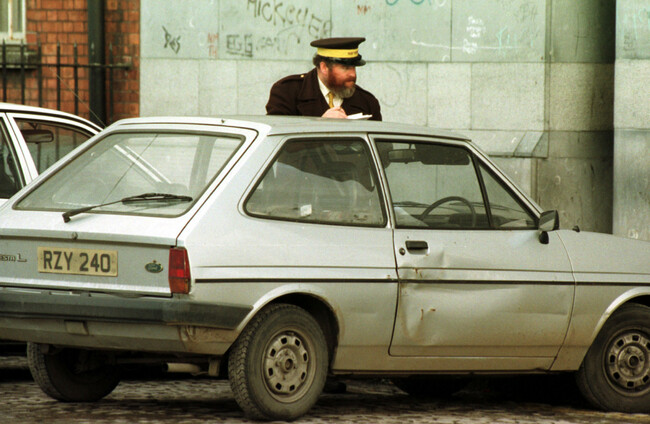
A traffic warden hands out a parking ticket to a Ford Fiesta in 1997. RollingNews.ie

Motoring When it comes to cars, we are often guilty of buying more than we need

Over the past four decades, the family car has grown taller, wider and heavier — and the consequences are playing out everywhere from rural roads to Dublin multi-storeys.

YOU NOTICE IT most in the car park. Not on the dealer’s forecourt. Not when you’re scrolling through photos online. But when you’re trying to swing into a space under St. Stephen’s Green or at Jervis Street. Mirrors folded in. Hip twisted sideways to squeeze out. Yes in my case it is not helped by a touch of middle age spread, but you are left doing your best to avoid a door ding or the crunch of an expensive alloy wheel. 

Despite the addition of an arsenal of cameras and parking sensors to many new models, it feels like parking has gotten harder. It hasn’t. The cars have gotten bigger. And they keep getting bigger because that it seems, is what we want. 

The average family car in Ireland today isn’t a compact hatchback anymore. It’s a crossover SUV. The Hyundai Tucson, the most popular new car in the country for the past five years or so, is about 4.5 metres long and 1.86 metres wide. It weighs between 1.6 and 1.75 tonnes. That is now the default Irish family car. And it weighs about the same as the original Land Rover Defender. 

When I was growing up things were a little different. Compare that to the Ford Escort, Volkswagen Golf or Toyota Corolla of the 1980s and 1990s. Those were around four metres long, roughly 1.6 metres wide, and weighed just under or just over a tonne. They were small because the world they moved through was small. They fit our roads, our estates, our school gates and our multi-storeys.

The Golf, the car that once defined “average”, has grown from 3.7 metres to more than 4.2 metres over its lifetime. You only have to go back a mere ten years to 2015 and the top-selling model in Ireland was the Volkswagen Golf and the Ford Focus was in second place. Ten years later, the Golf lies in 10th place and Ford will cease production of the Focus this month. They’ve already binned the much-loved Fiesta in favour of, you’ve guessed it, an SUV. 

This shift didn’t feel dramatic because it didn’t happen at once. It came gradually, generation by generation. The cars grew, but the spaces around them didn’t. You can notice when you go into Dublin Airport T1. Built in the early 1970s, when cars like the Mark 1 Ford Escort, Mini and Morris Minor were plentiful, they perhaps didn’t imagine that 50+ years later they’d be taking cars that are in some cases half a metre wider. 

But the story isn’t simply that cars got bigger for the sake of it. A crash in the 1970s was a very different event to a crash today. No airbags. Thin doors. A-pillars that folded like paper. The steering column didn’t collapse. Side impacts transferred straight through steel and into bodies. Survival often came down to plain luck. Drive any classic car and aside from the overwhelming smell of mustiness and fuel, comes the feeling of fragility. 

Modern cars are heavier because they are built to give you time inside a crash. Time for airbags to fire. Time for crumple zones to deform in stages. Time for the cabin to stay intact. Safety engineering has mass. Stronger doors, reinforced floors, and roof structures thick enough to hold the car’s weight upside-down all add weight. So do batteries, sensors, airbags, and electronic stability systems. 

But these are all things that prevent you and your very delicate family’s bones and organs from bearing the brunt of an impact. 

And before we get too misty-eyed about the past, remember that in 1985, 410 people lost their lives on Irish roads; by 2015, that figure had fallen to 165 — a 60% reduction in annual deaths. This progress was achieved even as traffic volumes and population grew substantially over the same period. The 2015 total was less than half the level recorded in 2005 (396 deaths), marking a 58% drop in just ten years. 

So yes — cars got heavier because they got safer. But safety wasn’t where the growth stopped. 

Once cars got taller and wider for safety, we discovered that big feels good.

A higher driving position feels more secure. Thick doors feel reassuring. The wide stance feels planted. And people bought that feeling, for reasons that are emotional as much as practical.

A quick survey of the SIMI New Car Sales figures show that a combination of both small and medium SUVs make up more than 56% of new car sales. Of the most popular cars searched for on DoneDeal Cars website you will find the list littered with mid-size SUVs, although thankfully the sensible Volkswagen Golf remains Number 1. 

That’s how the family car shifted from a hatchback to a crossover. Not because families suddenly needed more metal — but because the experience of size became part of the appeal. But there are inevitable consequences. 

On rural roads – often carved out of the landscape long before the car was even dreamt up – two SUVs meeting head-on often becomes a negotiation. Someone reverses. Someone goes into the hedge. Someone scrapes a wheel on gravel. The boreen didn’t change. The cars did.

In Dublin, most multi-storey car parks were built in the 1970s and 80s for cars that were 1.65 metres wide. According to Dublin City Council’s design standards, short-stay or retail parking bays must measure 2.5 metres in width and 4.75 metres in length. These dimensions are set out under Section 16.38.9 of the Dublin City Development Plan, which governs off-street car-parking design within the city. The Council specifies that no bay should ever be narrower than 2.4 metres, even for long-term parking, to allow adequate space for vehicle doors to open safely and for pedestrians to pass between cars. 

The big-selling Tucson is 1.86 metres before you even unfold the mirrors. But I am not picking on the Tucson, the likes of the Kia Sportage, Toyota RAV4 and Volkswagen ID.4 are all of a similar size. If you buy a Range Rover it is over 5 metres long 2.2 metres wide without the mirror folded. In a typical Dublin bay, that leaves less than 15 cm of clearance on either side and the vehicle itself overhangs the space slightly in length. It’s a vivid example of how today’s larger vehicles are pushing against infrastructure designed for an earlier era of motoring.

We are moving to EVs at a gathering pace and this puts Green campaigners in a mixed position. They, like any right-minded person, welcome the absence of tailpipe emissions, but with EV technology comes weight and size. Many of the new EVs weigh well over 2 tonnes and are pretty large and this takes up more space, especially on Dublin’s Medieval and Georgian Streets, where cyclists often compete for space. 

And despite the fact that many of them will absorb the impact of a pedestrian much better than a Fiesta in the 1970s and will start to brake even before you’ve noticed the pedestrian, you don’t need to resurrect Newton to grasp the basic point: more mass equals more force. A two-tonne family SUV carries far more energy into a collision than a 700kg hatchback ever did.

Big cars also consume more energy — whether petrol, diesel or electric. EVs solve tailpipe emissions, but a heavier car needs a bigger battery, and a bigger battery adds weight again. The wins are real — but so are the trade-offs.

If proposals by the Tax Strategy Group of the Department of Finance come to pass, we might soon be taxed, in part, for the weight of our vehicles. They won’t be EVs at first, under the proposals, but you would be foolish to think that won’t come, given the drop in VRT (Vehicle Registration Tax) earnings of late. 

Let me be clear. This isn’t a call to ban crossovers or shame the school run. People buy what works for their lives, their families, their sense of comfort and safety. But we are often guilty of buying more than we need.

There is a new raft of excellent small EVs on the market that are safe, comfortable, well-equipped and ideal for city use. The BYD Dolphin Surf, Hyundai Inster and Citroen eC3 are some examples that don’t cost the earth or take up too much space in it either. 

But it is worth recognising the shift. Because our infrastructure didn’t grow to match the cars that now use it. We built cars to fit the world. Then the cars got bigger. And at some point, something will have to give.

Paddy Comyn is the Head of Automotive Content and Communications with DoneDeal Cars. He has been involved in the Irish Motor Industry for more than 25 years. 

Note: Journal Media Ltd has shareholders in common with Done Deal Ltd

Readers like you are keeping these stories free for everyone...
A mix of advertising and supporting contributions helps keep paywalls away from valuable information like this article. Over 5,000 readers like you have already stepped up and support us with a monthly payment or a once-off donation.

View 47 comments
Close
47 Comments
This is YOUR comments community. Stay civil, stay constructive, stay on topic. Please familiarise yourself with our comments policy here before taking part.
Leave a Comment
    Submit a report
    Please help us understand how this comment violates our community guidelines.
    Thank you for the feedback
    Your feedback has been sent to our team for review.

    Leave a commentcancel

     
    JournalTv
    News in 60 seconds