TheJournal.ie uses cookies. By continuing to browse this site you are agreeing to our use of cookies. Click here to find out more »
Dublin: 8 °C Friday 24 May, 2013

Column: Another Priory Hall is coming down the tracks. Here’s why.

Phil Hogan is planning to introduce new regulations which are meant to make for better buildings. He’s making a major mistake, writes Mike Morris.

Mike Morris

WHILE THE RAMIFICATIONS of Priory Hall are still being felt, one of the least becoming aspects of the fallout was the fingerpointing that followed the emergence of the story.

And yet it’s fair to say that one of the most-publicised facts of the appalling Priory Hall affair, however, was that the building was not inspected by anyone during construction –  and yet certificates of compliance were produced by an architect, based on a cursory visual inspection and (effectively) the contractor’s word of honour. Most frighteningly this was not even an unusual situation.

The Draft Building Control (Amendment) Regulations - essentially a response to Priory Hall – are currently available for public consultation, with submissions by the Department of the Environment being accepted until this Thursday 24 May.  Among other measures, they contain new, statutory certificates of compliance for all buildings.

This was promised in the Irish Times by Minister Hogan himself: “These mandatory certificates will mean what they say,” he wrote, in an article on 27 October 2011. Priory Hall was a watershed moment, and one thing on which the cacophony of voices agreed was that Things Had To Change.

There’s no doubt that the intention of the new regulations is to do just that. So it’s all the more shocking, then, that the draft regulations misunderstand the sickness at the heart of the regulation system so badly that they may well make things worse.

What’s in these plans by Minister Hogan- and why they’re unworkable

Mylan jobs announcement

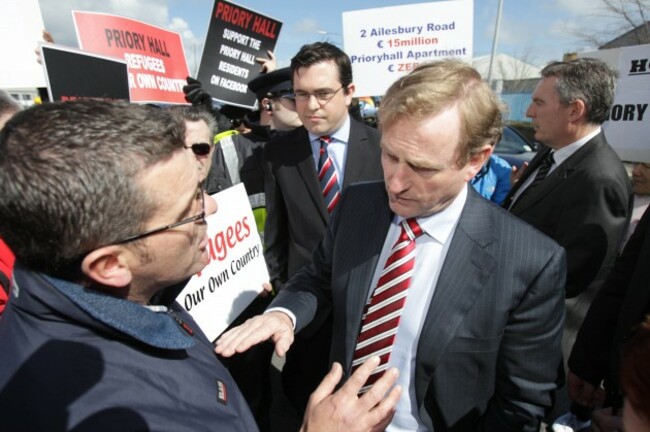
(Taoiseach Enda Kenny speaks to former Priory Hall resident Darren Kelly last month. Photo: Niall Carson/PA Wire)

The premise of the draft legislation is that a “properly qualified person” (an architect, engineer, or surveyor) should regularly inspect a building and warrant that it has been built without defect. Should this turn out not to be the case, the assigned professional is liable for financial restitution and prosecution. This seems to provide the tough regulation beloved by government posturing – but dig beneath the surface and the defects become obvious.

No designer can ever guarantee a building has been built to perfection, simply because they are not the ones who have built the building. To even begin to make such a statement, such a person would have to be on-site full-time for the entirety of the construction period; a house extension would require an client to pay an architect or engineer to be on-site, full-time, for several months. Even this, in practice, would not be enough – an architect is not qualified to know that a boiler is not defective, and an engineer cannot reasonably say for certain that a window will not leak. The very principle of asking someone to vouch for the work of someone else is desperately flawed, and legal advice taken by the RIAI suggests this may be uninsurable. We are in the realms of the ridiculous here.

The real story, though, is what the legislation doesn’t do. There was no shortage of comment after Priory Hall, but amid the search for blame, little attention was paid to this key point: had the builders behind Priory Hall not gone bust, there was little or nothing to stop them building even more apartments. There is no licensing of builders in the country. Bodies such as the Construction Industry Federation perform some of this function, but membership is not mandatory. Anyone can call themselves a builder, and this proposal does nothing to change that.

“I have been an architect for ten years… and I have never seen a Building Inspector”

What makes this worse is the lack of enforcement in the sector. Currently, a mere 12-15 per cent of buildings are supposedly inspected (Minister Hogan’s article promised “pooling of resources” to combat the problem, presumably under the impression that there are hundreds of Building Inspectors sitting idle somewhere in Leitrim).

There is little substantiation of even that figure, and most within the industry find it questionable.Anecdotal evidence time: I have been an architect for ten years, on projects of a combined value of over €50m, and I have never seen a Building Inspector. Most of my peers say the same. Similarly, while figures are not readily available for prosecutions under the Building Control Act, I have never heard of a prosecution.

Again, nothing has been done about this. The draft legislation expects designers to inspect properties, but designers cannot bring prosecutions against contractors. This does not constitute “enforcement” – it’s more like expecting traffic wardens to bring an end to speeding offences… in a country with no driving licences.

What needs to change

It is long past time the issue of Building Control was taken seriously. We should at least be talking of the following: a National Building Inspectorate, examining at least 40 per cent of all buildings under construction; a system of licensing or registration for builders; full prosecutions of all designers or builders who are in any way negligent of their duties, and public statistics of the same; an open register of all buildings that have been inspected, free for the public to view; and education of the public so that they know exactly their entitlements when building, or when buying a new-build property.

Instead we, have a perverse document that places the onus for proper building onto people who cannot possibly enforce it, and does nothing to increase state inspection and enforcement of building. If initiated as it is it could well lead to chaos, with buildings left uncertified as no professionals are prepared to sign the certificates required of them.

This is not about professionals, though; it’s about people. What do we have, from the point of view of the ordinary person? Well, it’s a reasonable assumption that the mooted legislation will not in fact come to pass, and that the Draft Regulations will be amended to produce certificates that designers can reasonably sign.

This will then just amount to an empty exercise in kicking the can down the road, a document that does not strengthen enforcement or inspection in any meaningful way whatsoever, a document which insults the Priory Hall residents it purports to protect… and in ten or twenty or thirty years, another high-profile news story of some other shoddy building will reveal that nothing whatsoever has changed. More finger-pointing; more innocent people left homeless or worse.

Failure to institute proper building control now is unforgivable. The excuses have run out, and what has been presented is more of the same. Enough of this.

Mike Morris is a registered architect and Member of the RIAI. He is writing here in a personal capacity.

Read next:

Comments (18 Comments)

  • As a Structural Design Engineer I could not agree more with the article and the vast majority of commenters here. Where as the design codes preach best practise and minimum standards what happens in an eceptional (albeit hypothetical) scenario where the code itself is at fault and not the designer nor builder nor inspector? Why, as stated above, should the collective work of all the various people, companies and civil authorities on site be made the responsibility of only one member of the design team? I know that under these set of regulations I would point blank refuse to inspect and certify a building as there is far too much room for error beyond any kind of practical reason. Were the IEI (of which I am a member), RIAI (of which the writer is a member), the CIF, the SCSI or anyone from the industry involved in compiling these regulations? Yes people should be responsible for their work however making someone a scape goat is not going to help, only hinder. One other point to make is that there is no protection of the above titles in statute. Anyone in Ireland can walk in the morning and simply decide to call themselves and Engineer if they so fancied. This needs regulation first before any measure like the above is tackled.

    Reply
  • How can an architect be responsible for the shortcuts taken by cowboys while their backs are turned. Sure, a lot of work can be visually inspected and approved but what about the workmanship that cannot be seen. We all know that builders hide dodgy workmanship from inspectors by covering their tracks before an inspector arrives on site. I’m more interested in what Mr Hogan intends to do about the fact that “anyone” can be a builder/ developer whereas in almost every other sector I can think of a person has to qualified ( or suitably trained) to be do his/her work.

    Reply
  • We are years behind d uk, us & Canada in building control whereby state officials inspect at every stage different aspects and issue certs. Yes it may slow builders down a bit but adds certainty in long run of building quality! And also detailed construction stage drawings aren’t generally submitted for analysis by d local authority as in the uk..

    Reply
    • We have enough legislation enforcement is the problem. By introducing more of this will create more corruption not less.

      Reply
    • Where are all those soft talking ”reputable” suited Estate Agents who made huge commissions selling these overpriced death traps to these unfortunate people??
      Where are their inhouse mortgage brokers with their 100% interest only mortgage products?
      They cant be all doing receivership and repossession work for the Banks these days?
      Or can they?
      http://www.youtube.com/watch?v=mspzKgDoWGI&feature=BFa&list=HL1337713121

      Reply
    • Let us not forget, most of these death traps were inspected and valued by these Estate Agents for mortgages and remortgages at the banks behest.
      Where is their accountability in this situation?

      Reply
    • All I can say is that I hope that if someone loses their life in a pyrite home the developer and his foreman should be held to account in the criminal courts. Its absolutely that there is no clark of works on every building site regardless of wether it is a public or private development.

      Reply
    • Hi Donny. In my experience from working on site the inspection of work does not slow the builder down. We sub let the inspections the same we’d sub let any package. The inspector then becomes one of our many consultants and his work is scheduled in accordance with or programme of works. Also it is false that detailed drawings are submitted to council during planning especially if the job is design and build, however the council and the end user is supplied with a set of ‘as built’ drawings prior to practical completion, again this does not hinder the builder in any way.

      Reply
  • As an apartment owner who has actually read the Draft Regs, I couldn’t agree more with the points made in this article. The new Regs dont go anywhere near dealing with the so called Building Controls that allowed Priory Hall to happen.

    Reply
  • Excellent article. Phil Hogan IMO is deliberately ignoring the real lessons of Priory Hall. Without proper inspection & enforcement new legislation won’t be effective. Local Councils abdicated responsibility by not bothering to carry out inspections despite taking in large levies on homes sold. DOE did in fact inspect Priory Hall before it was occupied but didn’t follow up on serious defects found. The proposed new legislation is a cop out to devert attention from state failures.

    Reply
  • These draft regulations were produced by overpaid civil servants in the department attempting to divert blame for any future Priory Hall fiascos away from themselves and their inspectors who seldom inspect properties.

    Reply
    • Kairnbury you have hit the nail on the head there….. Nothing will change while this and subsequent governments Pay or should I say over pay advisors and incompetent top civil servants who obviously have no qualifications about engineering and construction making decisions about subjects these Ministers have not got a clue about and that is exactly where we the Irish have been making our mistakes. The advisors should be qualified in the subject that they are advising on and each minister should have some form of business managerial skills

      Reply
  • These proposed regulations are an attempt by the government to absolve them of all responsibility. The simple truth is that INSPECTION and ENFORCEMENT are the only way to ensure that the Pyrite epidemic and Priory Hall don’t ever happen again. As it stands with these proposals not only is the architect fully liable (which is ridiculous as mike has explained) but also if we have a problem in the magnitude of the Pyrite epidemic or Priory Hall the indemnity insurance will not come close to addressing the problem and again leaves the homeowner high and dry with no legal redress. The government need to accept responsibility if we are going to have any guarantee and assurance of quality housing stock into the future. The government have to accept that they have a role to play.

    Reply
  • This is just exonerating builders and civil servants. It anti-social.

    Reply
  • Aurfur 22/05/12 #

    In England with tight planning Ronan Point Disaster, the higher alumnia cement fiasco weren’t stopped by the regulations. Nor are cowboy builders stopped. If caught they just go bankrupt.

    Building regulations are sufficient if applied. Unfortunately no amount of regulation will prevent criminals who are determined to deliberately flout the laws for personal gain.

    The housing market is so deflated in Ireland complex regulations and guarantees will depress it further. The buck should clearly stop with the developer but if he goes bust or the home bond doesn’t cover the defect then little can be done. I can’t see anyone ever guaranteeing another persons work with virtually an open cheque. As always let the buyer beware is the best advice.

    Reply
  • Surely there are two problems here:

    1. ANYBODY can describe themselves as a builder and qualify as such, regardless. Which really raises the question of how anybody can justify the obscene wage levels paid to such workers during the boom and afterwards, given that truly skilled workers in most industries rarely get paid that well.

    2. The building trade is in very thin showing at the moment – I suspect the government daren’t rock the boat by challenging poor workmanship for fear of retaliatory liquidations and bankruptcies. As a result builders are still able to hold the coutnry to ransom by the threat of shutdowns and further job losses.

    Reply
  • Laws do not solve problems. Governments have little understanding of true problem solving otherwise they wouldn’t be doing this. Even a national body of building control wouldn’t correct the poblem entirely. I would propose that we move construction away from an on site mentality and move towards a manufactured product. Created in a controlled environment and then bolted together where needed in as simple and full proof method as possible. Its allready been developed on a small scale and could easily become the norm. The quality control onus is on the manufacturer rather than an unregulated ‘builder’ who takes delight at cutting corners and making money at other peoples expense (and consistently gets away with it.)

    Reply
  • Excellant article Mike.
    I was a member of the RIAI and now ARB. I have been working in the UK as an architect for the last 4 years and believe the Building Control regulatory system here is quite effective and well worth investigating as an example of what can be done.
    The draft building control legislations the Irish Government is proposing is as usual reactionary and lacking any true understanding as to the full facts of the situation.

    Reply

Add New Comment