TheJournal.ie uses cookies. By continuing to browse this site you are agreeing to our use of cookies. Click here to find out more »
Dublin: 9 °C Tuesday 21 May, 2013

Column: Rent supplement is supporting squalor – and keeping prices high

Through rent supplement the Government pays for an enormous amount of housing, writes Ronan Lyons. So why isn’t it using that to our advantage?

Ronan Lyons

I LIVE IN rented accommodation on the North Circular Road in Dublin.

Our house is split into two, a one-bedroom apartment downstairs in the basement and our own home over two floors on top. Two doors up, a slightly larger house, with an extension at the back, contains seventeen bedsits. Yes, you read that right: 17! This modern urban tenement is being sustained entirely by the taxpayer, as only those on rent supplement live in the cramped accommodation that the house offers. Why is it, when the private market has moved on to higher standards of accommodation, that the taxpayer is funding the worst kind of accommodation?

Rent Supplement: the story so far

A couple of weeks ago, the latest Daft.ie rental figures came out. The picture was one of stabilising rents, particularly in the urban areas and in the larger homes segments, with rents actually rising in some markets. However, there is something of an asterisk attached to all of this. Whatever about segments where rents are increasing, stabilising rents may reflect as much government intervention in the market as it does stable demand. For those not familiar with rent supplement, a system of state-provided rent supplement is available to the unemployed, with maximum rents which vary by local authority area. Effectively, if you’re on this scheme, you can rent properties with monthly rents up to those indicated.

This is a huge scheme. The Department of Social Protection in Ireland funds about half the private tenants in the residential lettings market in the country: in June 2011, there were 97,000 recipients of rent supplement nationwide. As of the 2006 Census, there were just 150,000 households privately renting in the country.

Even if that is an underestimate and the true figure was 200,000 and has since grown to 300,000 (which would require the ‘would-have-been first-time-buyer’ cohort to grow significantly faster than the ‘we came here to build properties and have since headed home’ cohort), the Department controls a third of the market. This is huge market power. And just like in the case of electricity, where the same Department is trying to get a better discount out of the ESB than the current meagre 1%, the Department should use it to the advantage of the taxpayer.

But this is about more than just using market power for the benefit of the taxpayer. This is about a potential price floor, which keeps the cost of accommodation higher for all tenants and thus reduces Ireland’s competitiveness.

This is because there is no incentive for a tenant on rent supplement to see their rent reduced, as their likely contribution stays at €24 a month.

Are taxpayers paying for a price floor?

So, as rents generally fell by 25% over the course of 2008 and 2009, they got closer and closer to a point where working tenants could effectively be outbid by welfare tenants. Granted, rent supplement has been cut twice since 2007. The first time, in the Supplementary Budget for April 2009, it was effectively cut across the board by 8%. The second time, in June 2010, maximum supplements were cut in many cohorts but not for single persons (i.e. not for one-bedroom accommodation).

Overall, since 2007, maximum rent supplements have fallen by an average of 14% across the country. However, rents have fallen by closer to 30% for most types of accommodation. The result is that, for one-bedroom properties in particular, taxpayers may now be artificially propping up rents… and footing the bill.

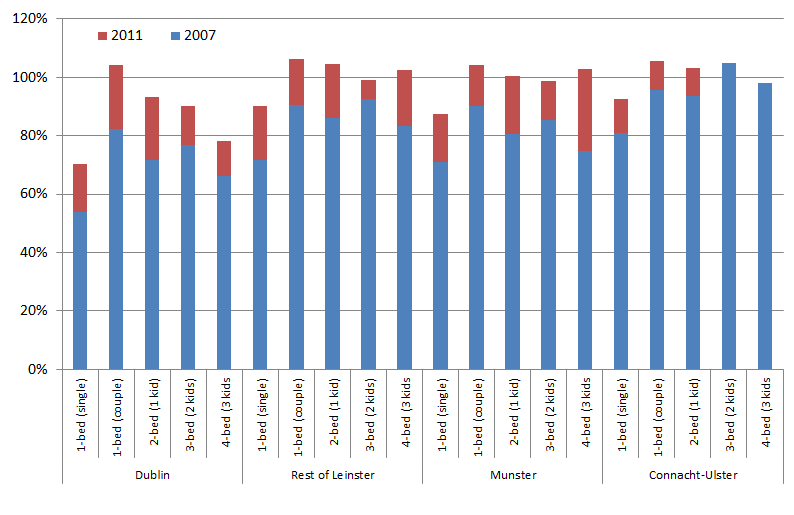
To see this, consider the chart below. It shows how the maximum rent supplement compares to the average rent, both at the peak of the market in late 2007 (the blue line) and now (the red line). The closer to 100% it gets, the more the taxpayer has set a floor on rents, as those who are ambivalent to higher rents (those on rent supplement) can outbid the average working tenant.

(Notes for the graph are below)

As you can see, despite the reductions in the supplement, there has been a definite drift towards supplement acting as a price floor. The only segments where this has not occurred (in Connacht and Ulster in 3-4 bedroom homes) were among those segments most distorted to begin with, with rent supplement covering effectively the average mortgage on average.

The most noticeable increases, i.e. where the potential is greatest for a distorted market where there was none previously, have been in Leinster and Munster. Where rent supplement had traditionally been 80% of the average rent, it is now 100% or greater. This is particularly acute in the two-bedroom segment, where every single local authority has maximum supplements for a couple above the average rent paid. If I’d compared single person supplement with bedsit rents (not one-bed accommodation), the problem in that segment would look equally serious. The short version is: welfare tenants – with no incentive to haggle down their rents – are easily able to outbid working tenants.

And yet lower rents may be wishful thinking (for some)…

I would be careful about believing that reform of rent supplement will push rents significantly further down in all segments. Within Dublin, for example, there is a noticeable difference between Dublin’s southside, where maximum supplements are still just 50%-75% of average rents, and the North city and West Dublin regions, where particularly for two, three and four-bedroom homes, the figure is over 100%. Where rents are well above supplement rates and not only stable but rising at the moment, there’s little to think that reduction in supplement rates will have an impact.

Added to this, it may also be the case that working tenants and welfare tenants form separate markets, at least in some parts of the country. On daft.ie, those listing their ads can state whether they will accept rent supplement. Only one in six do, meaning that there are large cohorts of landlords who are not interested given the perceived extra costs associated with Rent Supplement tenants. (There are also, presumably, many roll-over Rent Supplement landlords, who don’t need to advertise on daft.ie.)

What to do next?

Ultimately, the problem here is that Rent Supplement tenants are currently being sent into transactions with their landlord, without any incentive to haggle the rent down. The cost, as ever, falls on the taxpayer. Reforming Rent Supplement without addressing this is just a stop-gap.

It’s my own belief that rent supplement should be incorporated into general welfare payments, or ‘social income’ and that this income should be treated as taxable. This would level the playing field between workers and welfare recipients and make it far easier for someone coming back into employment to take a job offer. It would also encourage Rent Supplement recipients to haggle on their rent, as they would see some of the savings.

Clearly, there are issues about those on Rent Supplement regarded as vulnerable, including those with addictions. However, that is not an excuse not to reform a broken system. Where there are vulnerable people in society, provisions should be made for making sure they are not damaged by lack of care for their welfare.

That property two doors up from me I mentioned at the start, the one with 17 bedsits, went on fire a few weeks ago. The woman who discovered the fire said to me out on the street “How can they allow people to live in accommodation like this?” And she lives there. One can hardly argue that the current system, which sustains properties such as that one, is working for our most vulnerable.

In the forthcoming budget, the Government has the opportunity to achieve a triple-win by reducing rent supplement. The first win is for the taxpayer: the taxpayer is currently spending about €500m a year on rent supplement for almost 100,000 tenants. Significant savings can be made as the Department uses its market power to lower rents. The second win is for the welfare tenant: by making better quality accommodation more affordable, society can at last move beyond the modern urban tenement.

The final win is for the working tenant and for Ireland’s competitiveness: while some tenants will see no reduction, particularly in family homes in the cities, many will enjoy collateral benefit from the Department using its market power. The glut of property in the country generally should mean Irish rents are cheap compared to other countries and thus the post-rent disposable income here compares favourably. This December, with the Budget, a major step in that direction can be taken.

Ronan Lyons is an Irish economist based at Oxford University, and runs the Economic Research unit at Daft.ie. You can read more articles on his blog, where this originally appeared.

Notes for the graph: (1) The figures include the €24 contribution provided by recipients on top of their supplement.  (2) This graph compares the market average with the local authority maximum. The Department of Social Protection tells me they expect those on rent supplement to find accommodation at the 40th percentile, i.e. at a quality a little below the market average. This means that the price floor is even more of an issue as they are competing with bigger budgets for accommodation that costs less than the average. (3) I’ve assumed that both singles and couples with no kids are in one-bedroom accommodation, and that an extra room is added for each child. Where singles are required by their local authority to live in bedsits, or where children are of the same gender meaning two adults and two kids are expected to share two-bedroom accommodation. Again, this would push the bars above higher, as the same household has a bigger budget for cheaper accommodation.)

Read next:

Comments (58 Comments)

  • I don’t know where this writer is getting his facts from. Either I have been singled out by my community welfare officer or the writer is simply wrong. I am on disability allowance for a serious spinal condition and had to give up work 2 1/2 years ago after paying taxes etc for 35 years. Six months ago I was advised in writing that unless I negotiated a rent reduction with my landlord my rent supplement would be cut off. I duly did as requested, negotiated a rent reduction of €75 per month and provided written evidence to my community welfare officer so I wouldn’t be thrown out on the street! I can’t see any greater incentive than that to negotiate a reduction in rent & thereby my rent allowance!! Am I the only person in Ireland that this has happened to or is the author of this article simply encouraging discrimination against genuine welfare recipients that are already under severe distress?

    Reply
  • A lot of information here … But it seems it is a racket for bad landlords to make easy money… I realise not all land lords are bad , but there are some who will not keep their properties in a reasonable condition and if they are guaranteed the rent then why should they have to keep the properties good. Is there some sort of check incorporated into the system , that the properties are examined annually before the landlords are passed?

    Reply
  • agreed, rent support is a support for landlords and banks at this stage

    Reply
  • And what about greedy landlords who won’t reduce rents no matter what !!

    Reply
  • As per Morgan Kelly rent supplement is whats stopping a whole wave of investment mortgage defaults…plus people on supplement do have to negotiate at the drop of a hat or be cut off or move out. It’s a very insecure situation for people.

    Reply
  • The community welfare officer (or relieving officer as some call it) is supposed to come round and check the property before supplement or allowance is awarded

    Reply
  • Otherwise known as the landlords dole

    Reply
  • due to recession hit on construction industry i am currently unemployed and without rent supplement life here would become extremely difficult because it already is even with it…

    Reply
  • Also when applying for rent allowance, each area has a certain limit to the price of the rent, which is usually very little so when someone is seeking rent allowance and they ask for to much off the social welfare they are refused and must find accommodation in the price bracket the social welfare approve of.

    Reply
  • And in addition to my previous comment I pay an additional € 124 per week for my rent – not €24!!!!

    Reply
  • The rents are generally too high in comparison to the caps on rent supp,if people can’t get landlord to sign on paper the capped rent figure (even if it is over this figure ) the rent supp won’t be approved,this leads to absolute shitboxes being the only option to rent as they fall under or on the rent cap,rent being too high is the prob not rent cap being too low

    Reply
    • That is true and people have to move into the worst housing areas with bad social implications for their families…drugs, anti-social behaviour etc. And all because of decisions made by the ruling class aided by lazy journalism like this, plus civil servants refusal to look at something outside their direct line of vision! Useless rich and semi-well off people making policy and commenting on things they’ve no idea about! Landlords and their tenants actually have to lie in order to keep the charade going and Government are well aware of people having to fork out massive rents as well as receive the rent allowance and it’s not that they’re living in palaces either!! The political system needs to be taken back into the people’s control and people need to get active in everything they can, unions (If you’re lucky enough to still have a job), community groups, local politics etc. and not expect others to make a stand for you. And when someone does make a stand get behind them and support them. Occupy everything! Not just your home!

      Reply
  • Well im not trying to be funny but there are jobs out there.some people just won’t do low paying jobs and that’s wrong. I was talking to a owner of topaz the other day and he said he couldn’t get staff.if there’s no work in your area I’m sorry but youll have to move to find work rather than relying on everyone else to support you.i have no problem with people on the social that worked all their lives.it the people who have been on it for years that should be targeted.amounts should decrease each year depending on how much you’ve contributed to the paye in your lifetime.people who have worked all their lives and are genuine should be looked after.

    Reply
    • Not sure about decreasing welfare payments ,but how about community service work or education .10hrs a week for those unemployed for a year , and increase it 5hrs a week for every year up to 30 or so hours ?

      Reply
  • For a minute I thought the journal was part of the government propaganda machine – is it their job to soften the public up for taking more from the poor. Many landlords will not take a cut because they cannot take a cut due to the size of the mortgages they are in hoc to. They may be prepared to say they will on paper so their tenants can keep claiming the rent allowance as many already do and then their tenants will have to make up the shortfall so they can stay in their homes.

    Reply
  • Rent supplement is a massive subsidy to people who bought investment properties during the boom and so to the banks, as by keeping a floor on rents it prevents buy-to-letters from defaulting on their mortgages. I’d say avoiding another wave of mortgage defaults figures strongly in the government’s calculations and they are essentially propping up the property market deliberately, yet again.

    This is another reason why the government should have fully nationalised the banking system and sorted out all this crap years ago. They should have taken over the banks completely, closed them down after paying paid off some money to creditors & writing off the rest & left investors hand back the keys for mortgaged unviable properties to a new state bank. Then the state would own a vast stock of social housing and could abolish the rent supplement scheme which is about the most stupid, inefficient way of housing people possible.

    Reply
  • A good column Ronan. Your proposal of converting this rental supplement into a social income, added on to dole, is a great idea and hopefully Joan Burton is taking note. She will probably just lower rent supplement levels like the last time though.

    Reply
  • It happens to be “experience” Matthew.

    I don’t care who rents provided they behave.

    Reply
  • Dont we, through NAMA, own thousands of houses ? How about putting a few bods to work finishing the ghost estates then rent them at minimal rates to those on welfare ,or does seem a little to sensible ?

    Reply
    • I like your thinking, community service work or education is a great idea. It would weed out the frauds who don’t want to work and help the genuine people who want to work. There should be more job clubs and a lot more internships too.

      Reply
    • Agreed Jeff; they’re are plenty of builders on the dole who could finish off these estates for their dole+ (like the Intern scheme). I understand that people will say “why should builders only work for that amount?” but there is more to work than a paycheck (which is of extreme importance I know) but there’s also the social aspect… having to get up in the morning, going out and meeting other adults in a productive environment, etc is a lot better than having nothing to do all day. And remember many people in low-paying jobs do those jobs, not only for the pittance they earn, but for the companionship they find in their work. (not that I’m an advocate of low wages. But if you earn less than 26k in this country, you haven’t much left after taxes and bills)

      It would also provide much housing stock for those who are desperately in need of social housing, via repossessions / can’t get a mortgage etc. I’m sure most people would eventually buy these homes from the state so eventually it’d somewhat pay back for itself.

      Reply
  • How about get jobs and support yourselves and stop scrounging off everyone else. I know not everybody is doing it but it really gets my goat when ” single mothers” claim rent allowance even though they are shacked up with their partners who are quite often working.

    Reply
    • Where are the jobs i live in the countryside not even a sniff of a job round here so where the hell are the jobs tell me ………..

      Reply
    • There is benefit fraud which is terrible, I feel it’s robbing your own country but there is a whole lot more brown envelopes and backhanders in government. Middle class people are paying the price for everything in tax. People on social welfare who are genuine are getting targeted.There is a lot of media propaganda turning people against each other instead of working on the problem. This country and its policies and social welfare and schemes are in serious need of reform. Instead every one is pointing fingers. The government did a lot of spending in the boom years and even after too, with claiming €3000 for dry cleaners expenses and staying in top hotels and Mary Harney- It emerged in November 2008, that Harney personally requested the use of the Government jet for a FÁS trip to Florida in 2004, at a cost of up to €80,000 to taxpayers. She travelled to Florida with senior FÁS executives, department officials, and her husband, Brian Geoghegan, and was receiving more than €100-a-day subsistence money from the taxpayer when FÁS picked up her hairdressing bill in a Florida hotel. Like all government ministers travelling abroad, she was entitled to a daily allowance for “incidental expenses”. How is this allowed.

      Reply
    • 1) Dob them in if you know of it going on,it’s fraud

      2) The system is lax so this goes on alot and people can get away with it

      Reply
  • There are good landlords, bad landlords, lazy landlords,…. The bedsit remains the easiest accommodation type to rent out. Many people prefer to have their own space. Bedsits are more sought after than one bed apartments or single rooms in house shares. I personally believe they should be replaced by studio flats (one room with ensuite and kitchenette).
    Bedsits were the easiest to let prior to rent supplements and will be if its abolished.

    Reply
  • In case you all have been living in a hole, it has already been signalled that rent supplement is going to be hit in the budget. That can happen in 2 ways. The rent cap is lowered hitting the landlord plus the tenant is made pay more from their social welfare. The entire scheme should never have evolved under Social Welfare. Housing is the councils job. CWOs were never and will never be environmental health officers .. Those who are responsible for housing standards. In reply to those that live in tenements… there is no need for that, there’s plenty of good accommodation available. This article appears to me to be a mish mash of truths and untruths and it begs the question ..what is its motive and where I’d it getting it’s information? Many landlords out there are paying mortgages with the proceeds of these allowances, which along with mortgage allowances are subsidising the banks. I think the general trust of the budget will be to force the banks and it’s debtors to work things out without state aid. So look forward to changes. Finally it’s systems and regulations that determine practice around any scheme not individual public servants. CWOs have no legal role in vetting standards of accommodation, they can just seek value for money and suggest that people don’t live in shitholes.

    Reply
  • Waffler 30/11/11 #

    surely rent supplement keeps rents down? i cant avail of it because my rent is too high

    Reply
  • You can not get rent allowance until after the accommodation has been seen. To inform yourself a simple glance at the rent supplement rates on the Citizen Information website followed up by a search on Daft for properties available at that price will show you exactly the state of play. It is not pretty.

    Reply
  • I found this article poorly researched. Would appreciate it if the author knew what he was talking before he published such a rubbish article that has and will misinform its readers.

    Reply
  • The person who wrote this article dose not have a clue. People on rent allowance pay €120 per month towards there rent not €24. This is another load of crap probable coming from the government just ahead of the budget to see how people feel about taking more money from the poor. why don’t TDs take a pay cut.

    Reply
    • Agree with you. This article is very badly written. Pick one slum house to justify another attack on the needy. There are very many people depending on the rent supplement to keep a roof over there head. Abolishing it will lead to complete collapse of the rental market with no properties available to rent as they will be tied up in repossession for years. This is a daft article written by DAFT.

      Reply
    • I think he might just have more of a clue than you!

      Reply
    • People on rent supp pay 24 in a week which equates to 104 in a calendar month. But since last budget, the swa rate reduced by 2 euro. All rent supp are calculated off this rate, not off the jobseekers rate. Basically this meant that the effective weekly contribution for vast majority of welfare recipients became 26 euro or 112.66 in a calendar month. Clever

      Reply
  • Ciaro 01/12/11 #

    Properties where rent allowance is paid ate inspected by the authorities, why are they not doing their job?

    Reply
  • I rent 4 properties.
    People who decide to filthy their own rooms usually do it to blame the landlord for the filth.
    Then they stop paying rent because the landlord is evil.
    No wonder we see “socail housing people need not apply”.

    Reply
  • they need to asses their staff in the sw and housing to giving council houses to young couple with children within a year and giving rent allowence within a few days and what ever else they wont and some single people are waiting years to get this kind of help!!!

    Reply
  • “This is because there is no incentive for a tenant on rent supplement to see their rent reduced, as their likely contribution stays at €24 a month.”

    That is a huge error in your research and serious underestimation of the income for those on social welfare and in receipt of the Rent Supplement. Also, did the author survey the tenants of this nearby modern-day tenement and verify that all tenants were in receipt of social welfare and rent supplement, or was this simply assumed?

    As it stands, the WEEKLY contribution has risen from 24 up to 30 euro per week, and the cap for a single person in shared accommodation has dropped from 390 to 300 euros, a massive drop of almost 25% that most tenants will find near impossible to negotiate with landlords. This will ultimately result in landlords putting down on paper lower rents than they are actually charging in order for the tenant to qualify for the supplement, a very common practice even before the recent cuts.

    Even if an individual who has been paying 390 per month negotiates a reduction of 40 euros from his/her rent, and the landlord agrees to put this down on paper as 300 euros in order for the tenant to continue living in the same accommodation, that persons weekly income will be impacted severely.

    Unemployment Benefit, along with most other social welfare payments, is payed at a weekly rate of 188.00. Minus the weekly Rent Supplement contribution, the individual is then left with 158.00 euro per week. Then reduce the extra 50 euros per month (from the scenario outlined above) (or 11.53 euros per week) and you are left with 147.47 as your basic weekly income. Is there a need for an introduction of tax on the Rent Supplement when this is the hidden reality that many face?

    All that said, your article does usefully mention that only one in six advertisements on DAFT.ie will accept Rent Supplement. So, in terms of leveling the playing field, it may be more useful for the government to make it illegal for landlords to discriminate against tenants on this basis, and possibly introduce regional caps on how much landlords can actually charge for their properties, instead of trying to use tenants on social welfare as its main battering ram. This way, those working and unemployed can both avail of affordable rents, and the exchequer will also stand to save millions in the process.

    Reply
  • Does this mean that Daft.ie will be dropping their prices or will landlords just have to be content with renting\selling their properties on Craiglist.com and Gumtree.com?

    Reply
  • Excellent analysis of the system in its current format… However, I feel the reference to recipients only paying 24 a month is an extreme generalisation of a complex issue. There are people who pay more than this (I’d be surprised if more than 10% pay as little as 24 p.m)

    Reply
  • Waffler 30/11/11 #

    s

    Reply

Add New Comment