TheJournal.ie uses cookies. By continuing to browse this site you are agreeing to our use of cookies. Click here to find out more »
Dublin: 9 °C Friday 24 May, 2013

Column: The Troubles may have quietened, but the trauma lives on

Although the peace agreement came into effect in 1998, the pain didn’t stop for many, writes Richard Barklie.

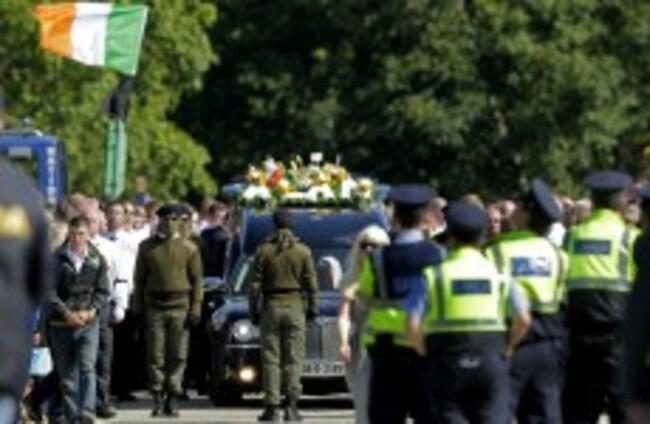
The funeral of Real IRA member Alan Ryan
Image: (Julien Behal/Press Association Images)

David Black is the first prison officer to be killed in Northern Ireland since 1993. He was a long-term officer with the Northern Ireland Prison Service and a member of the Orange Order. He was shot dead on the M1 in Armagh as he drove to work in Maghaberry Prison. There is round condemnation of the murder.

Richard Barklie of the WAVE Trauma Centre says we should not forget that the pain doesn’t end when the guns are laid down.

OFTEN WHEN THERE are discussions, either political or otherwise, victims are left at the end of the table. That is wrong.

The WAVE trauma centre offers support and care to over 3,600 people who have bereaved or traumatised through ‘the Troubles’, irrespective of religious, cultural or political belief. Their overall aim is to offer care and support a cross section of adults, young people and children.

The perception can sometimes be that we only care for one segment of those affected by the violence, but that is not the case. We currently support the families of ‘the disappeared’, we also support people who have been wounded innocently in the Troubles,  and kids whose parents may have been imprisoned, so it is a broad spectrum. Our mission statement is to support everyone.

Victims

Victims of the atrocities are often overlooked in the Northern Ireland debate. The word ‘victim’ itself has proved a contentious issue with no agreement on its definition; with the meaning getting kicked around like a political football. What we want for victims is appropriately tailored and long term health care provisions, adequate reparations and truth recovery and justice for those who seek it. We have advocated that these be enshrined within a Bill of Rights for Northern Ireland. While the peace agreement came into effect in 1998, many forget that this is not where the trauma stopped for families and victims. Conflict continues in Derry with many seeking help.

Many commentators refer to the peace following the Good Friday Agreement. Certainly things are quieter with fewer shootings and bombings, but many service users – particularly from Derry – would ask, is it real peace? There have been a catalogue of shootings, bombings, paramilitary assaults and murder affecting those in the city, coupled with public displays of strength from dissident paramilitary groups who claim the war against the British is not over and will continue. Beyond Derry we have been served once again with the public display of community division and sectarianism, and the usual display of violence over parading issues. Little has changed.

Lives destroyed

It is the victims that have to be remembered in all this. Their lives have been utterly changed, many at the hands of paramilitaries.  Service users find that one day they were living their lives normally, the next it was ripped apart and destroyed. People’s lives are changed forever and dealing with this can be difficult. Many suffer in silence, choosing not to seek help – or they simply do not know where to get help.

Trauma from many incidents affects close family relatives, friends and communities in varying ways. Take the abhorrent cold-blooded murder of Andrew Allen, a young Derry man slain at his home in Buncrana during February of this year . This impacted on family, local communities and friends to devastating effect. Many will never forget or recover. Like many other victims, the family will never have their son, brother, father or partner back. They are expected to move on – but something has been taken away from them, that person can never be replaced. The grief process can last for many many years.

It can be disheartening to see the events witnessed following the funeral of Alan Ryan in Dublin. Eradicating these displays of paramilitarism would be an achievement.

Children

There are transgenerational trauma issues at play here also. Within the victim sector, many young children are affected. Take Bloody Sunday – there those with parents in the security services living in constant fear, parents imprisoned, children who have been bereaved and so on. The impact of trauma has been passed on to children at very young ages. Some people are never going to come forward, for others it is simply not the right time for them to come forward and ask for support – but there are a lot of projects aimed at different service users.

For instance, the youth service is an important provision. Remember those participating are children who may have lost their mother or father in the violence, or may have grown up with their father in prison due to involvement in paramilitary activity. For these children it can be difficult to understand what it was all about, or how they can look at and deal with the past. Through cross community initiatives we can try and address some of the issues.

Our services are in constant demand which shows that many people in Northern Ireland are still suffering as a consequence of the conflict. Many from the border areas of Donegal are also seeking our services. Over the last five years the level of calls and referrals to WAVE has increased. Referrals are received from those affected by violence more recently, in addition to those traumatised or bereaved up to 35 years ago.

Instead of a focus on politics and violence, the focus must be on victims. It is the victims that lose out in many of the debates involving key issues around the so-called paradigm we refer to as peace in Northern Ireland. Victims of  Northern Ireland’s past need to have their place acknowledged and be able to have their say at all levels. Perhaps the newly appointed Victim’s Commissioner can bring this about, we shall see.

The scars

A study, the Cost of the Troubles (1997), estimates that more than 6,800 people have experienced one of their immediate family — parent or sibling — being killed in a troubles-related incident. There are many more who have been shot, suffered ill health or turned to substance abuse or suicide. Not to mention the countless other relatives of those killed in the violence.

The injuries and scars left from the conflict are ones from which many people may never recover. It can be a heart-wrenching role endeavouring to provide support and comfort to those who have been affected. Our aim, as an organisation with non-political views, is to come at this from a humane perspective. It is to support all those who have suffered, those committed to non-violence.

We have all agreed that violence is not the answer. The clear message was given some 14 years: that  we wanted peace in the future for the sake of our children and their children. Their children are now the new generation and living in a society still proliferated with violence. To those concerned in violence, we ask, please no more victims. To those in positions of authority we ask please respect and afford victims with the highest regard – they have suffered enough.

Richard Barklie works with the WAVE trauma centre which was formed in 1991. It operates from 5 locations – Belfast, Armagh, Omagh, Ballymoney and Derry/Londonderry.

Read next:

Comments (25 Comments)

  • What is described in this article is a real and genuine phenomenon. I’m working with parents and children in the Falls area in West Belfast. An area which witnessed countless murders and with memorials on every corner. Every school is trying to understand and support children whose families have been scarred and are still scarred by the Troubles. Barnardo’s invest heavily in this area and in my opinion the money is not only well spent but badly, badly needed. Those suffering from trauma need continued support and empathy, there is no quick fix.

    Reply
  • that leaves the question , why haven’t we got such a genuine truth commission. Who’s blocking it and who has consistently called for one?

    Reply
  • Red Ed 03/11/12 #

    Sad day for this man’s family. Nobody should support these mindless violent criminal thugs and I hope they get what’s coming to them. Their cause is obsolete now as we are all part of Europe and have very little sovereignity left

    Reply
  • Please correct me but was there not a referendum both north and south over the “six counties” which removed any claim by the Rep. of Ire. and placed the future of N.I. in the hands of those that live in the “wee six”.. Democracy in practice…people have spoken..but some who feel disenfranchised..with access to Ak47′s and the like..beg to differ..with the will of the majority of both faiths..and another person has died..Cop The F%&k On!!!

    Reply
  • Kerron, in reply to your comment about capitulation etc does the will of 98% of the population of the whole of this Island mean nothing to you? What mandate do you and the rest of those that share your beliefs have from the people of Ireland? How will the murder of that man advance Irish unity one iota? Yet you and your ilk will say he was a member of the “Crown Forces”. Were the civilians blown to pieces in the Omagh bombing members of the “Crown Forces” also? Maybe the twin unborn children that died were secretly members of MI5 or the Spanish students that were murdered were undercover members of the SAS!!!
    Please try and justify that one.
    You wrap yourself in the Irish Flag and purport to be ” True Patriots”. But in truth those that originally fought and died for that flag would be ashamed and disgusted by those that now claim their mantle.

    Reply
  • There is something about this article that does not sit easy with me. Yeah, I know it’s in essence a pitch for government funding – ‘afford victims with the highest regard’ clearly means ‘send more money’, but I think it’s more the use of language in other parts of the article that leaves me uncomfortable.

    Like, ‘the victim sector’ – really? Seriously? And ‘ the so-called paradigm we refer to as peace’, what is that trying to say? And ‘transgenerational trauma issues’ – I get that message alright, it means ‘the victim sector’ will never stop giving and funding must come for a long, long time, keeping many peace studies graduates in jobs. Yeah, I’m a bit cynical.

    I realise there are lots of people who have suffered terribly in the North, but there seems to be a massive and competitive industry growing up around helping them and getting funds from either or both governments and a raft of other funding bodies.

    Reply
    • Mjhint 03/11/12 #

      Katie you sound like David Irving as he has the same attitude towards the jews & he claims that funding raised from the holocaust is an industry. To be fair to you & him you could be right. The problem I have is his & your tone which when you dig a bit deeper you find another agenda. This mans death was wrong. The peace process has many flaws but it is first & foremost peace & secondly its a process which in using that word means its not finished. I dont know your agenda or political views but maybe you can come out of the closet. The people that killed this man are not the people I would be influenced by but if like the pira & SF they want to come in from the cold & try normal politics theres plenty of room at the table still. However they have no say or voice with this mindless ignorant & biggoted murder.

      Reply
    • @mjhint My comments were not at ALL to do with the terrible and utterly savage killing of David Blake. While the first paragraph of the article referred to that death, it is not what the substance of the article is about.

      I have no agenda and am not really coming at this from a political point of view at all. I am more than delighted that so many people have set aside violence, and wish as you say that others would see the futility of it also.

      I really don’t like being compared in any way at all with the odious and deluded David Irving, whose views would be as far from mine as it is possible to get. I realise that print is sometimes a poor means of communication, so I think you may just have misjudged my tone there.

      I just am aware that there are a multiplicity of agencies, bodies and voluntary groups growing up with what seem like laudable aims, all seeking funding and many with agendas to push which are not immediately obvious. I am not saying that WAVE is a good, a bad or an indifferent organisation – I don’t know very much about it, though I did have a good read of their website.

      What I am saying is that certain terms used in the article jar with me and seem…. I don’t know, odd. In particular the thinking behind the use of a term like ‘the victim sector’ jarred with me. That’s all. No agenda, no axe to grind.

      Reply
    • Mandy 16/11/12 #

      @katie does
      Just one thing, may not be important to you but the man you referred to, who was so brutally and needlessly killed, was called David Black, not Blake!!!

      Its good to at least attempt to get the most basic of facts right if you can.

      Reply
  • I have said this many many times on this site, until we have a real truth and reconciliation forum, the scars, suspicion will continue until every person impacted by the troubles die off… They will also leave their legacy to the next generation and enforce a segregation of the communities living in the North.

    The truth and reconcilliation forum model has been demonstrated to work well in South Africa.
    Nelson Mandela used the forum to express remorse at his part in ‘terrorist’ activities that left people dead.

    Why is it not happening here?
    Successive British and Irish Governments refuse to support it. They refuse to admit their own activities in the troubles.
    The Loyalists and Republican groups have both said they will support this forum, if the Governments will also participate.
    I hope that in the near future, the lack of vision on part of the Governments and the implications of their lack of support for this process is addressed in order to help resolve bitter and deep scars that impact tens of thousands of victims from the troubles. If it is not addressed while the participants are still alive, then you can be sure that the next generation are not going to get the best opportunity to free themselves of the shackles of distrust and perpetuity to violence that has impacted every generation since the Normans invaded this Island.

    Reply
  • One of the reasons the trauma continues is because we have Provo murderers in the Dail and Stormont who continue to lie about their past

    Reply
  • Free the north

    Reply
  • The ruc should have protected him, they were all under threat

    Reply
  • RUC still there -is the Black and Tans?

    Reply
  • Ed 03/11/12 #

    Journal needs to sort out the double posting, mildly annoying

    Reply
  • False peace without justice.

    Reply

Add New Comment