We need your help now

Support from readers like you keeps The Journal open.

You are visiting us because we have something you value. Independent, unbiased news that tells the truth. Advertising revenue goes some way to support our mission, but this year it has not been enough.

If you've seen value in our reporting, please contribute what you can, so we can continue to produce accurate and meaningful journalism. For everyone who needs it.

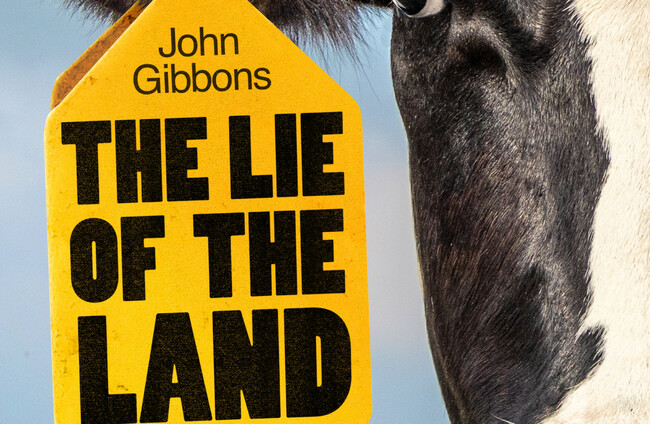
Cover of The Lie of The Land by John Gibbons Penguin Random House

John Gibbons Ireland had a 'Goldilocks' climate - but we've been killing Goldilocks

Climate writer John Gibbons shares an extract from his new book about how Ireland risks ruining our ‘climatic sweet spot’.

This is an exclusive extract from ‘The Lie Of The Land – A Game Plan for Ireland in the Climate Crisis’ by John Gibbons, which is published today by Penguin Sandycove and is available to order.

EARTH HAS LONG been described as a Goldilocks planet, with climatic and atmospheric conditions uniquely suited to life. If Earth is such a planet – not too hot, not too cold – then Ireland, with its temperate climate, is a Goldilocks country.

By an accident of geography, Ireland exists in a climatic sweet spot, sheltered from the very worst extremes of heat- waves, hurricanes, droughts and deluges.

But Goldilocks is dying. The long era of uncanny global climatic stability has ended; the climate has changed more radically in the past half-century than at any other time since the end of the last Ice Age.

Levels of atmospheric carbon dioxide (CO2), the planet’s key heat-trapping gas, are increasing around a hundred times faster than would be the case under natural warming conditions. Once a molecule of CO2 is released, it continues to warm the atmosphere, for between 300 and 1,000 years.

For every litre of fuel burned, the long-term warming effect is 100,000 times greater than the actual heat released at the moment of combustion. That’s the insidious power – and danger – of greenhouse gases.

When rapid increases in other greenhouse gases such as methane and nitrous oxide are also tallied, the picture becomes even darker. As a result of the proliferation of greenhouse gases, the planet is warming ten times faster than at any time in the last 65 million years.

In 2024, global average temperatures were 1.55 degrees above the pre-industrial average. That made it the hottest year on the instrumental record and, in all likelihood, the hottest in over 120,000 years. The second hottest year ever recorded was 2023. And the eleven years from 2014 to 2024 were all warmer than any year on record pre-2014.

The water that laps along Ireland’s shorelines is warmer and more acidic now than it has been in millennia. And, although you would not be able to detect it when you inhale, the very air that we breathe has also changed.

Today, it contains some 50% more CO2, and 200% more methane, than in the pre-industrial era. Incredibly, a single species has, in just a few generations, altered the very chemistry of the Earth’s atmosphere.

The distinct interglacial climatic era known as the Holocene, which prevailed for roughly the last 10,000 years, was a period of quite remarkable climatic stability. It was thanks to the conditions of the Holocene that our ancestors were able to forgo eons of nomadic hunter-gatherer existence, settle down and use the land to produce the food surpluses that gave rise to human civilization.

The Holocene, although still the current geological epoch, has now effectively been supplanted by an era scientists identify as the Anthropocene, so named because humans are now the most impactful drivers of planetary change.

In physical size and human population, Ireland may appear globally insignificant. The future of human civilization will not be determined here. But the story of Ireland’s relationship to the climate crisis – the story that this book will tell – is a fascinating microcosm of global dynamics. And the people of Ireland face a choice – or, more accurately, a spectrum of choices that will largely determine what life here will look like in the age of global heating.

The bad news – there is no avoiding it – is that grave damage has already been done, both globally and in Ireland, and that much of it is irreversible. The good news is that there is still much to play for.

Climate action is often described in terms of humans making sacrifices in the short term to secure a long-term future, but this framing is now out of date. With each passing year it becomes ever clearer that, barring a sharp change of direction, most humans currently alive will see the world change dramatically for the worse.

Like almost every other country in the world, Ireland has seen a sharp rise in extreme weather events in recent years. There is a general understanding that these events are linked to climate change, and are only going to get worse.

But for the vast majority of people in Ireland, the climate crisis remains a peripheral issue, like the sound of distant thunder, breaking to the surface of consciousness every now and again, then quickly ebbing away. The great majority of people are, it seems, more concerned about the end of the month than the end of the world.

John Gibbons is a journalist and author of ‘The Lie Of The Land – A Game Plan for Ireland in the Climate Crisis’. It is published by Penguin Sandycove and is out now.

Readers like you are keeping these stories free for everyone...
A mix of advertising and supporting contributions helps keep paywalls away from valuable information like this article. Over 5,000 readers like you have already stepped up and support us with a monthly payment or a once-off donation.

Close
JournalTv
News in 60 seconds