We need your help now

Support from readers like you keeps The Journal open.

You are visiting us because we have something you value. Independent, unbiased news that tells the truth. Advertising revenue goes some way to support our mission, but this year it has not been enough.

If you've seen value in our reporting, please contribute what you can, so we can continue to produce accurate and meaningful journalism. For everyone who needs it.

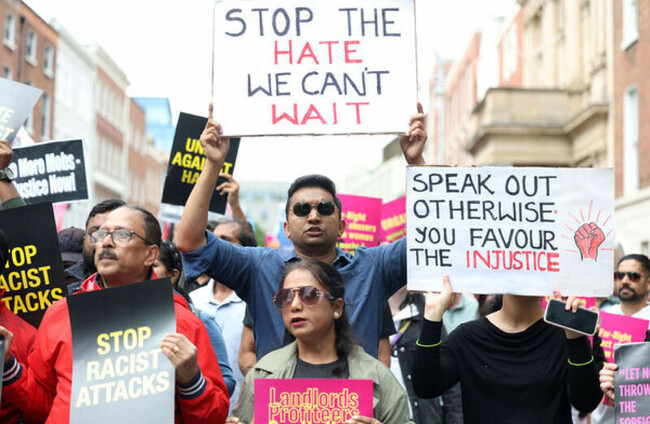
Protesters holding placards saying stop the hate as they march to the Dáil to protest against a brutal assault on an Indian national in Tallaght. Rolling News

Attack on Indian man in Dublin 'Words aren't enough, Irish people need to do more'

Priyanka Borpujari says recent racist attacks reflect a growing intolerance towards minority communities, one that we ignore at our peril.

WHEN A YOUNG, freckled lad dressed in a grey tracksuit screamed “Tipp ‘r Back!” repeatedly at me last Sunday, I put on my stern face.

“Hurling, hurling, yeenoo!”

A couple walking behind me giggled; they wore blue and yellow headbands. I wasn’t sure what was going on, but when the lad got very close to me, I knew he was drunk. I crossed the street without a smile. Minutes later, my phone buzzed with a notification that Tipperary had taken home the All-Ireland hurling trophy.

That’s when I realised what the lad was cheering on about. He had meant no harm, was merely celebrating his team, but I sat crying, realising how a genuine fear had seeped in under my skin, so that I could no longer smile and cheer with him. I felt vulnerable to attack in the street. 

For non-Irish and non-White people like me who have made Ireland our home, there is nothing we fear more than teenagers, who can get away with any form of racist attack.

So when the news broke of the Indian man who was assaulted and stripped in Tallaght recently — before an Irish woman stepped in to rescue him in her car — I wonder: what happens next, with Ireland’s brand of a thousand welcomes, that no longer seems to apply in the real world?

Attacks on the rise

What was surprising is that the news did not make it to the headlines immediately. Later that night, the woman — still shaking and between bouts of tears and anger — shared a video on Facebook describing all that had happened, killing the baseless rumours that the man was a paedophile who was caught without pants.

In her video — and later, when she spoke to me — she shared how the rumours were not true: she said that the bleeding man had a calm presence, and none of the pleading from remorse that might be typical of someone held guilty of a crime. It was through her video that we learnt that there had been four similar attacks the previous week in Tallaght. But there was not a peep in the news media, and possibly because nobody had reported being attacked.

Don’t we already know why people would rather lick their wounds than approach the police, when the judicial system — in Ireland, as in many other countries — chooses not to take complaints seriously? We see this with women who are raped or face domestic violence; we see this now with people who face racist attacks in Ireland.

Simply blaming the far-right and the scourge of rumours amplified by manipulated videos is not enough. Ever since the brutal racist attack in Tallaght, non-White, non-Irish, non-European folks living in Ireland are sharing their own personal stories:

Often it goes like this: ‘Something like this happened to me’; ‘They were teenagers’; ‘Nobody stepped in to help but only watched or looked away’; ‘the gardaí said they cannot file a report’.

Anti-immigrant rhetoric has taken centre stage in recent months, with massive marches and equally powerful anti-racist marches to counter them. Last month, both sides waved the Irish tricolour. Both sides shouted, “Shame on you”; both sides were disappointed by the government’s failure to address the housing crisis. One placard, held by those who led the anti-immigrant protest, said: “No housing for Gen Z.”

Watching a government be so apathetic to the housing crisis on the island paves the way for people like me to be scapegoated. While I appreciate the counter-demonstration, where are the everyday examples of anti-racism in action, beyond mere words? Ireland is immensely colourful with people from different countries filling key roles across all sectors, but where is this diversity among the decision-makers in institutions?

Genuine representation 

How is it that I never come across a non-Irish person being quoted in any news story, as, perhaps, giving their expert input? How many newsrooms have non-White journalists and editors? How many expert opinion columns are written regularly by those who look like me? The irony is that, in spite of my long career as a journalist reporting on various topics, I find my words in Irish media only when I talk about racism and discrimination, and not for the skills and expertise I bring. We are thus reduced to our skin colour and an identity based on our passport. 

The “international section” at the many cute bookshops in Ireland only includes authors from the US and the UK; you might see a “foreign” name there, but you may miss the part where that “foreign” name is actually a citizen of one of these countries.

This is the pattern across literary and arts festivals, across university pedagogies, newspaper columns and artist residencies. I agree that not all of Ireland is racist, but if a non-White person says that Ireland has a problem with acknowledging and addressing overt and subtle racism, the first step before designing any colourful equity-diversity-inclusion masterplan would be to listen to such voices.

On a micro level, how many Irish folks actually have non-Irish, non-European, non-American people within their friend circle? How many have actually invited someone who comes from a different culture to their home for a cuppa or a meal? How far do you go to truly understand the challenges of your non-Irish colleagues, with the paperwork — the Irish Resident Permit as just one example — that is nothing but a legitimised form of racist gatekeeping?

Support groups on Facebook are rife with people in Dublin asking each other about the safety of specific neighbourhoods. I didn’t pay much heed to such posts before, but perhaps it reveals to me my own bias that the attack on someone who shares my skin colour and passport has made me write this: I did not write this when a Croatian man was killed, or when the Gardai were called in at the Tola Vintage block party during Culture Night last year. So perhaps in a way, we are all tribal in our bones, that our cells wake up only when “one of us” is attacked. By that measure, those influenced by the incendiary rhetoric of Conor McGregor, attacking people who look like me becomes a way of their version of defending “one of us”.

The reality is that, even as Ireland has suffered at the hands of the British for several centuries, Ireland in this century has not yet come to terms with its own Whiteness and White privilege.

In three years of living here, as Ireland’s population grows because of those who come here to contribute to society, sudden instances of violence and the everyday evidence of non-existence show that Ireland’s branding of welcoming everyone is failing. Welcoming everyone is not just about the craic at Temple Bar, or the road trip along the Wild Atlantic Way that only tourists from the US can afford.

We passed a hate crime law, but the EU is having to drag Ireland to the table to implement hate speech laws. We are not supposed to express our anger towards teenagers gone awry, because, we are reminded: who hasn’t been a teenager once?

I am not sure anyone would have the energy to bring a case to court and endure an expensive legal battle to prove hate speech and hate crimes in Ireland. We all simply want to enjoy the rare sun, thrive in the face of all odds, and — instead of walking away in fear — cheer when “Tipp are back”.

And most importantly, to not have to write such an article pouring out our hearts, and hoping that the Irish media actually listens to everyone on the island, and gives everyone an equal platform. Everything else is just blah, blah, blah.

A native of India, Priyanka Borpujari has been a journalist for 18 years, reporting from India and several other countries. She currently resides in Dublin and is pursuing a PhD, and is finishing her first book on the Nellie massacre of 1983.  

Readers like you are keeping these stories free for everyone...
A mix of advertising and supporting contributions helps keep paywalls away from valuable information like this article. Over 5,000 readers like you have already stepped up and support us with a monthly payment or a once-off donation.

Close
132 Comments
    Submit a report
    Please help us understand how this comment violates our community guidelines.
    Thank you for the feedback
    Your feedback has been sent to our team for review.
    JournalTv
    News in 60 seconds