TheJournal.ie uses cookies. By continuing to browse this site you are agreeing to our use of cookies. Click here to find out more »
Dublin: 10 °C Sunday 26 May, 2013

RTÉ told to ‘take greater care’ after complaint over Late Late abortion interviews

The Broadcasting Authority of Ireland rejected the complaint but warned over the separation of human interest and political stories.

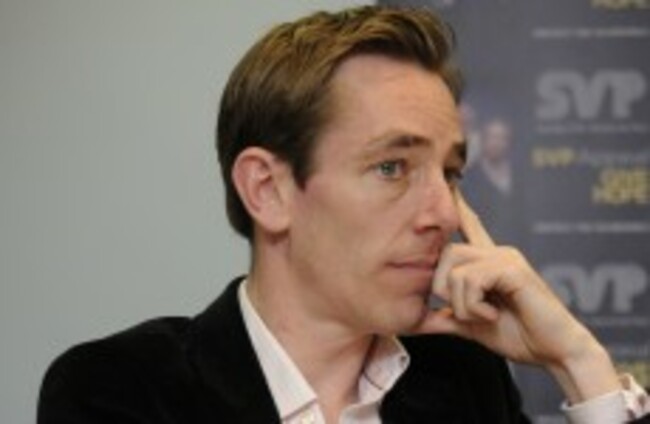
Image: Photocall Ireland!

THE BROADCASTING AUTHORITY of Ireland has told RTÉ’s Late Late Show to “take greater care” when dealing with human interest aspects of political issues to ensure there is a clear and adequate separation for audiences.

The warning came as the watchdog rejected a complaint over the 20 April show. During the programme in question, presenter Ryan Tubridy interviewed three women who had travelled to the UK for abortions after they were told their babies had fatal foetal abnormalities and were incompatible with life.

The complainant believed the Broadcasting Act had been infringed on the grounds that it was not fair to all interests concerned, not objective and not impartial. He also submitted the complaint under section 48 (1)(b) which covers harm, offence, incitement to crime and the authority of the State.

The complainant stated that the interviews failed to comply with a statutory requirement that news and current affairs be fair, objective and impartial. He believed the three women were engaged in a campaign to have Irish law changed so abortions could be made available in Ireland and said the interviews were undertaken in a manner to facilitate their objectives.

The BAI’s committee rejected the complaint after deciding that the segment “on balance, constituted a human interest rather than a news and current affairs item”. Therefore, the statutory obligations on news and current affairs content did not apply.

Although members of the committee agreed that there was an current affairs aspect for the interviews – namely the X-case and the ongoing requests to legislate for it – they concluded that it was appropriate to provide reference to the political context for the personal discussion.

However, the BAI also ruled that the separation between the human interest element of the story and the political element “was sufficient, although barely so, to ensure that the item did not constitute news and current affairs.”

For this reason, the broadcaster is asked to take greater care when treating human interest aspects of political issues so that the separation between these two types of interviews is adequate and clear for audiences.

The watchdog dismissed any claims that the programme contained an incitement to crime.

Responding to the complaint, RTÉ said the Late Late Show has interviewed people with interesting personal stories to tell for almost fifty years. It added that the item was not “a discussion about abortion per se” but three tragic personal stories being told.

It also argued that Tubridy had “put to them that many members of the public would not accept their decisions to abort their pregnancies and would have the view that the women should have gone through to birth.”

RTÉ can understand that Pro-Life supporters might have preferred that the discussion on The Late Late Show should have opened up to deal with wider issues. But this was not how the item was designed, the production team is entitled to determine the limits of the item and in this instance the focus was kept on the personal stories of the contributors. It was simply three women telling their own stories.

The broadcaster promised to report objectively and impartially on any measures which are proposed by Minister James Reilly when he addresses the issues arising from the X-Case when an expert group reports this year.

“What was broadcast on 20 April was not part of that coverage and to view the interviews as part of any campaign to introduce abortion in Ireland is to misunderstand the nature of the item.”

RTÉ refuted all claims that an incitement to commit crime was broadcast, stating that the terminations being discussed took place in the UK where such procedures are legal. “Nothing illegal took place in regard to the three women who featured in the programme,” they concluded.

Ireland and abortion: the facts

Read next:

Comments (61 Comments)

  • The complainant is clearly against abortion, in a way to accuse the segment of facilitating an argument to have abortion legalised. What gets my goat is that if it was a segment that condemned abortion this person would have never complained which means that he was never looking for an objective, balanced segment – He wanted a segment which was in line with his own view.

    Reply
  • Would have to agree with both the BIA’s rejection of the complaint and RTE’s interpretation! Is a talk show such as TLL not for this purpose??

    On another note, I do think the legislation in Ireland should change for cases like the three women and the “X” case! JMO

    Reply
  • All of these stories are personal. That ‘pro life’ groups only discuss at high level speaks volumes

    Reply
  • It seems to me that these types of legal challenges serve a number of purposes.

    If successful they place parameters on public discourse which fit their agenda.
    If unsuccessful they may still have a subtle impact on the editorial policy of RTE and other news media in the future.
    Either way they achieve publicity for their (in my opinion simplistic and increasingly rejected) analysis.

    This is looking increasingly desperate. They have lost control of the ‘common sense’ view of abortion in this country. As an issue, it is far more complicated and nuanced than they admit.

    Reply
  • The Broadcasting Authority is so full of shit. Who cares if he only interviewed women who travelled to the UK for abortions. If the shows highlights the struggle women face with abortion in the country that is biased and unfair because they didn’t show some lunatic who is against them having babies that will immediately die upon birth, be in a wheel chair the rest of their life, or be mentally disabled? Really? Who cares if it is biased and unfair (which it is not in the first place), freedom of speech? Even if he was interviewing only women who are pro-life, so? So if he interviewed African-Americans on his show who talk about their experience with racism he would have to also get the KKK’s or some White Supremacist group’s opinion as well? This comment will also probably need to be deleted as it violates 1023 ARGHTD Social Media Broadcasting Rule of Bias and inciting “Hatred” 101. Can’t expect any better from a state which facilitated pedophiles to torture children and introduces a blasphemy law. This country is run by absolute morons, who have nothing better to do.

    Reply
    • I care because I have to pay for RTÉ’s bias. If RTÉ want to broadcast what they want let them do so on their advertizing revenue. They have some cheek using the courts to force people to pay a regressive tax on televisions. I wonder why the ULA and other politicians don’t oppose the Television License? They know that they wouldn’t get favorable treatment on RTÉ.

      Reply
    • Ugh the bias is claiming there is a bias when there isn’t one. They just don’t like the opinions being given and Ireland has a fundamentalist stance against abortion; only state in the EU with such a position. The outrage should not be on RTE, it should be that basic human rights are violated and they have to go on RTE to defend their own bodies. These rules apply to privately owned Irish networks as well and that’s bullshit.

      Reply
    • The most basic human right is the right to life. It is reasonable for those who believe that life begins before birth to argue that life should be protected. If you believe the right to life starts at birth (or after) that’s up to you to argue your point. RTÉ is the national broadcaster. They are bound to be impartial (if they want to express a bias that’s fine, let them, just don’t force me to pay €160 pa for that, I’d gladly let them do what they want if I didn’t have to pay for it, I very rarely watch RTÉ television anyway) they regularly push that to the limits and often go over the line. This is not just so in the abortion issue, we all can point to other issues and occasions where they do it. You don’t see it in this case because you’re pro-choice.

      Reply
    • Oh because you think differently therefore they should be silenced and you shouldn’t have to pay what everyone else pays. Do you really think everyone in Ireland agrees with everything that is run on RTE? If the opinions were pro-life you could care less about “fairness” and “bias”. They just want to be able to control their own bodies not yours or mines. Only if people were more concerned about actual living people and not cells.

      Reply
    • I never said anyone should be silenced. Least of all parents who have experienced tragedy. What I am saying is that if Tubridy and RTÉ were genuinely interested in impartiality they would have invited parents who chose (you’re pro-choice aren’t you?) to have their babies with similar conditions on either the same show or a follow-up. They didn’t. There is the bias.

      Reply
    • But Liam what good is the right to life if the baby dies nearly as soon as it is born, in agony? Why should the baby go through that because of strangers bias religious views?

      Reply
    • The law already discriminates/denies rights against women who want to not have others dictate what they can and cant do with their own bodies. The show was not about debating it was about showing an other side whose voice is repeatedly ignored.

      Reply
    • Amy, I think you should direct that question at the parents who chose to bring their babies to birth though they had similar conditions. This is not a religious matter and I cannot for the life of me understand why pr0-choice people are so obsessed with religion. Your argument makes little sense unless you are also arguing for euthanasia, including involuntary euthanasia of people who are unable, incapable or unwilling to ask for it.
      Kevin, I didn’t watch all of the show, I rarely watch RTÉ but I think you’ll find that the women in question never referred to their babies as being part of them. Far from it they acknowledged that their babies were individuals.

      Reply
    • Actually I do believe in euthanasia, So die my comment make sense to you now? And no, I’m not going to direct my comment at anyone who’s been through the situation, they have an extremely difficult choice to make, every situation is different, and emotions and hope are factors in varying degrees in making the decisions. My point is, who are you to take the choice from them, religious or not? Have you spoken to people who chose to continue with the pregnancy? So you know that none of them have ever regretted that decision?

      Reply
    • I understand where you’re coming from Amy but the vast majority of abortions have nothing to do with the health of the child unfortunately. Pro-Choice is a fine way to justify an unplanned pregnancy but the unborn child doesn’t have that ‘Choice.’ I do agree in the instance where taking a pregnancy full term in which the child will die in agony and putting the mother at risk, the choice should apply but I think the ‘Choice’ is being abused.

      Reply
    • I just wanna clarify one thing, I am not pro-choice in the sense you are speaking of. I do not approve of aborting babies because they do not fit your lifestyle. And neither did the women on that programme express any view on it, this debate is about abortion for MEDICAL reasons, so I agree with you Derek.

      Reply
    • Yeah, that’s exactly how I feel Amy. I do think the phrase ‘Pro-Choice’ is thrown are a bit flippantly is all.

      Reply
    • Interestingly, in the Prime Time segment, they interviewed a woman who had chosen to continue a pregnancy where the infant died soon after birth – she too thought that termination should be available in these circumstances.

      Obviously she also went through a horrible traumatic experience and stories like this should be told – but there seems to be an assumption that women who continued pregnancies don’t support the TFMR campaign, which is obviously inaccurate.

      Reply
  • I am a sceptic regarding the idea of “balance.” Some ideas are clearly, demonstrably, factually wrong. Giving them air time alongside ideas that are factually well-supported lends a false legitimacy.

    In this case, though, you simply can’t “balance” one human story against another. Each one is personal, unique. What the law must do, however, is take account of the causes of human misery and attempt to remove contributing factors which are within its grasp – eg rules, bureaucracy.

    Changing the rules in Ireland would have no effect at all on the families of those choosing to carry severely sick babies to term & mourn their passing in an infant hospice. That option is well catered for and unhindered.

    Changing the rules would have made a difference to the women who told their stories. That’s why their stories needed telling.

    Reply
    • I am inclined to agree with you and I think the conduct of the women on the night was a credit to them, they spoke on their own particular circumstances and despite several efforts to steer the discussion onto a wider plane they stuck to their point which whether you agree with it or not is a valid one which is why I was mystified by this complaint.

      Reply
  • You couldn’t have had a show with these 3 women telling their upsetting stories and then some old fashioned priest telling them what they SHOULD have done.

    Reply
  • A certain John Waters sits on the BAI’s board. A lovely, lovely man. Not a complete misogynist :)

    Reply
  • Mjhint 12/10/12 #

    Why is it that people that have strong religious convictions are obsesses with term “abortion is murder”. Secondly I thinks its only fair to say that this complaint is weak & yes the women interviewed did only represent one side of the view because it dealth with women having only one choice,going to the UK. So if we had the services in Ireland we could have had another view from women who availed of that service. These women had no choice but to avail of these services & to present the anti abortion argument is not relevant to the topic. However I would agree in balance that we should have that debate now.

    Reply
    • According to some of a religious ethos, if a woman has an abortion, it’s “murder”. If she has a miscarriage, it’s part of God’s plan… so it’s okay for God to murder her baby, but not her?

      Reply
  • I watched this programme and I have to say that my heart went out to the three ladies that were interviewed. They did not want to abort healthy babies, neither did they want to abort babies with disabilities. Theirs was a desperate plight of babies that could not to live due to abnormalities that meant the babies would and could not live outside the womb. i thought thavee interview was sensitive and well balanced and the three ladies were very brave to come forward and you could see pain it had and still was causing for them.

    Reply
  • Annie 12/10/12 #

    Your wrong daisy. I follow a group on twitter called “pro life atheists”

    Reply
    • Then they need to raise their profile on Google because it didn’t come up on the first page. I’m not denying they exist, they’re just not as numerous, or high profile, as their god bothering counterparts.

      Reply
  • Annie 12/10/12 #

    So what daisy. I really don’t understand your point. As was said above its a human right issue not a religious issue. Does it really matter if people are religious or not

    Reply
    • Because while it’s fine to be religious, belief in ensoulment at conception (the central tenet of anti-choice views) is a religious doctrine rather than one based in science. Otherwise, how could you explain that doctors and scientists, those with in dept knowlege of foetal development, tend to be more pro choice than the average Irish person? So while it’s fine for people to believe in ensoulment at conception, this view inevitably is formed from an exposure to Catholic teaching.

      It’s fine to have religious beliefs. It’s not fine to turn those religious beliefs into law if there is no secular persuasiveness.

      Reply
  • Annie 12/10/12 #

    It’s the same argument everytime Liam. I am so sick of hearing about it. If your anti abortion you have to be a “religious nut”- a term I have seen regularly. your right though, the pro abortion side bring religion into it everytime. Maybe by tryin to blame religion for our views they make themselves feel better.

    Reply
    • The majority of Pro-life groups are church afiliated or have a strong religious ethos. Google “Irish Atheists against abortion” and it doesn’t give a link to any organisation.

      Reply
    • Google Pro Life Campaign and you’ll see that they are not a religious group, no mention of God, nada.

      Reply
    • Right… of course they’re not!

      Reply
    • Quote from Pro Life Campaign website about us page: “The Pro Life Campaign is a non-denominational human rights organisation” – and from the dictionary: Non-denominational = “Not restricted to or associated with a religious denomination.” Which would suggest to me that the organisation is composed of people from a range of religious denominations, i.e. Catholics, Anglicans, Presbyterian’s, etc, If they wanted to say not associated with any religious organisation the word they were looking for is secular – i.e. Not specifically relating to religion or to a religious body. So I think its fair and reasonable to suggest that the Pro Life Campaign is religious in nature as they have specifically chosen to self-identify as a religious grouping.

      Reply
    • I’m Pro Choice on medical/psychological grounds, I am NOT pro Abortion, anybody who thinks abortions are a fantastic oul thing that should be promoted needs their head checked.

      I’m Pro letting a woman decide for herself what to do with her body when in a serious situation, not a baby killer who believes they should be available to every moron who didn’t have the cop on to use protection and I’m quite frankly sick and tired of people failing to recognise that a LOT of people feel the same way I do.

      Reply
    • Well said Sarah. I honestly can’t understand how there isn’t a majority in government who agree with this view when it’s clear the majority of the population does, even just taking the comments and likes on this thread as an example (I realise it’s not a poll). Why are they insisting on putting these women through this agony, and also, making them feel ashamed of themselves for something which is completely out of their control and which is heartbreaking for them more than anyone else who just has an “opinion” on it. Everyone has the right to an opinion, and freedom of speech, but nobody has the right to inflict it on someone else when it’s so devastating to that persons life.

      Reply
    • @Niall –

      The Pro Life Campaign is non-denominational. This means that it does not view people solely in terms of their religious belief. It recognises the fact that abortion is a human rights issue and as such it affects men and women of all creeds and none. Hope this clarifies the matter for you.

      Reply
    • @Cora
      If they embrace people that don’t believe why don’t they call themselves secular rather than non-denominational which implies some denomination. i.e. Secular = No Denomination, or the absence of denomination. Non-denominational = No specific but at least one denomination.

      Reply
  • A lot of watery liberals here approving of abortion but with caveats. That’s not a pro-choice position.

    Abortion on demand, NO apologies!

    Reply
  • A group of women who want to tell their stories is one thing. If these women are involved in any kind of lobbying for abortion, that’s a totally different scenario. It wasn’t a balanced item as all the women were all in favour of abortion and portrayed it as an acceptable option which they want legislation on. At a time when there’s a big push to legalise abortion here in Ireland, there’s no doubt that such a programme couldn’t be seen as a totally benign presentation of personal stories. It wouldn’t have been difficult to locate some women who continued with their pregnancies in the face of dreadful diagnoses for their babies. Women like the women In ‘One Day More’ who presented their sad stories in the Senate a few months ago. Senator Mary Ann O’Brien praised the fact that these women were given a voice to tell their stories. She talked of how ” the elephant in the room is the word “abortion”. The lives of the babies that were heard by the members could have been terminated. She herself had a baby that died at two years of age, who she could have aborted. His name was Jack Irwin. Because of him, €36 million has been raised for the Jack and Jill Children’s Foundation. She expressed the wish that all members had been there to hear how fragile life is and that those present were there to respect human beings. She spoke of the “great sadness but great dignity portrayed” by the wonderful parents.

    Would have been lovely to have heard a few stories like this on The Late Late Show.

    Reply
    • Even if they said they believed the option should be legal and available? Because all the high profile women lately who have come forward lately to speak about their experiences willingly continuing a pregnancy have been supportive of TFMR…

      Reply
    • Not the women in ‘One Day More.’ It really doesn’t matter if you’re high profile or not when it comes to sharing your experience.

      Reply
    • Also, the idea that there are situations where there’s no option but to have an abortion when a child is diagnosed with a serious genetic condition in utero is just not true. People should look at websites like http://www.anencephalie-info.org/e/index.php or http://www.livingwithtri13.org/ which are eager to promote positive information about babies diagnosed with rare genetic conditions. As one mum said- “It is our belief that through knowledge and understanding of our children and their qualities of life we can change the label that is so wrongfully attached to them.

      Reply
    • Widely reported cases, not the the women are particularly high profile. And no one is saying we shouldn’t support parents who choose to continue the pregnancy. We’re saying people should be a bit more supportive of women who choose to terminate.

      Reply
    • In Ireland, women don’t have the right to choose whether or not to have an abortion. Once they become pregnant they have to stay pregnant until they either give birth or have a miscarriage. All women in Ireland have is the right when pregnant to travel to a country that provides abortion services.

      There’s no part to the pro choice movement that would ever force these women to abort their babies against their will – that’s why it’s called the right to CHOOSE. On the other hand, organisations that deny women that right have no qualms forcing them to go through the physical and emotional trauma of of giving birth to a child that will never survive outside the womb.

      Reply

Add New Comment