Sign in. It’s quick, free and it’s up to you.
An account is an optional way to support the work we do. Find out more.
Sign in. It’s quick, free and it’s up to you.
An account is an optional way to support the work we do. Find out more.
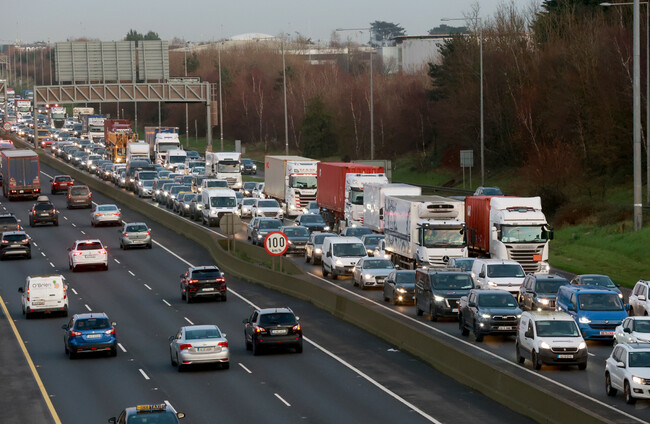
TRADE UNION FÓRSA has written to the Department of Public Expenditure calling for increased access to remote working for civil service staff due to the impact of the fuel crisis and continued congestion on Irish roads.
Fórsa is the largest Irish trade union for the public service, and the second largest trade union in the state – it represents 25,000 civil service staff.
In email correspondence between the Department and the union, seen by The Journal, Éamonn Donnelly, head of the civil service division of Fórsa, called for “urgent remedial action” regarding attendance at work during the fuel crisis.
He wants the Department to consider less on-site or in-office attendance, and relief measures to offset the cost of getting to work when attendance is required. He also called for an emergency suspension of the provisions in the travel and subsistence circulars which move travelling officers into the lower band rates.
“In simple terms, workers are finding it increasingly difficult to either get to work or afford to travel to work,” Donnelly said.
Speaking to The Journal, Fórsa spokesperson Niall Shanahan said the union is looking for at least one extra day of remote work for staff on hybrid working arrangements.
He said there are a variety of factors behind the call for increased remote working, including fuel costs, congestion and global uncertainty.
“Congestion was rising anyway, but peak hour fuel demand and the rising cost of fuel and the uncertainty of the next few months over the stability of the price of fuel is obviously a factor in our thinking,” he added.
A recent Fórsa survey of 20,000 members found that 65% are currently travelling to work three or more days a week, while over a quarter work on-site full time.
Around a third of respondents said they commute for more than an hour per day and almost half said their commute time has increased in the past year.
The survey found that 78% of workers seeking or availing of remote or hybrid working arrangements said it was due to the need to reduce weekly commuting time, while about two thirds said transport cost reduction is a major driver of demand for remote working.
“If there was an increase of a day a week in the remote option, you could see that having an immediate effect,” Shanahan said.
Fórsa’s position is that one further day of remote work would reduce peak-hour fuel demand, congestion, fuel consumption and commuting times.
“We only need to see the tailbacks coming into Dublin City early in the morning to understand that there’s an awful lot of people spending an awful lot of time on the road who perhaps don’t need to be on the road as often if remote work is an option for them.”
Shanahan said that the pandemic showed that productivity is not impacted by remote working.
“In the face of the uncertainty, because of the continuing conflict in the Middle East, I think we have to stay open minded to practical solutions, particularly where it comes at no cost to the employer, and where there is zero impact on productivity,” he added.
“This is an immediate solution that the government could activate in the interest of reducing peak air fuel demand and addressing the uncertainty over future fuel costs.”
In a Fórsa news bulletin earlier this month, Donnelly said that as well as global uncertainty, disruption to travel caused by the fuel protests this month further showed the importance of hybrid working arrangements.
He cited the International Energy Agency’s (EIA) measures to ease the economic impact of the energy crisis on consumers, including recommendations to work from home, reduce speed limits, encourage public transport, avoid air travel and increase car sharing
The EU Commissioner for Energy Dan Jorgensen has also previously endorsed the recommendations, and advised EU member states to look at the options.
However after the outbreak of war in Iran and the subsequent energy crisis, Tánaiste Simon Harris said the government has no plans to alter its advice around remote working or travel.
Fórsa representatives will meet with representatives from the Department of Public Expenditure this Friday to discuss remote working arrangements.
The Department of Public Expenditure has been contacted for comment.

To embed this post, copy the code below on your site














have your say