TheJournal.ie uses cookies. By continuing to browse this site you are agreeing to our use of cookies. Click here to find out more »
Dublin: 9 °C Thursday 23 May, 2013

Scientists find evidence of ancient ocean on Mars

A two-year investigation by a European Space Agency probe has found strong new evidence to show there was once an ocean on the red planet.

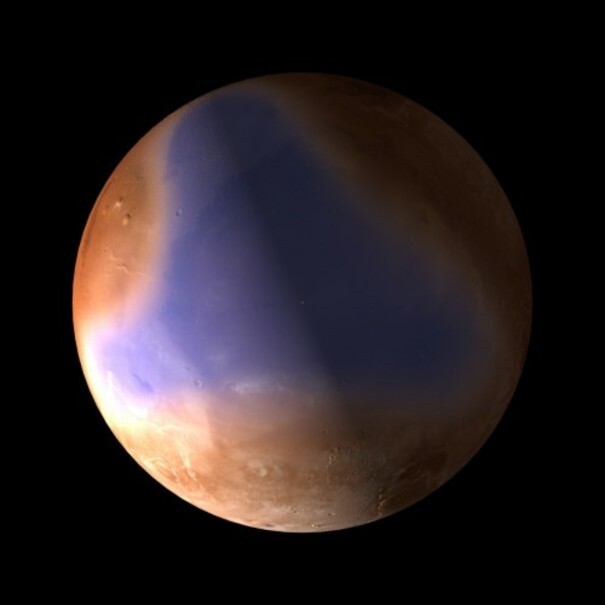
Artist's impression of how the ocean on Mars may have looked

SCIENTISTS HAVE ALREADY known that there was water on Mars – but now they’ve found evidence of an entire ocean.

New results from a European Space Agency (ESA) radar have given the strongest evidence yet that there was once an ocean on the red planet.

The ESA’s MARSIS radar on board the Mars Express, which has been investigating the planet since 2005, detected sediments reminiscent of an ocean floor within the boundaries of previously identified ancient shorelines on Mars.

“We interpret these as sedimentary deposits, maybe ice-rich,” said Jérémie Mouginot, one of the researchers who have analysed more than two years of data from the radar. “It’s a strong new indication that there was once an ocean here”.

The ocean is believed to have existed three or four billion years ago, but may have existed for less than a million years. Mouginot estimates that the water could have either frozen in place and been preserved underground or else turned into vapour and gradually lifted into the atmosphere.

However it’s unlikely that there would have been evidence of life. “I don’t think it could have stayed as an ocean long enough for life to form,” said Mouginot.

However, the research provides some of the strongest evidence yet that there were once large bodies of liquid water on Mars, said Olivier Witasse, ESA’s Mars Express Project Scientist. It also raises questions, he added, saying:

This adds new pieces of information to the puzzle but the question remains: where did all the water go?

Scientists find evidence of ancient ocean on Mars
1 / 2
  • Artist's impression of how the ocean could have looked

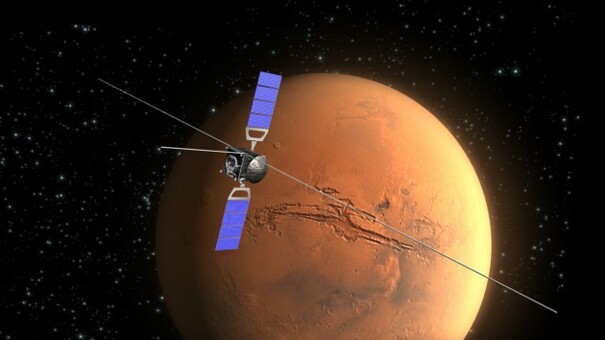
  • Artist's impression of the Marris probe

What do you mean you missed it? An asteroid just flew past Earth >

Read next:

Comments (15 Comments)

  • A combination of factors Val. 4 billion years ago Mars was a much warmer place than today, as the planet had not cooled sufficiently since its formation. The interior of the planet at that time was similar to Earth’s today, i.e. a thin crust floating on a molten interior giving rise to volcanoes such as at Olympus Mons. The interior, as on Earth, is made primarily of iron, and in such instances where the core is molten, this iron creates a magnetic field (such as can be seen on Earth). The magnetic field protects the planet from solar radiation. This radiation breaks H2O molecules down into their respective parts – Oxygen and Hydrogen. With the cooling of the planet’s interior the magnetic field breaks down allowing the solar radiation in which then breaks down the H2O. The hydrogen is too light to remain on Mars’ surface (bear in mind Mars has only1/3 the gravity of Earth) and floats to the top of the atmosphere where, now that the magnetic field is gone, solar winds are allowed to tear the hydrogen away from the planet and carry it into space and ionising other particles which are also stripped away. As the atmosphere thins the planet cools even further. Any water that remains becomes locked in the rocks, any oxygen which remains ends up bound in CO2. The process is a relatively fast one. See this article from NASA on the process.

    Reply
  • How I wish the human race could solve our problems here and explore inner and outer space together. The trillions spent on war could feed and clothe us all and used to expand our understanding of our home. The universe.

    It will never happen, but still.

    Reply
  • Deadly bit of news. Little bit disappointed by the artists image though. Surely Mars then wouldn’t have looked the same as now i.e. red and dusty, if it had an ocean would it? Surely it would have looked a little bit closer to our own planet. Raises serious questions about what happened there for an entire ocean to dry up also.

    Reply
  • I prefer mars to snickers. The past history of either is not really that important

    Reply
  • Global warming ;)

    Reply
  • Who cares we should be looking after our own planet

    Reply
  • Ian F. 07/02/12 #

    The fact that there was once water on Mars is old news. The mainstream news is only catching on now?

    Reply

Add New Comment