Sign in. It’s quick, free and it’s up to you.
An account is an optional way to support the work we do. Find out more.
Sign in. It’s quick, free and it’s up to you.
An account is an optional way to support the work we do. Find out more.
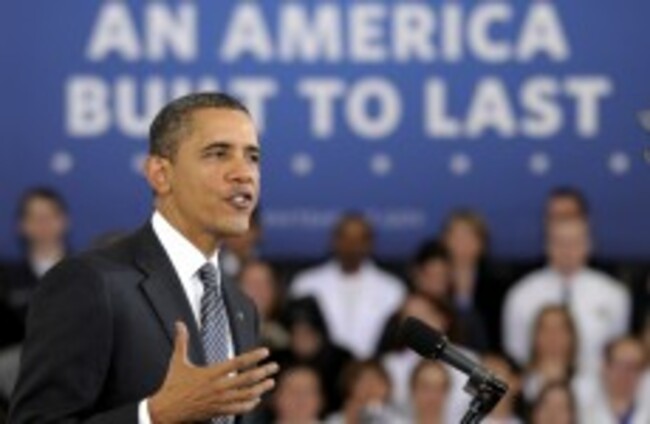
US PRESIDENT BARACK Obama has unveiled a $3.8 trillion (€2.9 trillion) spending plan for 2013 that seeks to achieve $4 trillion (€3 trillion) in deficit reduction over the next decade.
But it does little to restrain growth in the government’s huge health benefit programs, a major cause of future deficits. Obama’s new budget was immediately attacked by Republicans as a retread of previously rejected ideas.
The budget battle is likely to be a major component of the fall election campaign. The president would achieve $1.5 trillion of the deficit reductions in tax increases on the wealthy and by removing certain corporate tax breaks.
Obama rejected GOP charges of class warfare. In his budget message, he said: “This is not about class warfare. This is about the nation’s welfare.”
In a message that repeated populist themes Obama also sounded in his State of the Union address, the president defended his proposed tax increases on the wealthy, saying it was important that the burden of getting deficits under control be a shared responsibility.
“This is about making fair choices that benefit not just the people who have done fantastically well over the last few decades but that also benefit the middle class, those fighting to get into the middle class and the economy as a whole,” Obama said.
Obama used an appearance before students at Northern Virginia Community College to unveil the budget and highlight a $8 billion proposal that aims at boosting the ability of the nation’s community colleges to train students for the jobs of the future. He told the students his budget was a “reflection of shared responsibility.”
While administration officials defended the overall plan as a balanced approach, Republicans attacked it as failing to enough to restrain the deficit, which Obama had promised in 2009 to cut in half by the end of his first term.
“This isn’t really a budget at all. It’s a campaign document,” said Senate Republican Leader Mitch McConnell of Kentucky. “The president is shirking his responsibility to lead and using this budget to divide.”
Republican Rep. Paul Ryan, chairman of the House Budget Committee, said that Obama had ducked “the responsibility to tackle this country’s real fiscal problems.
Ryan is preparing an alternative to Obama’s budget that will be similar to a measure that the House approved last year but failed in the Senate where many lawmakers objected to a major overhaul to Medicare.
“We do not intend on backing off on anything,” Ryan said in an interview. “We intend on giving the country an alternative and a solution to our biggest problems.”
Republicans challenged the math underlying Obama’s budget, saying it double-counted deficit reductions already approved in an August budget deal and also claimed $848 billion in savings from ending the wars in Iraq and Afghanistan even though this money would not have been spent.
Republican presidential candidate Mitt Romney attacked Obama’s spending plan for failing to “take any meaningful steps toward solving our entitlement crisis.”
This year’s budget debate is expected to dominate the presidential contest and congressional elections with the issue not finally resolved probably until a lame-duck session of Congress after the November election, when lawmakers will have to decide what to do with expiring Bush-era tax cuts and looming across-the-board spending cuts.
Obama’s new spending plan projects a deficit for the current budget year of $1.33 trillion, marking the fourth straight year that the deficit would top $1 trillion.
The spending plan projects the deficit would decrease to $901 billion in the 2013 budget year, which begins Oct. 1. That reflects $3.8 trillion in spending next year, an increase of 0.2 percent over this year’s expected outlays, and a 17.5 percent increase in revenues.
The deficits are projected to gradually go down to $575 billion in 2018, which would still be higher in dollar terms than any deficits run up before Obama took office. It would be below 3 percent of the total economy, however, and thus at a level economists generally consider sustainable.
Obama’s budget hewed closely to the approach he outlined in September in a submission to the congressional “super committee” that failed to agree on at least $1.2 trillion in additional spending cuts to keep across-the-board cuts from taking effect next January.
The Obama budget stuck to the caps on annual appropriations approved in August that are designed to save $1 trillion over the next decade. It also put forward $1.5 trillion in higher taxes, primarily by allowing the Bush-era tax cuts to expire at the end of this year for families making $250,000 or more per year.
Obama, as he has in the past, also proposed eliminating tax deductions the wealthy receive and would also put in place a rule named for billionaire Warren Buffett that would seek to make sure that households making more than $1 million annually pay at least 30 percent of their income in taxes.
Obama would also impose a new $61 billion tax over 10 years on big banks aimed at recovering the costs of the financial bailout and providing money to help homeowners facing foreclosure on their homes. The proposal also would raise $41 billion over 10 years by eliminating tax breaks for oil, gas and coal companies and it claims significant savings from ending the wars in Iraq and Afghanistan.
It would save $25 billion over 11 years through cutting costs in the U.S. Postal Service, including eliminating Saturday mail delivery.
Among the areas targeted for increases, Obama proposed $476 billion in increased spending on transportation projects including efforts to expand inner-city rail services.
To spur job creation in the short-term, Obama is proposing a $50 billion “upfront” investment for transportation, $30 billion to modernize at least 35,000 schools and $30 billion to help states hire teachers and police, rescue and fire department workers. Republicans in Congress, opposed to further stimulus spending, have blocked these proposals in the past.
The Obama budget seeks $360 billion in savings in Medicare and Medicaid mainly through reduced payments to health care providers, avoiding tougher measures, advocated by House Republicans and the deficit commissions, which supporters said were critical to the cause of restraining health care costs.
The projections in Obama’s budget show that he is doing little to restrain the surge in these programs expected in coming years with the retirement of baby boomers. Obama’s budget projects that Medicare spending will double over the coming decade from $478 billion this year to almost $1 trillion in 2022.
Medicaid, the government health care program for the poor and disabled, would more than double from $255 billion this year to $589 billion by 2022.
- Martin Crutsinger, AP Economics Writer

To embed this post, copy the code below on your site













have your say