Sign in. It’s quick, free and it’s up to you.
An account is an optional way to support the work we do. Find out more.
Sign in. It’s quick, free and it’s up to you.
An account is an optional way to support the work we do. Find out more.

NOT EVERYBODY KNOWS about the quick solution to Ireland’s waiting list problem.
It has been knocking about now for almost two years, but the EU-wide Cross-Border Healthcare Directive still remains relatively unknown.
Unlike the HSE’s travel abroad scheme, it isn’t limited to patients unable to receive treatment in Ireland – and effectively allows Irish patients to have their pick of the EU’s healthcare systems.
New figures released under the Freedom of Information Act to TheJournal.ie have shown that awareness of the scheme is rapidly on the up.
The last nine months have seen the amount of money paid out under it more than double, and the list of conditions patients are travelling to have treated has also grown.
How big has the change been?
Between the second quarter of last year and the first quarter of this year, the amount of money paid out under the directive increased by more than €200,000 – from €161,941.04 up to €401,643.44.
In that time, the amount of money being paid out for outpatient and day care treatments has almost tripled, going from €35,092.95 up to €111,076.37.
Payment for inpatient treatments also jumped up, going from €126,848.09 up to €290,567.07.
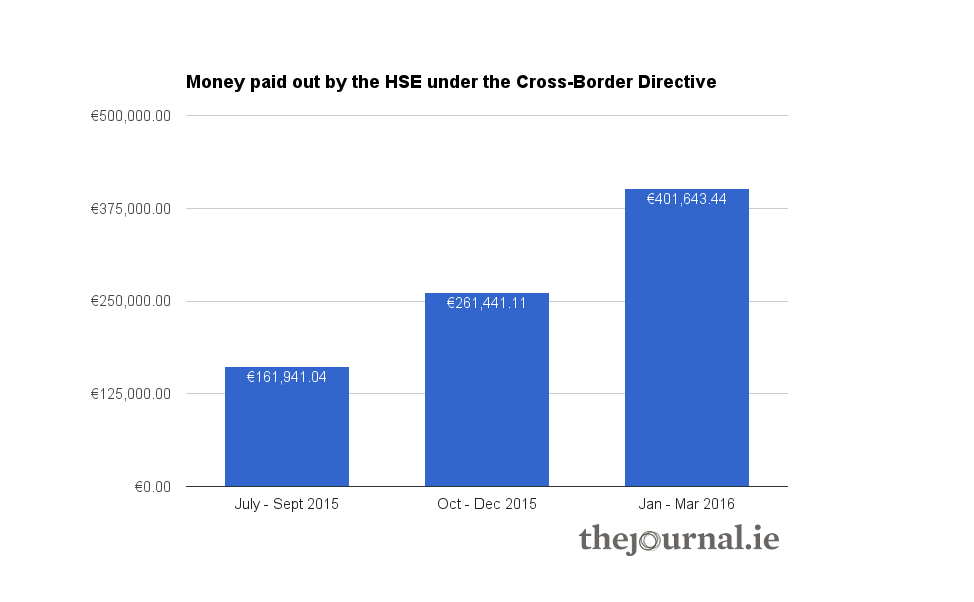 Source: FOIClick here to view a larger version of this image.
These boosts are down to the HSE stepping up its efforts to put the word out about the directive.
Now when a patient calls up to ask about waiting times, they are told about the programme. The HSE has also been proactive in spreading the word among patients' groups about it.
"The media attention has really helped," Catherine Donohue, the HSE's general manager of Acute Hospital Services told TheJournal.ie.
"There was definitely a spike in interest after an appearance by Tommie Gorman (RTÉ's Northern Correspondent) on the Late Late Show at the start of April when he was on talking about it."
And, according to Donohue, most patients availing of treatment abroad report positive experiences.
For example, we had one person who got a hip replacement. We called her and she didn’t answer the phone because she was doing the hoovering.
Once a patient has a referral from their doctor saying they require a treatment, there are no financial restrictions placed on them beyond what they might expect to experience at home in Ireland.
Where are people going and what are they getting done?
Eastern Europe has long had a reputation for cheaper healthcare, and the list of destinations reflect that.
Irish people have been jetting off to Lithuania and Poland, as well as the United Kingdom (including Northern Ireland).
Areas of treatment that patients have been flying to receive have included:
Patients are travelling to receive a wider range of treatments than last year, when figures released to TheJournal.ie showed that orthopedics and orthodontics patients were the only areas that patients were travelling to be treated in.
It is very likely that patients may have traveled to other countries, and received a wider range of treatments, but - due to data protection reasons - that information hasn't been disclosed.
Reimbursement rates for the scheme can be found on the HSE's website here.

To embed this post, copy the code below on your site














have your say