Take part in our latest brand partnership survey

We need your help now

Support from readers like you keeps The Journal open.

You are visiting us because we have something you value. Independent, unbiased news that tells the truth. Advertising revenue goes some way to support our mission, but this year it has not been enough.

If you've seen value in our reporting, please contribute what you can, so we can continue to produce accurate and meaningful journalism. For everyone who needs it.

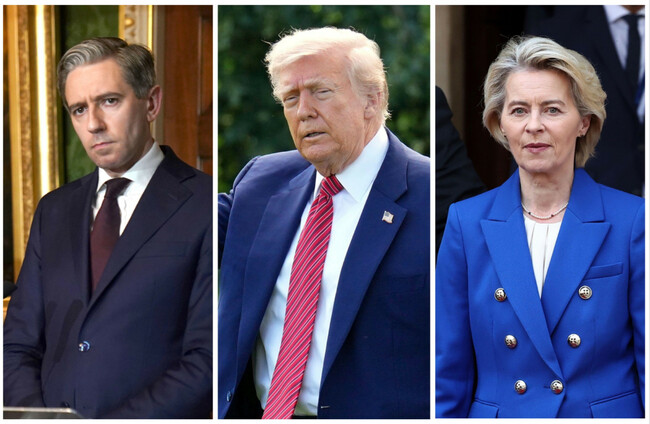
L-R: Foreign Affairs Minister Simon Harris, US President Donald Trump, President of the European Commission Ursula von der Leyen. Alamy

Trump says 50% tariffs on EU delayed until 9 July after 'very nice call' with von der Leyen

On Friday, US President Donald Trump threatened the EU with a 50% tariff from 1 June.

LAST UPDATE | 26 May

US PRESIDENT DONALD Trump has said he will pause his threatened 50% tariffs on the European Union until 9 July, after a “very nice call” with EU chief Ursula von der Leyen.

Trump had threatened on Friday to invoke the steep tariffs as soon as 1 June, saying talks with the EU over his previous levies were “going nowhere.”

He also threatened to place a 25% tariff on tech giant Apple, which has its European headquarters in Cork, in order to move iPhone production to the US.

Von der Leyen “just called me… and she asked for an extension on the 1 June date, and she said she wants to get down to serious negotiation,” Trump told reporters before boarding Air Force One in New Jersey.

“And I agreed to do that,” he added.

Von der Leyen had earlier said on X that she held a “good call” with Trump, but that “to reach a good deal, we would need the time until 9 July.”

The US leader said Friday he was “not looking for a deal” with the EU, repeating his oft-stated view that the bloc was created to “take advantage” of the United States.

Trump has hit the bloc with three sets of tariffs: 25% on steel and aluminium and on automobiles, followed by a 20% “reciprocal” levy on all imports – which has been suspended pending talks, though a baseline 10% remains in force.

The EU had announced plans to hit US goods worth nearly €100 billion with tariffs if negotiations fail to produce a deal.

Olof Gill, the European Commissions spokesperson for Economic Security, Trade and Financial Services, told RTÉ’s Morning Ireland if there is “chaos, it’s not on this side of the Atlantic”.

He said the EU has been “ready to negotiate with the US for several months”.

“If the statement by President Trump yesterday evening means that we’re now finally going to get down to brass tacks, we welcome that.”

While Gill said both sides are “quite far apart”, he added that “it’s not an unbridgeable distance”.

He added: “We’re just trying to move beyond the noise and focus on the details.

“We’ve presented to our American counterparts what we believe is a very good basis for negotiation, where both sides can derive benefit.

“We just want to ignore all the bluster and noise going on in the background – we’re ready to talk and that has always been the case.”

Speaking on his way into an EU Foreign Affairs Development Council this morning, Fine Gael’s Neale Richmond welcomed the pause and remarked that it “give us an opportunity to really ramp up the level of engagement between the European Commission and our American partners”.

“Tariffs are bad for the EU and the US, but most importantly they’re bad for the citizens and the consumers in both those blocks,” said Richmond, who is Minister of State for International Development.

He added that the EU “don’t need to react or overreact to every social media post from the US administration”.

“I still very much have a belief that the EU can work together to get an element of a resolution, but I think it should be important to say we’re into a damage limitation space, the decisions of the US administration beyond our control.

“Certainly, the rhetoric has been very worrying, and will continue to be so.

“But I’ll be quite frank, I don’t want to ever see a reciprocal tariff package put into place.”

‘Could Ireland weather a tariff shock?’

Trump’s tariff pause on the EU comes as AIB cautioned that Ireland’s economic growth is expected to slow across this year and 2026 as a result of global uncertainty over tariffs and trade tensions.

AIB’s Economic Outlook Report which has been released today examined Ireland’s current economic status and its population’s spending, as well as external factors – such as the threat of tariffs – that could have a dire impact on the country’s economy. 

The theme for the report was:  “Could Ireland weather a tariff and Foreign Direct Investment (FDI) shock? – A balance sheet perspective”.

AIB Chief Economist David McNamara said on RTÉ’s Morning Ireland that Trump’s tariffs pause announcement “plays into the theme around uncertainty”.

“If you look at some of the international forecaster’s markets, they’re factoring in that the announcements by Trump are negotiating ploys and that ultimately he will come towards a deal,” said McNamara.

“But it creates uncertainty and in that environment, business are likely to pull back o investments, consumers might save more than they had planned to spend, and in that environment you start to see growth slow.”

Gill meanwhile said that “Ireland is one of the most exposed to this situation and that’s very well recognised at the highest levels of policy making in the EU”.

The AIB report found that the economy has built up enough resilience to withstand potential shocks in the short term.

“However, permanent tariffs or changes to the US tax code which would reduce Ireland’s FDI attractiveness, would pose a greater longer-term challenge,” the report stated. 

Such a scenario would force Ireland to look to non-US markets for trade, a review of the country’s industrial model, fostering Irish enterprises and a boost in competitiveness to maintain a healthy economy, the AIB report stated.

Irish modified domestic demand – different to total domestic demand (TDD) as large transactions of foreign corporations that do not have a big impact on the domestic economy are excluded – is forecast to grow by 2.3% this year, 2% in 2026 and 2.6% in 2027. 

The Central Statistics Office describes modified domestic demand as “a smaller number than GDP [due to the above exclusion] and it more truly reflects how Households, Government and domestic Corporations in Ireland are doing.”

Consumer spending and business investment growth in Ireland are expected to cool this year due to “international volatility”.

“US tariffs and future US tax policy are the main downside risks to the Irish economy,” the report said.

While agricultural exports are exposed to the tariffs, the “key risk” centres on ireland’s multinational-dominated sectors.

These sectors account for around 12% of total employment and are responsible for 50% of Ireland’s GDP, as well as around 80% of exports.

 ”There is a heightened risk of tariffs on the Irish pharma sector, which, along with technology services, dominates multinational sector output.

“Any negative spillovers from the multinational sector could hit domestic sector output and employment.

“However, the key medium-term risk to the Irish economy is the concentration of our taxation base in corporation and income taxes sourced from the multinational sector.”

Irish households are expected to reduce their spending while some business sectors may delay planned investments.

The economic risks are accompanied by a balance sheet resilience, mitigating some concern.

While the labour market “will continue to grow”, employment growth is forecast to slow from 2.7% last year to 2% this year, 1.5% next year (2026), and then 1.8% in 2027.

McNamara said of the reports findings: “The uncertainty created by the dramatic shift in US trade policy and the responses of other key trading blocs, is expected to dampen global growth in 2025 and 2026.

“Nonetheless, Ireland enters this period of uncertainty from a position of strength, with the economy growing at a robust pace in recent months, while both the public and private sectors have built up material financial buffers in recent years.”

- With additional reporting by Diarmuid Pepper and © – AFP 2025

Readers like you are keeping these stories free for everyone...
A mix of advertising and supporting contributions helps keep paywalls away from valuable information like this article. Over 5,000 readers like you have already stepped up and support us with a monthly payment or a once-off donation.

View 102 comments
Close
102 Comments
This is YOUR comments community. Stay civil, stay constructive, stay on topic. Please familiarise yourself with our comments policy here before taking part.
Leave a Comment
    Submit a report
    Please help us understand how this comment violates our community guidelines.
    Thank you for the feedback
    Your feedback has been sent to our team for review.

    Leave a commentcancel

     
    JournalTv
    News in 60 seconds