Sign in. It’s quick, free and it’s up to you.
An account is an optional way to support the work we do. Find out more.
Sign in. It’s quick, free and it’s up to you.
An account is an optional way to support the work we do. Find out more.
POLITICIANS ON BOTH sides of the two upcoming referendums debated the proposed amendments on television last night as voters prepare to fill out their ballots tomorrow.
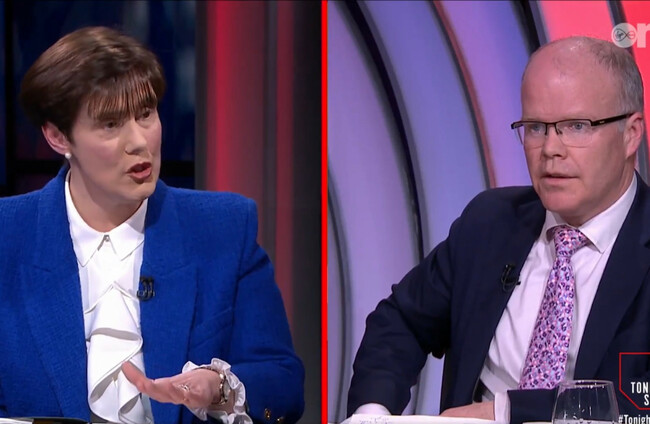
Minister for Justice Helen McEntee and Senator Michael McDowell debated the referendum on families and durable relationships on Virgin Media TV’s The Tonight Show, followed by Minister for Education Norma Foley and Aontú TD Peadar Toibín debating the amendment on women’s “duties within the home” and the provision of care.
Voters will be asked tomorrow if they wish to:
Government parties are calling for a Yes vote in both referendums and have gained support from the largest Opposition parties, though some Independents and smaller parties are advocating for a No on one or both of the amendments.
Family recognition
Minister McEntee’s opening argument in favour of the family referendum was that it would bring the constitution in line with reality, given that there are lots of different types of families.
“We’re doing two things with this vote. Firstly we are protecting the family that is based on marriage. We’re also bringing our constitution in line with the world we already live in,” she said, describing families that may just have one parent, or families with unmarried cohabitating parents, or families centred around grandparents raising their grandchildren.
“All of us, we already recognise these families. Where they are not recognised is in our constitution. By voting yes, we are for the first time ever saying to these families, who are already recognised by law and by all of us every day, that the constitution now recognises them as a family in a way that it hasn’t before
But it’s very clear that this does not remove the special protection families based on marriage have. In fact, we will be voting to reinstate that.”
Durable relationships
Senator McDowell refuted that the amendment would provide any new rights for families not based on marriage and argued that “recognition is just a piece of political rhetoric”.
“What I’m worried about in all of this is that introducing the notion of families based on durable relationships and saying that they are also families gives rise to a number of unforeseen complications that will lead to legal chaos,” he said.
He took issue with the term durable relationships and said that there is “massive uncertainty” about what it means.
He raised a hypothetical example of a family in which a woman has two different children with two different partners, and where one of those partners also has a third child with someone else, and said there could be various challenges around succession and property rights.
McEntee disputed that: “It is already the case that families change, that relationships change, that children are born with different parents. We have very clear laws around succession, laws around taxes, laws that already exist irrespective of our constitutions. So to suggest that by changing our constitution to recognise these types of families that are already protected by law, that suddenly it’s going to open up a Pandora’s box, it’s absolutely not the case.”
She said that if an aspect of the constitution is being considered by a judge – such as the proposed term durable relationships – the judge must look at the intention of the article, and that the intention of the amendment is clear: “What’s intended is that we will recognise families in a way that they haven’t been before.”
On the term durable relationships and why the government hadn’t set down a specific definition, McEntee said that “the minute you define something and define that so specifically in our constitution, you start looking at what’s not in it. The minute you define it, the race is on for, ‘what have we not included in it?’”.
“It’s already a defined term in our courts, and Michael knows this. A durable relationship has already been defined. It’s a relationship where there is commitment, where there is intention for it to be longlasting, where that’s how it’s presented to society and that’s how society accepts it.”
“It’s already in case law, so you don’t have to accept it in the constitution.”
"This does not remove the special protection that families based on marriage have"
— TonightVMTV (@TonightVMTV) March 6, 2024
Minister for Justice @HMcEntee on Friday's family referendum #TonightVMTV pic.twitter.com/gE6tGWpO4x
McDowell took issue with the difference between a marriage needing a formal divorce to be considered over, whereas an unmarried couple can separate more easily.
He later repeated that the change would cause “chaos” and lead to “disputes and unanticipated results that will lead to complete uncertainty at the heart of our legal system”. He also said that the public are confused about the term.
McEntee insisted that the government spent months examining the language to be used in the amendment. “It’s not something that was plucked for no reason. It’s been very clearly defined in our courts what a durable relationship is. What we’re trying to do here is not amend tax laws or succession laws, or even immigration laws as has been suggested,” she said.
"Saying durable relationships are also families, gives rise to a number of unforeseen circumstances, which will lead to legal chaos..."@SenatorMcDowell on why he will vote no in the Family Referendum.@ClaireBrockTV #TonightVMTV pic.twitter.com/CfBlp9RIdI
— TonightVMTV (@TonightVMTV) March 6, 2024
Immigration
Presenter Claire Brock picked up on the mention of immigration, asking McEntee whether the amendment would have consequences for proving someone is a family member or family reunification.
McEntee responded that the existing family reunification law is “very clear and very narrow for specific reasons, it’s between a parent and a child”.
“That’s not going to change because of this referendum. We’re talking about recognising a family but when it comes to government making decisions and a minister making decisions, a minister has to – and the senator will know this, as a former minister – take into account things like security,” she said.
“There is not going to be suddenly an influx of people who can apply, because the law is very clear.”
McDowell returned again to the use of the term durable relationships and repeated that “we are going down the road towards chaos”.
"This is not going to change the laws we have now, there are not going to be suddenly an influx of people"
— TonightVMTV (@TonightVMTV) March 6, 2024
Minister for Justice @HMcEntee tells @ClaireBrockTV that the family referendum won't impact immigration laws #TonightVMTV pic.twitter.com/mBDys0V3MG
"This shows the confusion that there will be in immigration law"@SenatorMcDowell disagrees with @HMcEntee that the family referendum won't impact immigration laws#TonightVMTV pic.twitter.com/nxQrHdEz8l
— TonightVMTV (@TonightVMTV) March 6, 2024
Women’s ‘duties within the home’
The debate on the second proposed amendment – deleting the article about women’s “duties within the home” and replacing it with one about the provision of care within families – opened with a question to Minister Norma Foley about the reasoning for deleting the current article.
“I would like to think that our constitution is a statement of our values and it reflects all of those who provide care within the family,” Foley said.
“I met a constituent at the weekend, John, who cares for his mother. 24/7, he’s looking after her, and yet John is invisible in the constitution currently. I think everybody who provides care deserves to be seen in the constitution, whether they are sons or daughters or dads looking after children or grandparents raising children,” she said.
“We celebrate what women do in the home and the care that they provide for children. That’s very important. And in this instance, when we have the new wording in the constitution, it will ensure that equal value is given to the care provided by dads for children and to carers like John and grandparents – it’s ‘constitutional catchup’.”
Tóibín said that he accepts that the existing language in the constitution is “archaic” and said he would like to see it changed, saying it should reflect both mothers and fathers within the home.
But he said that the amendment should have put an obligation on the state to provide support to carers and those who need care.
“I think this is peak virtue signalling by the government,” he said. “Its primary aim is to defend the government’s budget from providing help.”
"This is probably peak virtue-signalling from the Government..."@Toibin1 on why he's voting No in the care referendum on Friday.@ClaireBrockTV #TonightVMTV pic.twitter.com/rMGPyBsoaX
— TonightVMTV (@TonightVMTV) March 6, 2024
Provision of care
Claire Brock put that accusation of ‘virtue signalling’ to Minister Foley, which the minister rejected as a “fanciful phrase”.
“Let’s be honest: Over one billion euro is being spent by Government on carer’s allowance. There’s more than one billion euro on home care packages, more than one billion euro on Fair Deal. Is it enough and is it happening quickly enough? Absolutely not, and that’s the reason why I’m in politics – to do more and provide more for the people we represent,” Foley said.
“What’s currently in the constitution refers to the care provided by a mother to her children within the family. The first premise is around the family, so what we’re saying is that all other care should be recognised,” she said.
“And one thing I do want to say: If we only have in the constitution the care that a mother provides to her child, who is caring for the mother? I know the length and breadth of this country, there are sons and daughters caring for their mothers, but they also are invisible in this constitution. They deserve to be recognised in the constitution.”
"I could say the exact same thing to you Peadar, that you're virtue signalling"
— TonightVMTV (@TonightVMTV) March 6, 2024
Minister for Education @NormaFoleyTD1 defends the upcoming care referendum #TonightVMTV pic.twitter.com/5I9sdMJBIK
Tóibín pushed back, saying that care has “never been so devalued as it is at the moment”, saying that many childcare providers and nursing homes have had to close.
“Every time you ask the government why they won’t put an obligation [in the constitution], they say it’s because the constitution shouldn’t be a place where budgets are concerned, that it’s for government to decide budgets and budgets shouldn’t come into the constitution, but that’s patently untrue,” Tóibín said.
“The day after this is passed, if it is passed, there will be no material benefit to people with disabilities or carers.”

To embed this post, copy the code below on your site















have your say