TheJournal.ie uses cookies. By continuing to browse this site you are agreeing to our use of cookies. Click here to find out more »
Dublin: 15 °C Sunday 19 May, 2013

UK: Ministers set to approve the extension of fracking

Meanwhile, Ireland’s Environmental Protection Agency is undertaking an investigation the possible implications of fracking.

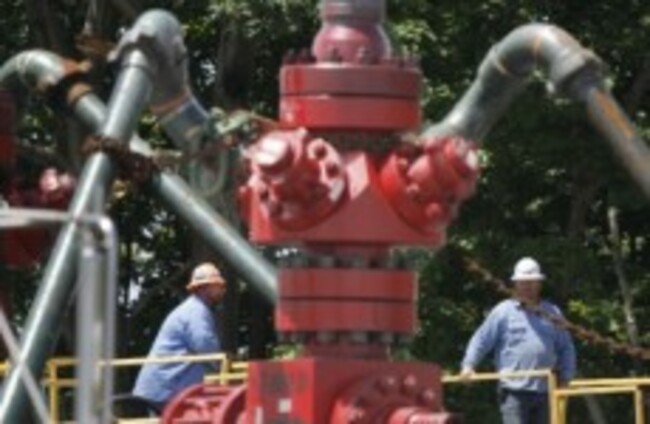
Image: Keith Srakocic/AP/Press Association Images

MINSITERS IN THE UK are set to approve the expansion of the practice of drilling for shale gas following recommendations contained in a government report.

Fracking, or hydraulic fracturing, is a way of extracting natural gas from pockets in underground rock. Water and chemicals are pumped deep underground at high pressures to fracture rocks and allow pockets of natural gas to escape.

Experts involved in the report said that fracking was safe – despite accepting that two small earthquakes in Blackpool last year were caused by the first stages of the practice being carried out there.

The report did raise serious questions about the safety of fracking in areas of known seismic activity, noting that the integrity of at least one of the wells in Blackpool had been damaged by the earthquake provoked by fracking, the Guardian reports.

However, the report recommended that fracking should be allowed on a wider scale, providing that a “smaller pre-injection and monitoring stage” was included – which has not taken place at existing sites to date. The report also called for “an effective monitoring system to provide near real-time locations and magnitudes of any seismic events [as] part of any future fracking operations”.

One of the report’s writers, Peter Styles, professor at Keele University, Brian Baptie of the British Geological Survey, said that further fracking at the Lancashire location would likely result in further earthquakes.

Ireland investigating potential consequences of fracking

Fracking has not been banned by the Irish government, however several county councils in Ireland – including Donegal, Sligo, Clare, Leitrim and Roscommon – over concerns raised about the safety of the practice.

Opponents of the practice say it causes problems with disposal of the fracking fluid and can possibly contaminate water supplies.

However, some proponents of fracking, such as Senator Feargal Quinn, say that tapping into the a rich natural resource could stimulate job growth.

In response to the developments in the UK, Quinn told TheJournal.ie that that he believed allowing fracking in Ireland was worth serious consideration. While noting that investigations would first need to be completed to satisfy questions about the safety of the practice, Quinn said that Ireland could follow in the UK’s footsteps by similarly introducing a certain amount of controls.

However, Sinn Fein’s Energy spokesperson Phil Flanagan rejected the suggestion that the British report may have an impact on policy in Ireland, saying the report was “completely irrelevant” to what happens in Ireland.

He also described as “bizarre” the assertion that fracking was safe after the “limited review” carried out by British experts.

He said that the review had looked  onlyat the issue of earthquakes during the fracking process, but did not take into consideration any of the other potential dangers that are associated with fracking “such as water contamination, the use of toxic chemicals and what is done with the waste water afterwards”.

Flanagan added:

The review panel determined that fracking does indeed cause earthquakes but that any earthquakes that will occur would probably be very small in magnitude and as a result, fracking is safe to use. But how can they determine if it is safe without even considering the potential damage that would be done to the borehole as a result of movements deep underground.

The Environmental Protection Agency is currently investigating the possible implications of fracking, and the Minister for Communications, Energy and Natural Resources, Pat Rabbitte, said last week that no licences will be awarded for the mining of gas through fracking before the EPA has presented its findings.

“We simply don’t know enough about the process,” Rabbitte said last Friday when referring to two motions seeking to prevent Ireland from proceeding with any exploration before full environmental audits.

“Last October I commissioned the EPA to do a study on this issue,” Rabbitte said. “We don’t have the expertise and in fact it has taken almost three years to produce a report in the United States on this subject.

Read more of TheJournal.ie’s coverage of fracking>

Read next:

Comments (26 Comments)

  • “could stimulate job growth” yes but at what cost to the environment, people’s health and well being. How many jobs could be stimulated by this 10/100/1000 and how many will be Irish people and not people brought in by a foreign corporation to exploit our natural resources

    Reply
  • Fracking to drain the last of the natural resources left on the planet. It destabilises localised ground and causes earthquakes but obviously this doesn’t matter if we can squeeze some gas out of it. If these fools continue to rape the ground we walk on and contaminate the water with more chemicals. What will we have after that. As one great native American said “Only when the last tree has been cut down; Only when the last river has been poisoned; Only when the last fish has been caught; Only then will you find that money cannot be eaten.”

    Reply
  • ‘fracking does cause earthquakes…’ that’s all I need to know! But Flanagan does raise highly valid questions- how are those chemicals disposed of? And I am growing tired of hearing ‘but it might create jobs!’ – a comment designed to garner submissive public approval by playing down or often ignoring the potentially damaging implications. Even if the earthquakes are small, they would cause displacement of water and for all we know a particularly robust wave caused by fracking could be the thing that sweeps your uncle off a rock while he’s fishing or capsizes a boat of people trying to make a living off the sea. Damage to people in such a scale that fracking might never be considered as the cause but could be nonetheless, we are playing with peoples lives here, not to mention the environmental impact. There has to be a better way.

    Reply
  • 1. Hydraulic fracking has been around for 60 years. Developments made by U.S. engineers around 2008-9 have simply made the process much more commercially viable.

    So what are the developments??Simply made it more commercially viable how?.They have increased the pressure per square inch by 40% which has made more money allright but has also increased the effect of the fracturing.

    There are communities all over the US who are complaining about the problems fracking is causing,why would they lie?They’re ordinary citizens who deserve to have their fears listened to.
    Btw the exemptions on the Safe Water Act are clear for everyone to see.I would’nt go to the bother of answering all your points but I just hope people research it themselves.

    Reply
    • That was a reply to Jeff.

      Reply
    • Jeff 18/04/12 #

      The benefits out weight the risk & the needs of the many out weight the needs off a few people that never felt a earth quake when they where digging mines below their houses, or wondered where the fuel to drive their cars comes from or to heat there homes, or the needs of the not in my back yard mob for media attention.

      One of the world’s largest economic analysis and forecasting firms, IHS Global Insight, divided the total impact of shale gas production into 4 different categories, jobs, economic, energy, and tax revenue benefits.

      Jobs – In 2010 the shale natural gas industry supported 600,000 jobs. The IHS Global Insight report projects growth to nearly 870,000 jobs in 2015 and to more than 1.6 million by 2035.

      Economic – Shale gas’ economic contribution is expanding rapidly, from $76 billion in 2010 to an estimated $118 billion by 2015 and $231 billion in 2035. The report estimates nearly $1.9 billion in shale gas capital investments are expected between 2010 and 2015.

      Energy – Production of shale gas, just 2 percent of total U.S. Lower 48 production in 2000, grew to 27 percent last year. As of September shale gas accounted for 34 percent of total production. The report estimates that by 2015 the share will increase to 43 percent, reaching 60 percent by 2035.

      Tax revenue – By 2035 shale gas production contributions to federal, state and local governments will total more than $57 billion – more than triple the $18.6 billion contribution in 2010. Cumulatively, the shale industry is projected to generate more than $933 billion in tax and royalty revenues to governments over the next 25 years.

      Reply
    • Strangely enough Environmental consequences wasn’t one of the categories in their report.

      Reply
    • Funny how you go from saying in your first post that claims of danger related to fracking are absurd to now saying the risks involved are worth it.
      Chancer! Unlike you I care about the planet I leave behind me.Renewable energy is the only responsible way forward and can also produce jobs by the way

      Reply
    • Jeff 18/04/12 #

      I accept that I could be wrong ? do you Brian ?, as for the planet there are a billions of poor around the world that need “cheap” plentiful energy to get out of poverty & Ireland too, what right do you have to denied to them so you can enjoy your comfortable life style while others pay the price.

      Reply
    • I’m glad you accept you could be wrong.At least that’s a start.As for the rest of your post I can’t get my head around the logic.I’m arguing against fracking and in favour of renewable energy and you’re saying that I’m denying the chance of billions to get out of poverty?So allowing corporations like Halliburton destroy water supplies in search of profit is going to pull people out of poverty? Bizarre

      Reply
    • Jeff 19/04/12 #

      Brian clearly your have problems seen the wood from the trees (assuming u would cut them down :-)) but it not the profits of Halliburton that’s important its what they produce ie cheap energy, which is need to help fuel growth & development in Ireland and around the world. If you can explain or show me a worked example of a cheaper renewable energy that we can use to drive growth & development, then most interest to hear it, most likely you will win a noble prize too.

      Reply
    • Nah I give up on you mate.If you care you will research it yourself.I have my doubts

      Reply
  • Jesus Christ almighty. If it has the potential to cause earthquakes and contaminate water, lets sell ourselves out in another way! We’ll get very little return on investment, as the oil companies won’t be employing Irish people(or very few anyway), and the tax they’ll be paying on their earnings is minimal compared to what they pay in other oil rich countries. And, we’ll be left picking up the tab for the environmental damage, which will actually be irreversible. I know we’re in a financial crisis, but lets have a bit of dignity here!

    Reply
  • Let’s just hope that any decisions are based on solid scientific evidence, rather than on a sensationalist and in parts fraudulent Internet documentary.

    Reply
  • No fracking way!!!!!

    Reply
    • Jeff 18/04/12 #

      The whole anti-fracking movement has its head where the sun doesn’t shine—and here are just ten reasons why:

      1. Hydraulic fracking has been around for 60 years. Developments made by U.S. engineers around 2008-9 have simply made the process much more commercially viable. 

      2. Since fracking was introduced in 1949, over 2 million frack treatments have been pumped without a single documented case of treatments polluting a water aquifer.
      3. 90 percent of all gas wells drilled in the United States since 1949 have been fracked.
      4. The depth of most shale gas deposits drilled is between 6,000 and 10,000 feet—water aquifers exist at an average depth of 500 feet.
      5. Claims of ‘migration’ between the shale gas layers and water aquifers due to fracking or for any other reason, are patently absurd as the gas would have to pass through millions of tons of impermeable rock. If the rock was that porous, neither the water nor the gas would have been there in the first place. (As the hard data in fig. 1 from a study of 15,000 frac treatments in the Barnett Shale Field reveals plainly.)
      6. Fracture design engineers go to great lengths to avoid fracture growth of even 100 feet to prevent losing production.
      7. The new eco-horror genre flicks, like Josh Fox’s “Gasland,” create impact by making outrageous claims which include suggesting “569 chemicals” are used in a single “toxic cocktail” frack treatment. The reality is that 99.5 percent of the treatment is water and sand. Much of the remainder is made up of a maximum of 12 or so harmless gelling agents, like Guar gum (used in ice cream making), and chemicals commonly used around the house.
      8. Domestic running water faucets being set alight with a match might wow gullible film audiences, but dissolved methane found in well water may well be biogenic (naturally occurring). As the largest component in natural gas, methane is not even regulated as it is not toxic and escapes naturally like soda bubbles.
      9. Hydraulic fracking procedures are heavily regulated and not, as often claimed by eco-activists, exempt from drinking water and other key regulatory laws.
      10. Concerns about using “excessive water resources” in the process are already being assuaged by new developments, including recycling water. And the U.S. Ground Water Protection Council confirms that drilling with compressed air is becoming increasingly common.

      As Montaigne said three hundred years ago, “Nothing is so firmly believed as that which is least well known”. After well over a decade of flat-lining global temperatures, it’s not surprising that greenist activists are tapping into new emotive areas to rally the troops to their simplistic eco-paradigm. “Save Our Water” clearly offers an anti-toxic sound-bite tonic – albeit one based on fracking ignorance.

      Read more: http://www.energytribune.com//articles.cfm/7206/Ten-Fracking-Things-Everyone-Should-Know#ixzz1sO6LKodl

      Reply
    • Ha. What a load of bull. Those ten points are all by Peter Glover the ultra conservative “ethical Christian”. He also denies global warming with his special use of selective science. Wait a minute Jeff, are you saying that the environmentalists have a deep seeded motive to use their limited funds to make a hoax on the world to crash the world economy. They must be stopped before it’s “too late” and we must put our trust in the big oil companies, they have the interests of people and the environment at heart. Phew! Lucky you pointed this out to us. ;-)

      Reply
  • there’s a lot of corrupt irish politicians, and with the recession, i’m sure they are all starving for a few brown envelopes.

    Reply
  • get the frack out of here

    Reply
  • I wonder how many brown envelopes were passed around…

    Reply
  • MojoRise 18/04/12 #

    Reminds me of that song by the Chemical bothers galvanise push the button…. Anyone sticking a pipe in my land and I be pulling a trigger ;)

    Reply
  • Just watch the documentary Gasland!

    Reply

Add New Comment