Sign in. It’s quick, free and it’s up to you.
An account is an optional way to support the work we do. Find out more.
Sign in. It’s quick, free and it’s up to you.
An account is an optional way to support the work we do. Find out more.
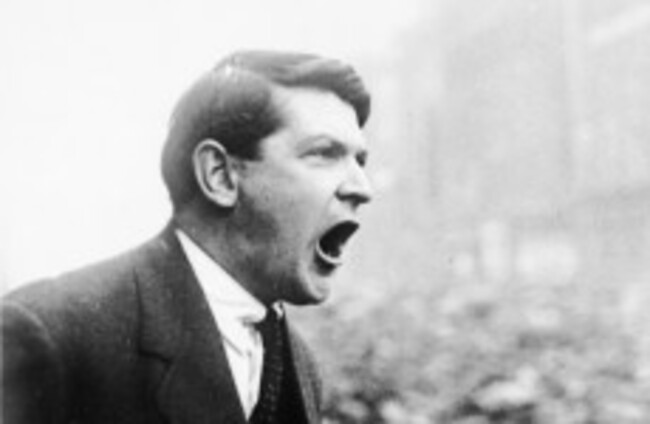
GEORGE WASHINGTON has defeated Michael Collins in a poll of British academics to identify Britain’s most formidable military foe, leaving the Corkonian in second place out of 20 military enemies.
The Irish revolutionary had finished in the top five of a public poll of 20 of Britain’s former military opponents, alongside Washington, Napoleon Bonaparte, Erwin Rommel and Mustafa Ataturk.
A vote among the top 5 taken at the National Army Museum on Saturday evening decided Washington was the strongest foe, with 30 votes, compared to Collins on 14, Bonaparte on 12, German field marshal Rommel on 7 and Ataturk, the founder of modern Turkey, on 4.
Reuters quotes historian Stephen Brumwell, who was arguing the case for Washington, as suggesting America’s victory in the war of independence had been “the worst defeat for the British Empire, ever. His personal leadership was crucial.
“His army was always under strength, hungry, badly supplied. He shared the dangers of his men. Anyone other than Washington would have given up the fight. He came to personify the cause, and the scale of his victory was immense.”
The Irish Times reported that UCC historian Gabriel Doherty, who was arguing for Collins, made reference to the Corkonian’s administrative skills and the fact that he was able to act as a politician and administrator as well as a military commander.
The inclusion of Collins in the final five had raised eyebrows last month, though not as many as the inclusion of Ataturk, who had been the target of a concerted online campaign which forced poll organisers to remove some of his votes.
The poll only considered enemies who had commanded forces in the field against Britain since the 17th century, meaning the most probable entry, Adolf Hitler, was not eligible.
Collins had fought in the 1916 Rising was interned in Wales. He was later elected an MP for Sinn Féin but abstained from Westminster, as all other Sinn Féin MPs did, and instead took a seat in a revolutionary assembly which became the Dáil.
After the war of independence that followed, Collins – by then the finance minister in the cabinet of Éamon de Valera – led a delegation to London to negotiate the Anglo-Irish Treaty which granted Ireland the status of a dominion with the British Empire, giving it a domestic parliament.
That treaty prompted De Valera to quit power, leaving Collins as the Chairman of the Irish Free State. De Valera’s anti-Treaty side prompted a Civil War which claimed Collins’ life in an ambush at Béal na mBláth, Co Cork, in 1922.

To embed this post, copy the code below on your site














have your say