Sign in. It’s quick, free and it’s up to you.
An account is an optional way to support the work we do. Find out more.
Sign in. It’s quick, free and it’s up to you.
An account is an optional way to support the work we do. Find out more.
(Alt é seo ónár bhfoireann Gaeltachta. Is féidir leat an bunleagan as Gaeilge a léamh anseo.)
THERE WERE NO protests on the country’s roads, no long queues at fuel stations and no one unable to get to work on the original script for the day the Taoiseach would spend today announcing good news in the Gaeltacht of his home county of Cork.
Mícheál Martin had a packed schedule on home soil today. First he travelled to Macroom, where he called into two factories — Danone, the food ingredient manufacturer, and Cygnum, a company that builds timber frames for modular homes.
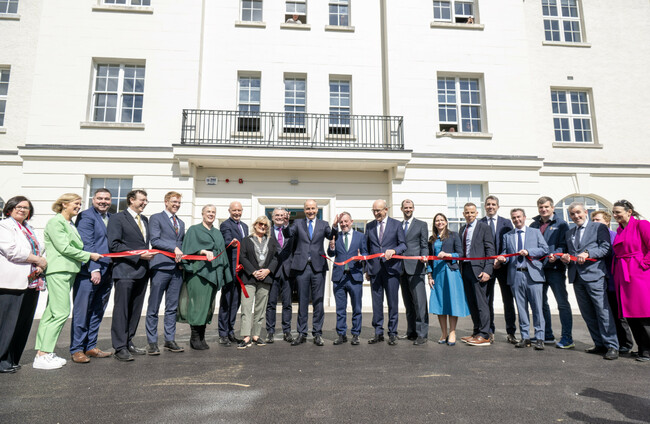
After those two events, the Taoiseach had to make his way west to the Muskerry Gaeltacht, where he was opening Campus Íosagáin, a regional enterprise hub located in the refurbished building of Coláiste Íosagáin in Ballyvourney. When that residential school was open, GAA commentator Mícheál Ó Muircheartaigh, singer Seán Ó Sé and composer Peadar Ó Riada were among its past pupils.
Under normal circumstances he would have been able to travel to Ballyvourney via the N22, a road he himself opened in 2022, but it was closed due to a fuel protest. As a result, the journey had to be made on the old N22, now called the R618.
At Campus Íosagáin, a large crowd was waiting to greet him, among them senior representatives of Údarás na Gaeltachta — who were behind the development which has cost €10 million to date — representatives from Enterprise Ireland, who also supported the project, along with locals, past pupils, former teachers and many others.
Unlike many others who were on the roads today, the Taoiseach was not late for any of his appointments. When he stepped out of his car at Cygnum — a company that has invested in excess of €18 million to extend its factory, enabling the team to double the number of homes they produce from around 1,400 per year to 2,800 — he apologised in a light-hearted way to those gathered to welcome him for being slightly early.
Many people found themselves in the same boat that day, as nobody was sure whether they would be able to travel their usual route from A to B — and as a result, very few people arrived exactly on time, with some coming too early and others too late.
As the Taoiseach was arriving at Cygnum, a small group of protesters had made their way to the gate of the industrial estate just outside Macroom, but there was a significant Garda presence ensuring there was no risk of any delay.
Inside the building, the Taoiseach had good news to announce: “This strong investment aligns with the Government’s priority of increasing housing supply, supporting regional development and building a more sustainable future for Ireland,” he said.
This new facility will help increase capacity and will support the delivery of high-quality homes for communities across the country.
When he arrived at the doors of Campus Íosagáin, a large crowd was waiting to welcome him, everyone dressed in fine attire with polished shoes. As he was entering the newly restored building, a man in a high-visibility vest stopped him, telling him to “do something about the diesel” and accusing him of running away from the Irish people. He did not pause for even half a second to engage with the protester who had slipped into the crowd.
After a tour of the building, the Taoiseach — who was born and raised on the banks of the Lee — found himself in the ‘Lee Room’ at the top of the building to deliver a speech on this momentous occasion.
He said the range of partners supporting Údarás na Gaeltachta in the restoration of the building — Enterprise Ireland, University College Cork (UCC), Munster Technological University (MTU) and Cork County Council — made clear the ambition behind the project.
By investing in ambitious strategic projects like Campus Íosagáin, we can transform our rural and Gaeltacht communities right across Ireland.
After a number of other speeches and photographs, he managed to slip downstairs to speak with reporters from the national media — The Journal among them — though there was little interest in the good news he had been announcing. One topic was on everyone’s lips: the protests.
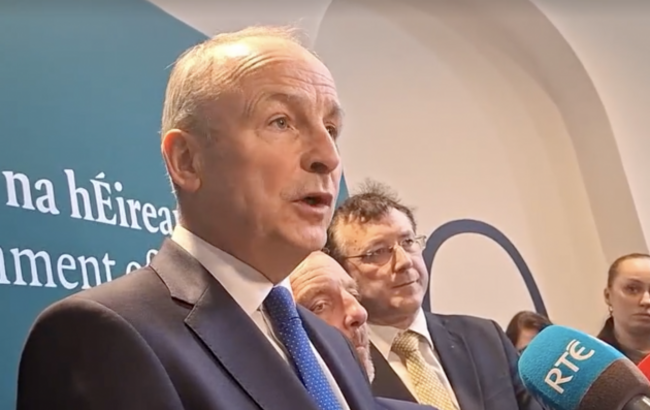
“People are under pressure, there is no doubt about that, prices are very high because of the war in the Middle East and we are aware of that — there is pressure on businesses, there is pressure on everyone. We had a package a fortnight ago, one of the biggest, almost, anywhere in Europe to date, and we said we would be reviewing that scheme,” he said in response to a question from The Journal.
“We are meeting with various organisations, listening to them, asking what more we can do to ease the pressure.
“In this protest there is a mix — that is the difficulty we have — who is in charge, who is behind it.
There are certain people who are genuinely under pressure but in my view there are ways of dealing with these issues and we are willing to listen to people.
The Taoiseach’s frustration was evident as he spoke about the protests blocking fuel from being distributed from the ports and chemicals for water treatment from leaving the port facility in Foynes in Limerick, but he left reporters with this key message:
“Keep doing your work, but I have a fundamental message for those who are trying to prevent people from going to work or going about their daily business — stop the blockading of roads and ports. We have no objection to protests; people are entitled to protest, but this goes beyond a legitimate protest. When you start blocking access to ports, oil refineries and so on, that is a different matter entirely.”
While the Taoiseach was grateful for today’s tour of good news, it is clear that a challenging weekend lies ahead for him and his Government colleagues.
The Journal’s Gaeltacht initiative is supported by the Local Democracy Reporting Scheme.
This article was originally written in the reporter’s native Irish and has been translated to English here. AI was used as part of the translation process before final edits.

To embed this post, copy the code below on your site















have your say