Sign in. It’s quick, free and it’s up to you.
An account is an optional way to support the work we do. Find out more.
Sign in. It’s quick, free and it’s up to you.
An account is an optional way to support the work we do. Find out more.

Nearly 200,000 VACCINE doses against Covid-19 were administered in Ireland in January, with 50,900 people vaccinated in the last week of the month.
199,800 doses of the vaccine were administered during January, according to figures from the HSE.
At the start of January, Minister for Health Donnelly said that Ireland would deliver around 240,000 vaccines during the first six weeks of the year.
Between 25 and 31 January, 50,900 people received a vaccine dose, most of which were second doses.
43,000 frontline healthcare workers received their second dose in the last week and are now fully vaccinated, alongside 1,500 who were given their first dose.
In long-term residential care facilities, 3,800 first doses and 2,600 second doses were administered in the last week of January.
Donnelly said the rollout was “thanks to the on-going efforts of our brilliant vaccination teams, the Ambulance Service, the Defence Forces and many others right across the HSE”.
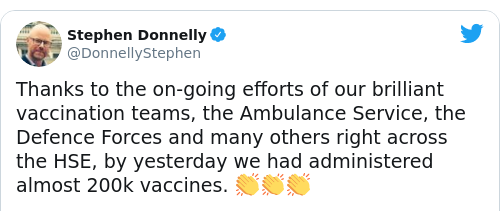 Stephen Donnelly / Twitter
 / Twitter
Stephen Donnelly / Twitter
Stephen Donnelly / Twitter / Twitter
The first priority groups to receive vaccines were people aged 65 and older who live in long-term care facilities and frontline healthcare workers.
Vaccines for people aged 85 and older, who are in the next priority group, are due to begin soon in February.
Guidance from the HSE says that people aged 85 and older will be contacted by their GP when a vaccine is available.
Updates on the number of people vaccinated in Ireland are currently being provided by the HSE twice a week.
The HSE said on Friday that it should be in a position to provide daily updates “in the next week or two” as several TDs raised concerns over the need for more timely figures.
The HSE’s vaccination lead David Walsh said he was aware daily figures are “of great concern” and that the HSE was “working towards that”.
“We’ve been working in quite a difficult environments across long-term care and hospital settings, which weren’t set up for the system, and we’re still trying to catch up with that element of it,” he said.

To embed this post, copy the code below on your site














have your say