Sign in. It’s quick, free and it’s up to you.
An account is an optional way to support the work we do. Find out more.
Sign in. It’s quick, free and it’s up to you.
An account is an optional way to support the work we do. Find out more.
HOW WOULD YOU feel if this article was written by ChatGPT?
A major survey of Irish people’s news consumption, and Irish attitudes to the media, has found 19% are somewhat or even very comfortable with the idea of news mainly produced by AI, with some human oversight.
That’s up by four percentage points in just one year, the annual Reuters Institute Digital News Report for Ireland found.
Under-35s are almost twice as comfortable with the idea of AI-produced news as over-35s.
Five percent of Irish people say they’re already getting some of their news from AI chatbots.
(This article was entirely written by a human, by the way.)
The annual research report, published today, finds Irish people remain more engaged with the news – and more trusting of the news media – than audiences in other countries, including the US and the UK.
Irish young people aged 18-24 are now more interested in the news than they have been at any point since the Covid-19 pandemic.
However, this high point still amounts to just 39% of 18-24-year-olds expressing an interest in the news.
Taking a longer term perspective, there is no question that overall engagement in the news is steadily declining in Ireland, as it is internationally. In 2015, over 70% of Irish people were “extremely” or “very” interested in the news; now, the equivalent figure is 56%.
The prevalence of news avoidance is also clear. While there was a 3 point drop year-on-year in the number of Irish people reporting that they are avoiding the news, to 41%, the proportion of people avoiding the news is much higher than it was in 2017 when just 28% were doing so.
The report’s authors noted that consumption of online news, including social media, is at its lowest point in a decade.
So why are people turning away from the news? Reuters Institute researchers, who have discovered the same trend across a number of countries, have previously noted that research in this area suggests people may be more engaged by other forms of online content, such as short-form video.
Other factors that may be at play include the deprioritisation of news on social media platforms, and negative personal perceptions of the news, particularly among people who left education after school; the decline in news engagement is steeper among this group.
As well as being more interested in news compared with audiences in other countries, Irish people also have greater trust in news media.
While 50% of Irish people trust the news most of the time, the equivalent figure was 35% in the UK, 30% in the US, and 39% on average across a number of European countries.
Irish people are also more likely to pay for news, with 20% now doing so, up 3% in a year. This was particularly driven by people aged between 35 and 44. In the UK, just 10% of people pay for news.
More than two thirds of Irish people are concerned about what is real and what is fake online, with older people particularly worried.
More than half of respondents pointed the finger at social media platforms X, TikTok and Facebook as channels for false and misleading information, while just 17% said the same about news websites. Over half of Irish respondents believed online influencers and personalities posed a threat when it came to false and misleading information.
Irish people were more likely than those in other jurisdictions surveyed to trust journalists not to disseminated false and misleading information.
The survey found fact-checking – verifying the accuracy of public claims and statements – was seen by audiences as an important action the news media can undertake to improve trust. The Journal’s FactCheck unit was noted as the only verified Irish signatory of the International Fact-Checking Network.
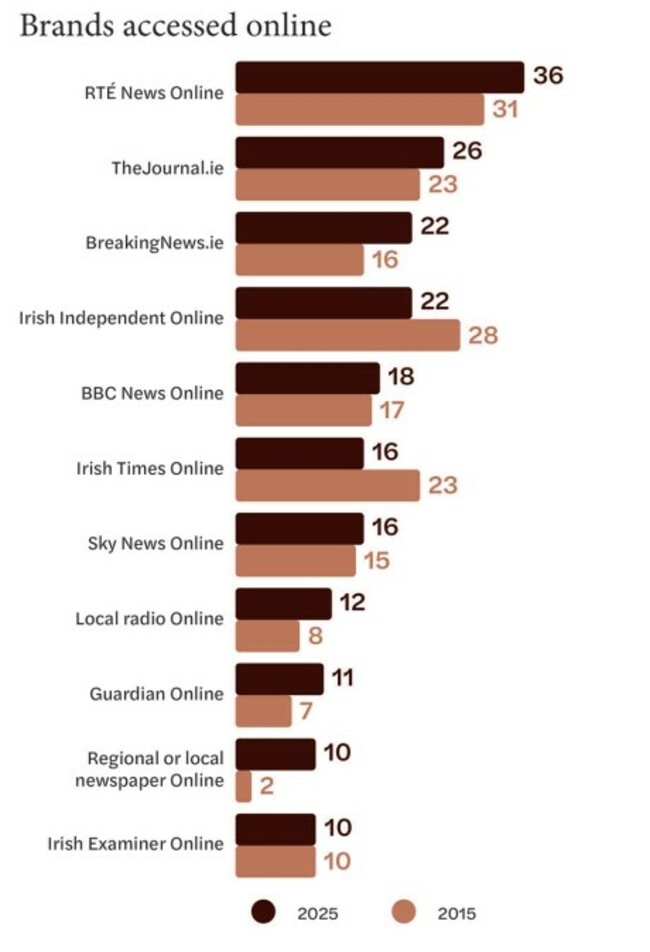
The Journal was the second most used online news outlet, with just over one in four respondents indicating they had read it in the past week, behind only RTÉ on 36%. BreakingNews.ie and the Irish Independent were the next most used, each at 22%.
The results for most frequently accessed sources of news online were similar, with 26% of people using RTÉ three or more times per week, followed by The Journal on 13% and the Irish Independent on 12%.
Offline, RTÉ TV and radio news were the most accessed sources of news, at 44% and 29% respectively, followed by Sky News at 27%.
Older audiences are the most reliant on radio news, with just 16% of people aged 18-24 using the radio as a source of news, as compared with over half of those aged 65 and older.
Irish people are bigger consumers of news podcasts than people in the UK and other European countries on average. However, this is still very much a minority pursuit, with just 12% of Irish people reporting they had listened to a podcast as a source of news in the past week.
Although a growing number of people indicated they would be comfortable with news produced mainly by AI with some human oversight, 45% of people believed AI would make news less trustworthy, while 40% said it would make the news less accurate.
Nevertheless, the survey pointed to an appetite for AI-powered features such as news summaries, or homepages customised based on readers’ interests.
The survey of 2,000 people was conducted by pollsters from YouGov and Cint using an online questionnaire, a type of polling that tends to under-represent older and less affluent people, meaning online news consumption is likely to be over-represented in the results and traditional offline use under-represented.
The type of sampling used in the survey meant a change of 2 percentage points or less was unlikely to be statistically significant.
The research was undertaken by the Reuters Institute for the Study of Journalism at the University of Oxford, with analysis of the Irish data provided by the DCU Institute for Future Media, Democracy and Society. It was funded by Coimisiún na Meán.

To embed this post, copy the code below on your site














have your say