We need your help now

Support from readers like you keeps The Journal open.

You are visiting us because we have something you value. Independent, unbiased news that tells the truth. Advertising revenue goes some way to support our mission, but this year it has not been enough.

If you've seen value in our reporting, please contribute what you can, so we can continue to produce accurate and meaningful journalism. For everyone who needs it.

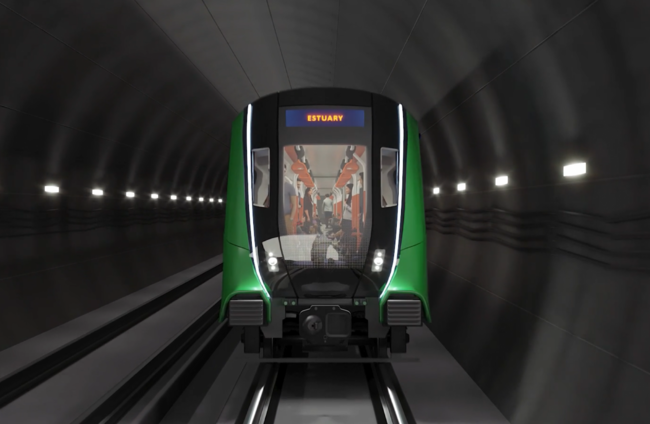
An artist's impression of a Metrolink tram Transport Infrastructure Ireland

French company named on UN list for links to Israeli settlements makes joint bid to run Metrolink

Alstom, one of the world’s largest rail companies, has already bid to operate the Luas.

A FRENCH MULTINATIONAL that has been named on a list of companies for its links to illegal Israeli settlements is among an international consortium bidding to run Dublin’s Metrolink project.

Alstom, one of the world’s largest rail companies, is named on a United Nations list that names businesses and parent companies whose subsidiaries enable the continued existence of Israeli settlements.

Companies on the list are deemed to be involved in any of 10 different activities that are deemed to facilitate the existence of Israeli settlements, which are deemed illegal under international law.

Alstom is named because the UN says it has provided transport infrastructure that supports the existence of the settlements, and because of its use of natural resources in occupied Palestinian territories for business purposes.

The company manufactures rolling stock and other forms of rail infrastructure, including high-speed trains, metros, monorails and trams, as well as signalling.

Among its most famous products are trains for France’s high-speed intercity rail service, the TGV.

It has already manufactured all trams for Dublin’s Luas system and is producing electric trains for Dublin’s DART+ project.

Earlier this year, Alstom made a joint bid with an Italian company to operate and maintain the Luas.

Now it has emerged that the company has established a consortium to run the Metrolink, along with FCC, Meridiam, John Laing, and RATP Dev.

The consortium will bid for the design, construction, financing, operation and maintenance of the Metrolink.

A joint statement said that the consortium “brings together leading expertise across infrastructure development, automated metro operation and maintenance, financing and engineering”.

Alstom will contribute its “extensive experience” in metro systems and railway technology, FCC will lead the civil engineering aspects, and RATP Dev will provide operational and maintenance expertise.

Meanwhile Meridiam and John Laing are both  leading international investors in infrastructure projects.

FCC noted that it has “extensive experience” in major civil engineering and industrial projects in Ireland – the company developed the M50 motorway, the N6 in Galway, TU Dublin’s Grangegorman campus and the extension of the North Runway at Dublin Airport.

RATP Dev meanwhile is best known for operating the public transport system in Paris and is currently engaged in five major greenfield automated metro projects in Paris, Sydney, Singapore, Riyadh and Doha.

Alstom is the only one of the five companies named on the UN database.

A spokesperson for the company previously told The Journal Investigates that it does not have any activity within or related to occupied Palestinian territories, and it has requested removal from the UN database when it is next updated

If approved, construction of the long-delayed Metrolink in Dublin could begin in 2028 and is expected to cost up to €12 billion.

Both Dermot Desmond and Ryanair boss Michael O’Leary have criticised the Metrolink.

Desmond claimed the Metrolink will not be “required” due to self-driving, autonomous vehicles while O’Leary criticised the costs involved.

O’Leary asked how Ireland could “seriously consider wasting approximately €20 billion of taxpayer money”. 

A €23 billion price tag first-appeared in a ministerial briefing to Darragh O’Brien earlier this year, a figure that was a ‘potential upper range’ cost but was not the estimated cost.

However, The Journal‘s FactCheck has previously highlighted that the figure is a misleading claim. 

There is a 95% chance the figure will not go above €23 billion – but the more-likely price range is between €7.16 billion and €12.25 billion.

Readers like you are keeping these stories free for everyone...
A mix of advertising and supporting contributions helps keep paywalls away from valuable information like this article. Over 5,000 readers like you have already stepped up and support us with a monthly payment or a once-off donation.

Close
84 Comments
This is YOUR comments community. Stay civil, stay constructive, stay on topic. Please familiarise yourself with our comments policy here before taking part.
Leave a Comment
    Submit a report
    Please help us understand how this comment violates our community guidelines.
    Thank you for the feedback
    Your feedback has been sent to our team for review.

    Leave a commentcancel

     
    JournalTv
    News in 60 seconds