We need your help now

Support from readers like you keeps The Journal open.

You are visiting us because we have something you value. Independent, unbiased news that tells the truth. Advertising revenue goes some way to support our mission, but this year it has not been enough.

If you've seen value in our reporting, please contribute what you can, so we can continue to produce accurate and meaningful journalism. For everyone who needs it.

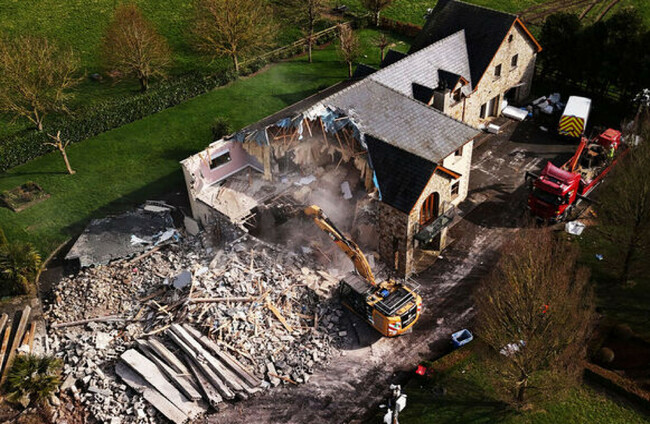
Demolition work under way at the house in Bohermeen, Co Meath RollingNews.ie

Does Ireland have a problem with ignoring planning permission?

It seems unlikely there is a huge chunk of people completely ignoring planning rules – but lower-level breaches are more common, writes Paul O’Donoghue.

A SAGA RUNNING for 20 years finally came to a close this week, with the demolition of a lavish home in Faughan Hill in Meath.

The property is being knocked down following a court order that it was built in 2006 without planning permission.

There has been plenty of back and forth over whether the court order was the correct one, with seemingly endless appeals since the local council refused to grant retention permission all the way back in 2008.

Plenty of arguments were put forward to keep the property, with the owners claiming that they were trying to ‘rectify’ the situation for years.

But what is not in dispute: the home was built without planning permission.

Pushing ahead with development, despite not having the right to, is not something unique to this case.

But is it a major issue, and how do local authorities normally deal with it?

When it comes to the number of properties built without planning permission, it’s worth noting right off the bat that it is quite difficult to tell exactly how widespread this is.

That is because Ireland does not publish figures tracking the number of unauthorised developments (residential or commercial) discovered by local councils each year.

The National Oversight and Audit Commission (NOAC) does, however, have figures showing planning enforcement investigations.

Its most recent report on the area found that local councils in Ireland investigate about 7,400 planning enforcement cases per year.

This category includes any building that has an issue with planning.

So this includes residential properties built without proper permission, like the home in Meath, and it also includes commercial properties, such as a shop with incorrect signage.

As of 2024 there were almost 22,000 cases under investigation in total, pointing to a significant backlog. This number has steadily increased over time, although this could be expected due to the country’s rising population.

So if councils started investigating about 7,400 cases, how many did they get through in a year?

In 2024, which is the most recent year available, it was almost 6,400.

So, what happens in these cases? This is where things get a bit murky.

The report does not go into detail on how many of these unauthorised developments result in removal orders or court action.

In fact, as noted, we don’t even know how many cases are residential versus commercial.

To get a better idea of this we can look at this story by the Irish Independent, which did Trojan work in asking all local councils in Ireland for data on planning disputes for residential dwellings in the last 15 years.

Multiple councils did not respond to the publication. Of the ones that did, Wexford County Council had the highest number of cases, opening 111 files about dwelling offences over the 15-year period.

Louth County Council came next with 51, while the remainder tended to have between one or two dozen cases, with many being lower.

A few notable authorities, such as Dublin City Council, did not record any cases.

The country’s councils deal with thousands of new planning enforcement cases annually.

The fact that the vast majority have not recorded more than two dozen instances over a 15-year period indicates that flagrant residential breaches – where someone builds an entire home without planning permission, such as the Faughan Hill property – are likely relatively rare.

However, the Irish Independent article also touched on another interesting aspect: the number of properties which received retention permission.

This is a type of planning permission applied for after a development has already been built without the necessary initial permission. This can include both entire properties and smaller works, such as unauthorised renovations or extensions.

In many cases, officials will grant retention.

Louth County Council, for example, said that “most” of its 51 cases were regularised with retention permission. It was a similar story in several other counties, such as Cavan and Carlow.

The commercial side of things

This raises the question of whether some people prefer to ‘ask forgiveness, not permission’.

In other words, pushing ahead with development work without planning permission, and then simply rolling the dice on applying for retention permission later.

For some companies, this was briefly commonplace.

Several years ago, US coffee giant Starbucks opened multiple outlets without planning permission. The company applied for council clearance only once it had already built a store.

In many cases, local authorities went as far as warning Starbucks not to build its stores without prior approval.

However, the company received retention permission in most cases anyway, with critics saying this essentially allowed the company to bypass the normal planning process.

Some councils put their foot down and took legal action.

However, as was the case with Faughan Hill, the process was slow. It took three years for Cork City Council to shut an unauthorised store in the city centre, despite sending multiple warnings.

Discount retailer Dealz also had multiple run-ins with local councils over similar issues – opening shops without proper planning permission.

Again, enforcement was patchy and slow – for example, a final decision over one of its stores was twice pushed back by planning officials.

However, more recently it has pledged to act ‘responsibly’ when it comes to planning rules.

These instances are notable and attract plenty of attention, and they do point to the fact that those who are determined enough can likely frustrate the planning system.

There does not tend to be much of a ‘stick’ – the worst case scenario is that you have to get rid of the unauthorised development after already having got to use it during the dispute. And the legal process can be greatly elongated with multiple appeals.

However, the figures from the Irish Independent indicate that it is still rare for individuals to push ahead and build with no permission.

The stats from the NOAC give a somewhat higher-level picture.

Going back to a stat we mentioned earlier – councils closed 6,400 planning enforcement cases in 2024.

Of that number, 40% were dismissed as ‘trivial, minor or without foundation’. Or, they were closed because the cases were statute barred – if an unauthorised development, such as an extension, has been in place for more than seven years, the council generally can’t take an enforcement action.

Some 8% of cases were closed through negotiations, while the remaining 52% were shut ‘due to enforcement proceedings’.

This last one is a broad category. It could mean that the council ‘won’ the case, and the person subject to enforcement complied. Or it could mean that the case went to court.

Importantly, it does not tell us the exact outcome.

That is perhaps the key to take away here – that Ireland’s figures around planning enforcement are patchy.

Based on what we know, it seems unlikely that there is an enormous chunk of people completely ignoring planning rules to build entire properties.

However, lower-level breaches are more common and it can be a difficult and lengthy process for councils to enforce the rules.

It’s hard to say definitively how big an issue this is. But as has been demonstrated on multiple occasions, Ireland’s planning system is one which determined actors are more than capable of frustrating.

Readers like you are keeping these stories free for everyone...
A mix of advertising and supporting contributions helps keep paywalls away from valuable information like this article. Over 5,000 readers like you have already stepped up and support us with a monthly payment or a once-off donation.

Close
9 Comments
This is YOUR comments community. Stay civil, stay constructive, stay on topic. Please familiarise yourself with our comments policy here before taking part.
Leave a Comment
    Submit a report
    Please help us understand how this comment violates our community guidelines.
    Thank you for the feedback
    Your feedback has been sent to our team for review.

    Leave a commentcancel

     
    JournalTv
    News in 60 seconds