Sign in. It’s quick, free and it’s up to you.
An account is an optional way to support the work we do. Find out more.
Sign in. It’s quick, free and it’s up to you.
An account is an optional way to support the work we do. Find out more.

TEN YEARS AGO, Irish social media users were locked in a holy alliance in an annual show of unity against the use of the term St Patty’s Day.
The phrase – an Americanised shorthand for St Patrick’s Day – was a spectre that had haunted Ireland since we adopted Facebook and Twitter en masse, allowing us to see how people from across the globe were mangling our colloquialisms.
Every March, timelines filled with variations of the message “it’s Paddy’s Day, not Patty’s Day”, a tradition that peaked when cartoonist Maria Doyle (AKA TwistedDoodles) first published a viral guide in 2016 explaining the problem to our American cousins.
The trend was indicative of a more innocent online age, but it also foreshadowed the impact of globalised conversations about St Patrick’s Day on social media.
Over the past week, my various feeds were filled with commentary about Paddy’s Day that bore no connection to the real-life celebration happening in Irish cities and towns.
Instead, I saw memes, debates and discussions that said more about the state of platforms like X and Facebook than they did about Ireland and Irishness in 2026.
Both platforms showcased how caustic takes about Irishness from the US could force themselves into timelines like mine.
These takes appeared in my feed unprompted, partly from similar accounts to those I follow as The Journal’s FactCheck editor.
They were surfaced by algorithms rather than me choosing to seek them out, another reminder of how platforms choose what they think is worth showing.
The more ridiculous of these included Christian MAGA posters who shared orange squares to their profiles in Protestant defiance against what they saw as 17 March being associated with Catholic pride, despite St Patrick’s lifetime preceding the Reformation by more than a millennium.
Even more outlandish was a suggestion by conspiracy theorist Naomi Wolf that Dublin City Council may have used an illustration of snakes in its branding of the capital’s St Patrick’s Festival to infuse the holiday with a Satanic reference.
These are the types of posts that X starts to feed you once you delve deeply enough into the parallel Patrick’s Day universe that exists online.
The more common talking point, however, was the promotion of a white supremacist view that conflates Irishness with racial purity, a theme that has been regurgitated many times over by anti-immigrant groups both here and abroad.
This content was consistently pushed into my feed, with X and Facebook deciding that this was a version of Ireland I was most likely to engage with once I’d clicked a few similar posts.
There is a particular obsession among certain cohorts of users online, who see Ireland as a bastion of whiteness in a world that is slowly decaying because of multiculturalism.
One expression of this idea has compared Ireland to The Shire in the Lord of the Rings, and foreigners as “orcs” coming to rape and pillage us without us knowing it - a nod to the Great Replacement conspiracy theory.
Depressingly, St Patrick’s Day has now become an international holiday for those who want to tell people how much they think about this.
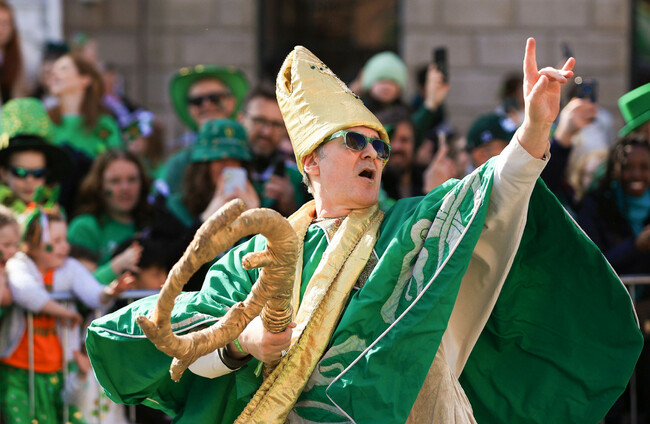
When footage of parades emerged online this week, it was accompanied by a deluge of claims that participation of non-white individuals evidenced the ongoing decline of Irish culture and heritage.
Although many Irish-based accounts took part, there was no shortage of users from outside Ireland that were eager to hop on the bandwagon for the week that was in it.
The online marketplace of racist ideas being what it is, social media also facilitated transatlantic exchanges in the other direction.
On X, anti-immigration protester Kirk Loco managed to go viral by sharing a video of President Catherine Connolly’s inaugural Patrick’s Day speech, which touched on immigration and refugees, claiming it was “woke nonsense” and “socialist propaganda”.
His post was seen millions of times after being re-shared by everyone from far-right political activist Jack Posobiec, actor turned Maga superfan James Woods and the aforementioned Naomi Wolf.
Connolly’s speech was intended primarily for an Irish audience as part of an address for our holiday, but the nature of social media meant it could be detached from its original context and weaponised by audiences with little connection to Ireland.
This happened because platforms are no longer a place where people go to connect, as they did once upon a time.
Instead, they are designed with algorithms that reward posts which provoke strong reactions – especially when that reaction is anger or some other form of outrage.
It results in a feedback loop where the most divisive interpretations of an event or a moment like Connolly’s speech are most widely seen, and discussions about a topic completely eclipse the original point being made or why.
An event like St Patrick’s Day is rocket fuel for this, because it’s a holiday celebrated across the world that most people know about, but which has an underlying meaning that’s malleable enough for anyone to interpret it as they’d like.
Throw in the fact that it relates to a European country that was once associated with devout Christian values, and it’s even easier to see how it’s a magnet for extremist rhetoric – just don’t mention the role played by immigrants in making it so widely known.
If you’re an outsider looking in, you might not know that these views aren’t widely held in Ireland and that they’re being amplified by a small number of highly active accounts.
Who ever thought we’d miss shouting about St Patty’s Day?

To embed this post, copy the code below on your site















have your say