Sign in. It’s quick, free and it’s up to you.
An account is an optional way to support the work we do. Find out more.
Sign in. It’s quick, free and it’s up to you.
An account is an optional way to support the work we do. Find out more.
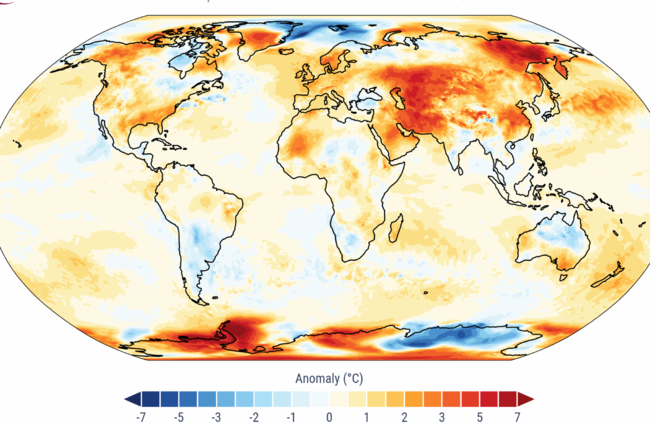
THIS APRIL WAS almost the hottest of modern records, coming second only to April 2024.
The average global surface air temperature last month was 14.96 degrees Celsius, the second hottest since modern records at the start of the industrial era, according to the latest monthly climate bulletin from Europe’s Copernicus Climate Change Service.
That was 0.60 of a degree above the 1991-2020 average for April and 1.51 degrees above the estimated 1850-1900 average.
While those margins may appear small on paper, the world is actually very sensitive to temperatures changes; if sustained over many years, increases in global average temperatures of even a few degrees would be enough to send the world into all-out climate crisis.
Countries agreed under the Paris Agreement in 2015 to try to limit rises in global average temperatures compared to pre-industrial times to to 1.5 degrees.
April 2025 was the 21st month out of the last 22 where the global average surface air temperature was more than 1.5 degrees above the pre-industrial level.
The goal of the Paris Agreement has not technically been breached – the rise will need to be sustained over a longer period of time for it to be considered that the Agreement’s target has been missed – but it is a concerning signal that the world is heading in the wrong direction.
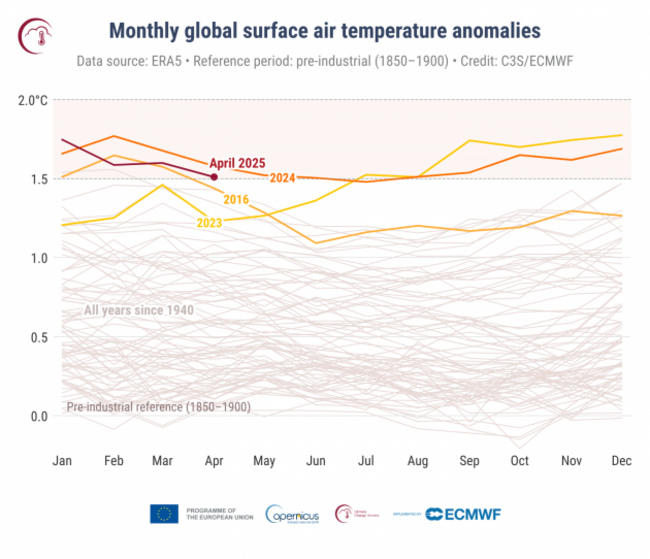
The 12-month period of May 2024 to April 2025 was 0.70 of a degree above the 1991-2020 average and 1.58 degrees above the pre-industrial level.
April 2025 was 0.07 of a degree cooler than April 2024, the hottest on record, and 0.07 of a degree warmer than the third hottest, which was April 2016.
“Globally, April 2025 was the second-hottest April on record, continuing the long sequence of months over 1.5ºC above pre-industrial,” said Samantha Burgess, strategic lead for climate at the European Centre for Medium-Range Weather Forecasts, which runs the Copernicus service.
“Continuous climate monitoring is an essential tool for understanding and responding to the ongoing changes of our climate system,” Burgess said.
In Europe, the average temperature was 9.38 degrees Celsius, which is 1.01 degrees above the 1991-2020 average for April, making it the sixth-warmest April for Europe.
The global average sea surface temperature between the latitudes of 60°S–60°N was 20.89 degrees Celsius, the second-highest value on record for the month — 0.15 of a degree below the April 2024 record.
Sea surface temperatures “remained unusually high” in many ocean basins and seas, including large areas of the North Atlantic Ocean and the Mediterranean Sea.
Arctic sea ice extent was 3% below average, the sixth lowest monthly extent for April in the 47-year satellite record, and Antarctic sea ice extent was 10% below average, making it the 10th lowest on record for the month.

To embed this post, copy the code below on your site













have your say