We need your help now

Support from readers like you keeps The Journal open.

You are visiting us because we have something you value. Independent, unbiased news that tells the truth. Advertising revenue goes some way to support our mission, but this year it has not been enough.

If you've seen value in our reporting, please contribute what you can, so we can continue to produce accurate and meaningful journalism. For everyone who needs it.

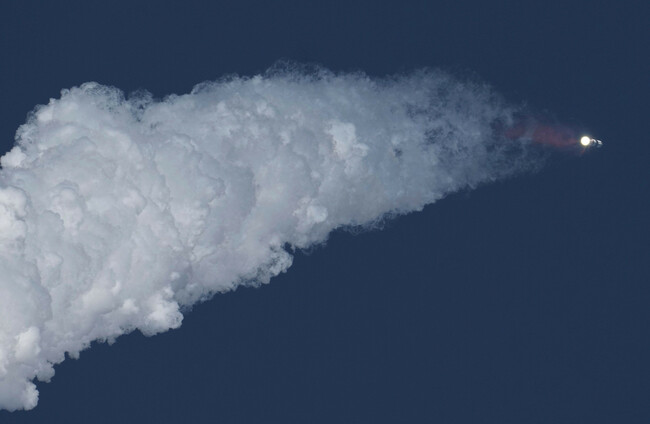
SpaceX's rocket Starship makes a test flight from Starbase in Boca Chica, Texas, Thursday, March 6, 2025. Alamy Stock Photo

Debris from SpaceX Starship rocket disrupts US air traffic after breaking up during launch

Contact was lost as the spacecraft went into an out-of-control spin.

SPACEX LAUNCHED ANOTHER mammoth Starship rocket yesterday, but lost contact minutes into the test flight as the spacecraft came tumbling down and broke apart.

The incident happened nearly two months after an explosion sent flaming debris raining down on the Turks and Caicos Islands in the Caribbean.

Wreckage from the latest explosion was seen streaming from the skies over Florida. The New York Times reported that the falling debris disrupted air traffic at a number of US airports.

The falling debris disrupted flights in the Floridian cities of Miami, Orlando, Palm Beach and Fort Lauderdale, and even as far away as Philadelphia.

The Federal Aviation Administration ordered the grounding of planes in response, citing

The Journal / YouTube

“space launch debris”. 


It was not immediately known whether the spacecraft’s self-destruct system had kicked in to blow it up after the 403-foot rocket blasted off from Texas.

SpaceX caught the first-stage booster back at the pad with giant mechanical arms, but engines on the spacecraft on top started shutting down as it streaked eastward for what was supposed to be a controlled entry over the Indian Ocean.

Contact was lost as the spacecraft went into an out-of-control spin.

Starship reached nearly 90 miles in altitude before trouble struck and before four mock satellites could be deployed.

It was not immediately clear where it came down, but images of flaming debris were captured from Florida, including near Cape Canaveral, and posted online.

The space skimming flight was supposed to last an hour.

Associated Press / YouTube

“Unfortunately this happened last time too, so we have some practice at this now,” SpaceX flight commentator Dan Huot said from the launch site.

SpaceX later confirmed that the spacecraft experienced “a rapid unscheduled disassembly” during the ascent engine firing.

“Our team immediately began coordination with safety officials to implement pre-planned contingency responses,” the company said in a statement posted online.

NASA has booked Starship to land its astronauts on the moon later this decade.

SpaceX’s Elon Musk is aiming for Mars with Starship, the world’s biggest and most powerful rocket.

Like last time, Starship had mock satellites to release once the craft reached space on this eighth test flight as a practice for future missions.

They resembled SpaceX’s Starlink internet satellites, thousands of which orbit Earth, and were meant to fall back down following their brief taste of space.

Starship’s flaps, computers and fuel system were redesigned in preparation for the next big step: returning the spacecraft to the launch site just like the booster.

During the last demo, SpaceX captured the booster at the launch pad, but the spacecraft blew up several minutes later over the Atlantic.

No injuries or major damage were reported.

According to an investigation that remains ongoing, leaking fuel triggered a series of fires that shut down the spacecraft’s engines. The on-board self-destruct system kicked in as planned.

SpaceX said it made several improvements to the spacecraft following the accident, and the Federal Aviation Administration recently cleared Starship once more for launch.

Starships soar out of the southernmost tip of Texas near the Mexican border. SpaceX is building another Starship complex at Cape Canaveral, home to the company’s smaller Falcon rockets that ferry astronauts and satellites to orbit.

Close
34 Comments
This is YOUR comments community. Stay civil, stay constructive, stay on topic. Please familiarise yourself with our comments policy here before taking part.
Leave a Comment
    Submit a report
    Please help us understand how this comment violates our community guidelines.
    Thank you for the feedback
    Your feedback has been sent to our team for review.

    Leave a commentcancel

     
    JournalTv
    News in 60 seconds