We need your help now

Support from readers like you keeps The Journal open.

You are visiting us because we have something you value. Independent, unbiased news that tells the truth. Advertising revenue goes some way to support our mission, but this year it has not been enough.

If you've seen value in our reporting, please contribute what you can, so we can continue to produce accurate and meaningful journalism. For everyone who needs it.

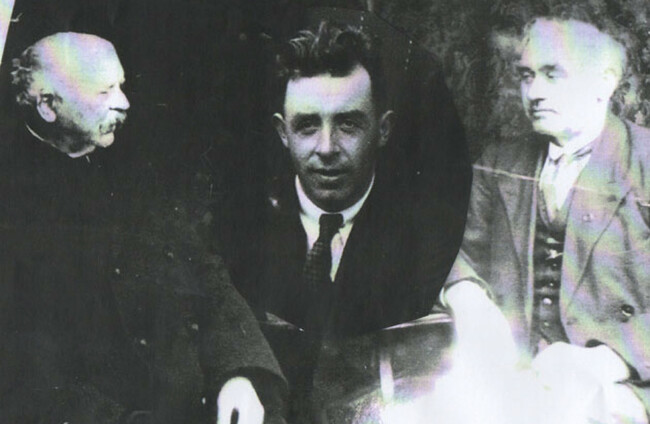
Pádraig Ó Cruadhlaoich (Gael na nGael), Pádraig Mac Suibhe (An Suibhneach Meann) agus Dómhnall Ó Ceocháin a bhunaigh an Dáimh Scoil ar Lá 'le Stíofáin 1925. Dáimh Scoil Mhúscraí

A Gaeltacht poetry institution asks whether AI could really write a poem

A poetry court in the bardic tradition was re-established 100 years ago will this year ask the question: can AI write poetry in Irish?

(Seo alt ónár bhfoireann Gaeltachta.  Is féidir an bunleagan as Gaeilge a léamh anseo.)

ARTIFICIAL INTELLIGENCE IS certainly having its moment during 2025 and its use can be detected throughout the internet and wider society. Now a Cork Gaeltacht institution is posing the questions: could AI be used to compose poetry? In Irish? 

I am the Cléireach (clerk) of Dáimh Scoil Mhúscraí, an annual poetry gathering that meets every year during the Christmas period, and one of the cléireach’s responsibilities is to write a question that will inspire the other poets and rhymers to write.

A Dáimh Scoil or poetry court is essentially a gathering where poets regale each other and an audience with the poems and songs they’ve composed during the previous year or so.  It goes back to an era in ancient Ireland where the bard or file was a high ranking person in the court of the Rí/King.

This year, since artificial intelligence has become so ubiquitous not to say controversial, the question arises whether it has the wit and the sensitivity to compose poetry? 

The answer to that question may be given at this year’s Dáimh Scoil which will be held this coming Sunday afternoon, 28 December, in Áras Éamon Mac Suibhne in Cúil Aodha in the Cork Gaeltacht. The Dáimh Scoil was re-established a century ago in the area after it had decline almost 100 years earlier.

Three friends meet in 1925

Pádraig Ó Cruadhlaoich (Gaedhal na nGaedhal, as he would call himself by his pen name), Dómhnall Ó Ceocháin and Pádraig Mac Suibhne (An Suibhneach Meann) were the three friends with an interest in poetry who came together on St. Stephen’s Day 1925 to establish the Baile Mhúirne School Faculty. The name was later changed to ensure that people from all corners of Mhúscraí, a Gaeltacht barony in the heart of County Cork, would be welcome.

There used to be a poetry court run by the O’Herlihy family in Baile Mhúirne in Tigh na Cille near  St Gobnait’s Cemetery in Baile Mhúirne, the resting place of many famous poets such as Seán Ó Riordáin. Aogán Ó Rathaille is said to have visited the Tigh na Cille school around the year 1700.

The Dáimh Scoil remains, at its heart, a sociable event. People come there, share poems and the rest listen and enjoy the works of the poets. There is no competition, no judging – the most the poet can expect is a round of laughter and applause. It’s not all comedy, however, as poems lamenting those who passed away during the year are also shared.

To this day, the Dáimh Scoil gathering is much like the kind of event that it was a century ago. The Uachtarán first recites an invitation written by him or her in verse and the poets have the opportunity to respond in verse.

This year, Seán Óg Ó Duinnín, headmaster of a local secondary school and a man who has co composed and co-produced two successful musicals, has been named as Uachtarán.

Seán Óg has poetry in his blood as his father, Seán, was a constant participant in the Dáimh Scoil over the years, reciting humorous and sad poems and more there annually until his death in 2009.

The tradition of poetry is also in my heritage. My father, Dónal, was a poet who participated in the Dáimh Scoil every year and my uncle, Peadar, was a Clerk before me. My great-uncle was one of the founders, the late Pádraig Mac Suibhne (An Suibhneach Meann).

An Poc ar Buile

Over the years since its establishment, the Dáimh Scoil  has gained a reputation for allowing poems and songs composed there to gain a wider audience. Indeed, ‘An Poc Ar Buile’, a song composed by Dómhnall Ó Mulláin, a farmer with a penchant for poetry who lived in Screathan na nGamhan west along the road from Cúil Aodha, topped the charts in Ireland in the early 1960s.

FleadhTV / YouTube

Sometime in the 1940s, Ó Mulláin sang An Poc Ar Buile for the first time at the College. About twenty years later, Seán Ó Sé, a singer from near Bantry but who was teaching in Cork city, and composer Seán Ó Riada, who following his success with the soundtrack of Mise Éire, recorded it.

It was as a result of that recording that the song became a chart-topper – in as much as there were charts of popular music at the time  – and the song with its rousing chorus has been sung often since by Ó Sé, so often, in fact, that he is nicknamed ‘An Pocar’ in Cork, and others.  It is most often heard at late night singing sessions.

Many other songs, songs you may have heard at school, such as ‘Táimse agus Máire’, ‘Scoil Bharr d’ínse’, ‘Na Táilliúirí’ and others, were composed by Ó MulláIn and other poets in the area for the Dáimh Scoil.

Dáimh Scoil poets, such as Pádraig Ó Cruadhlaoich, Pádraig Mac Suibhne and Proinsías Ó Ceallaigh, won many prizes at the Oireachtas na Gaeilge for their works of poetry and works by other writers such as Peadar Ó Liatháin and Séamus Ó Céilleachair were selected to be included on the Irish syllabus for secondary school students for a time.

When the Dáimh Scoil was at its peak, with hundreds attending the event from all corners of the country in the 1940s-1960s, life was much darker than it is now, without even public lights in Cúil Aodha let alone television or internet, so people had a lot of time to devote to composing poetry.

The Dáimh Scoil, like the bardic schools of old in Ireland, had a system for awarding a licence to writers who had achieved a high standard with their work, demonstrating that they had the appropriate skills and could call themselves poets.

There was no need for a licence to present your verse at the School Poetry Festival – and it’s still not required. It was rather a reminder that one could improve one’s skills and add polish to one’s work. Poetry has rules regarding rhythm, rhyme, meter, syllable structure, and the like, and they can be learned to help compose better and more poetic work.

The cléireach’s primary obligation is to compose an appropriate question to test and inspire the poets who attend the Dáimh Scoil. In previous years there were questions about the oil crisis in the 70s, about the prosperity that came during the Celtic Tiger era, we had a question in 2016 about Donald Trump and, last year the onslaught on the population of Gaza was the topic.

‘Can AI write my poem?’

The question behind this year’s ‘ceist’ is whether artificial intelligence can take into account what has been done so far and use it to compose a poem in Irish? Would we be able to tell the difference between the poem composed by AI and a verse compiled by a human being?

This is a verse, as Gaeilge, from this year’s ceist/question and the English translation, by a machine translator follows.  

Ag suí anseo cráite ag iarraidh ceist a scríobh,                                          Cad a fhéadfaidh mé a shlánú ó ghorta véarsaí?                                    An bhfuil uirlis nó app a thabharfaidh mé slán                                       Nó an féidir gur AI a scríobhfaidh mo dhán?

 And the English translation:

Sitting here, struggling to write a question,                                              What can save me from a verse famine?                                                      Is there a tool or app that will save me?                                                        Or can AI write my poem?

While the translation may be accurate, it’s fair to say that it may not merit the description of poetry (any more than the original verse!). However, it may prompt a response from some of the Dáimh Scoil’s poets and, perhaps, they can shed some light on whether AI is a tool that can be used to write a poem in Irish.

If you don’t get along to Sunday’s event, the proceedings of the Dáimh Scoil will be broadcast on RTÉ Ráidió na Gaeltachta early in the New Year.

The Journal’s Gaeltacht initiative is supported by the Local Democracy Reporting Scheme

Readers like you are keeping these stories free for everyone...
A mix of advertising and supporting contributions helps keep paywalls away from valuable information like this article. Over 5,000 readers like you have already stepped up and support us with a monthly payment or a once-off donation.

Close
Comments
This is YOUR comments community. Stay civil, stay constructive, stay on topic. Please familiarise yourself with our comments policy here before taking part.
Leave a Comment
    Submit a report
    Please help us understand how this comment violates our community guidelines.
    Thank you for the feedback
    Your feedback has been sent to our team for review.

    Leave a commentcancel

     
    JournalTv
    News in 60 seconds