We need your help now

Support from readers like you keeps The Journal open.

You are visiting us because we have something you value. Independent, unbiased news that tells the truth. Advertising revenue goes some way to support our mission, but this year it has not been enough.

If you've seen value in our reporting, please contribute what you can, so we can continue to produce accurate and meaningful journalism. For everyone who needs it.

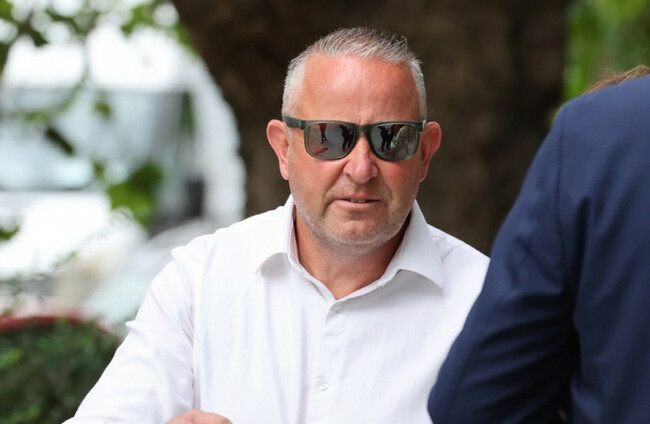
Trevor Bolger outside the Criminal Courts of Justice. irishphotodesk.ie

Garda who assaulted his wife could not be named for three years due to reporting restriction

Trevor Bolger, who pleaded guilty to assaulting Margaret Loftus in October 2012, was handed a three-month suspended sentence last week.

A REPORTING RESTRICTION that prevented the naming of a Dublin-based garda who received a suspended sentence for assaulting his then-wife was lifted after the defence conceded there was no basis for keeping it in place. 

The media was not allowed to report Trevor Bolger’s name for more than three years. The restriction was only lifted after a number of media organisations went to court to argue against it. 

Trevor Bolger (48) was last week handed a three-month suspended sentence after he pleaded guilty to assaulting Margaret Loftus on 25 October 2012. 

The court heard that the maximum penalty for the assault, under Section 2 of the Non-Fatal Offences Against the Person Act which is normally dealt with summarily in the District Court, is six months imprisonment or a fine.

Separately, it remains unclear whether Bolger will lose his job as a garda following the sentencing. He was suspended from An Garda Siochána more than six years ago as a result of the case. 

It is understood that Garda Commissioner Justin Kelly is considering whether to dismiss Bolger, in line with garda procedures on how the force deals with gardaí who have been convicted of an offence.

In her victim impact statement, Margaret Loftus, who was also a garda, described how her sense of truth and justice was shattered by the assault. She said that it also impacted personal relationships she had with fellow gardaí. 

“There was a stigma attached to me – for standing up for myself,” she said.

She told the court the “protracted assault” was “terrifying” and that she feared that if she had stayed with him, she would have been killed.

Speaking outside the Criminal Courts of Justice, she outlined how it had taken 14 years and 58 court appearances to get to Friday’s verdict. 

The assault

Bolger joined An Garda Síochána in 2001. He and Margaret Loftus met when they were both stationed in Ballymun Garda Station in Dublin in 2006 and they married four years later. They had two children. 

The assault took place in October 2012, when they attended a family gathering in her native Co Mayo for her brother’s 30th birthday party.

Bolger was annoyed at having to attend the event, and later became irate about Loftus left his side to go and speak to her family in the pub. He sat at the bar drinking for the rest of the night. 

When they left the pub and returned to her childhood bedroom where they were staying, Bolger attacked Loftus. He hit her in the back and grabbed her by the hair while she begged him not to hurt her.

The following afternoon, Loftus had her father stand beside her while she told Bolger that their marriage was over. 

Loftus made a formal complaint against Bolger in 2018, who by that time was working at Howth Garda Station in Dublin and had been promoted to detective earlier the same year. There is no evidence that garda management was aware of the complaint at the time of the promotion. Bolger was interviewed voluntarily that December, where he twice denied he had carried out the assault in question. 

He was charged in December 2019 and suspended from An Garda Síochána. He remains suspended. 

Reporting restrictions

A temporary reporting restriction was imposed on the case in July 2020, preventing Bolger’s name from being published. Judge Paula Murphy said she was restricting the reporting until such time that the full facts of the issue were put before the court.

Later that month, lawyers for Bolger asked the court to restrict the publication of his name until the trial when the “the matter can be thoroughly explored” by the trial judge.

The lawyers said that there was “deeply private” material in the book of evidence and that if the media were permitted to name Bolger, it would risk other parties being identified.

Judge Melanie Greally told the court that she was not convinced that publishing Bolger’s name would affect his ability to get a fair trial, but said that the privacy rights of third parties could be compromised by publication.

The reporting restriction remained in place until July 2023, when it was successfully challenged by The Journal, RTÉ, The Irish Times, The Irish Examiner and Mediahuis, the publisher of The Irish Independent.

At the hearing, defence lawyers conceded that there was no basis for the reporting restriction to remain in place and it was subsequently lifted. The sitting judge said the media was free to report proceedings in the normal way.

Last week, the court heard that Bolger no longer drinks alcohol and has engaged with the MOVE (Men Overcoming Violent Emotions) programme, which works with domestic violence against women. He will take part in one of its courses this year. 

A number of testimonials were also handed in to the court from family and friends of Bolger, including one from a retired Garda inspector.

Six-year wait 

There has been no public explanation why it took six years for the matter to reach a courtroom. 

margaret-loftus-16jan-ccj4 Margaret Loftus (second from right) outside at the Criminal Courts of Justice last week. irishphotodesk.ie irishphotodesk.ie

When asked about the gap by reporters outside court on Friday, Loftus said: “I imagine the blanks will be filled in in time, but this certainly wasn’t a case where I sat at home for six years and done nothing.”

Pressed on why she believed it took so long for the case to go to court, she said: “I think that’s for another day.”

In an interview with The Irish Times on Tuesday, Loftus said that in the earlier years after the assault, she felt it was difficult to get a substantive investigation started because Bolger was also a serving garda. She said that when she later submitted a detailed witness statement to the Garda Commissioner’s office in 2018, an investigation team attended her home the following day.

Loftus told The Irish Times that, in the earlier years after the assault, she felt it was difficult to get a substantive investigation started because Bolger was also a serving garda. She said that when she later submitted a detailed statement to the Commissioner’s office in 2018, an investigation team attended her home the following day.

She also told The Irish Times that she was devastated when told Bolger had agreed to plead guilty to a Section 2 charge because it meant other charges would not go to trial, namely a threat to kill and coercive control.

One source told The Journal they could understand how a complainant in Loftus’s position might feel intimidated when reporting an assault involving a serving member of the force.

The Irish Times also reported this week that gardaí began inquiries into how one of their journalists had learned that Bolger was before the courts. The newspaper first reported on the case in 2020.

In a statement to The Journal, assistant general secretary of the NUJ Séamus Dooley described it as a “worrying and wasteful use of resources into a matter of public interest” by the gardaí. 

“If the accused was not a member of the force would such an investigation have been initiated?” Dooley asked.

“I believe the Garda Commissioner needs to clarify why the investigation was initiated and on whose instructions it was carried out.”

An Garda Siochána has been asked for a response. 

Potential dismissal 

As a result of his conviction, it is possible that Bolger may face dismissal from An Garda Siochána under Section 51 of the Policing, Security and Community Safety Act 2024.

Under the act, the Garda Commissioner may dismiss a member of the force if they believe their continued membership would undermine public confidence in An Garda Síochána, and their dismissal is necessary to maintain that confidence.

In a statement to The Journal, a spokesperson for An Garda Siochána said: “Following the criminal conviction of a Garda, this would be further considered by An Garda Síochána under either performance proceedings, conduct proceedings or dismissal proceedings under the Policing, Security and Community Safety Act 2024.

The spokesperson said the Garda Commissioner “has made it very clear that there is zero tolerance for domestic abuse outside and inside of An Garda Síochána”.

“An Garda Síochána provides a wide range of welfare supports to gardaí and such supports should have been provided to the Garda and her allegations taken seriously.”

Loftus told The Irish Times that she fears Bolger may not lose his job.

“If he doesn’t lose his job I will personally handcuff myself to the gates of Leinster House,” she said. “It’s an absolute national scandal that he can do all that he’s done and think he’ll be allowed to go back, and put on the [Garda] uniform.”

- Additional reporting by Declan Brennan 

Readers like you are keeping these stories free for everyone...
A mix of advertising and supporting contributions helps keep paywalls away from valuable information like this article. Over 5,000 readers like you have already stepped up and support us with a monthly payment or a once-off donation.

Close
JournalTv
News in 60 seconds