We need your help now

Support from readers like you keeps The Journal open.

You are visiting us because we have something you value. Independent, unbiased news that tells the truth. Advertising revenue goes some way to support our mission, but this year it has not been enough.

If you've seen value in our reporting, please contribute what you can, so we can continue to produce accurate and meaningful journalism. For everyone who needs it.

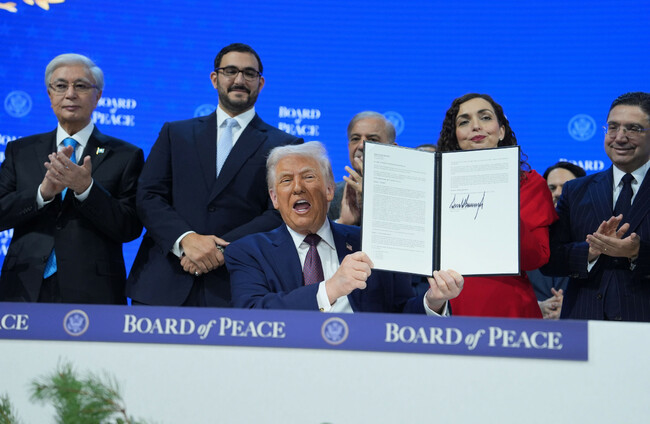
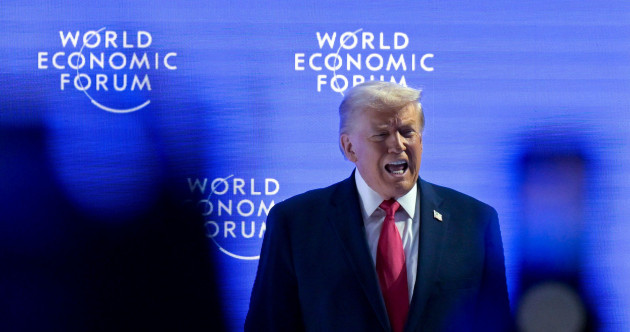
Donald Trump holds up a signed Board of Peace charter during the Annual Meeting of the World Economic Forum in Davos. Alamy Stock Photo

Trump has unveiled his 'Board of Peace' in Davos - here's what we know

The US President will chair the organisation, and countries who want to be permanent members will need to pay $1 billion.

LAST UPDATE | 2 hrs ago

DONALD TRUMP HAS unveiled his new so-called ‘Board of Peace’ in Davos.

It comes a day after the US President rolled back on his threats to impose tariffs on several European countries if they opposed his plans to take over Greenland, partially defusing a crisis which had shaken the meeting of global elites.

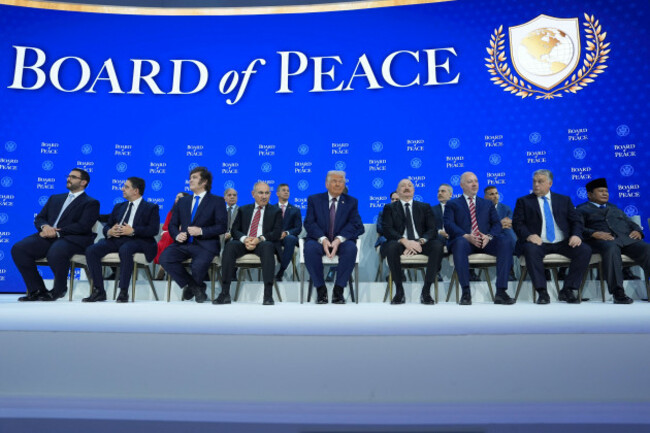
On his second day at the Swiss ski resort, he led a signing ceremony for the US organisation’s charter. 

Representatives from 19 countries signed the document, including Argentina’s Javier Milei and Hungary’s Viktor Orban – the only EU country that has so far accepted the invitation to join the board. 

Speaking at the ceremony, Trump said the board could be “one of the most consequential bodies ever created”, though he stopped short of giving any further detail on the board or the charter. 

He also indicated that it will work in conjunction with the United Nations, amid concerns that the Republic wants to rival the international organisation. 

Here’s what we know about the ‘Board of Peace’ so far.

What is the ‘Board of Peace’

The organisation was first mentioned as part of Trump’s 20-point peace plan for a ceasefire in Gaza last September.

The plan said the board would “set the framework and handle the funding for the redevelopment of Gaza” until the Palestinian Authority had reformed.

However, its charter does not limit its role to Gaza. It describes the board as “international organisation that seeks to promote stability, restore dependable and lawful governance, and secure enduring peace in areas affected or threatened by conflict”.

It will “undertake such peace-building functions in accordance with international law”, it adds.

While the charter does not mention Gaza, the White House has said a ‘Gaza Executive Board’ will be established to “help support effective governance and the delivery of best-in-class services that advance peace, stability, and prosperity for the people of Gaza”.

Who will run it?

Trump will be chairman but also “separately serve” as representative of the US.

“The chairman shall have exclusive authority to create, modify or dissolve subsidiary entities as necessary or appropriate to fulfil the Board of Peace’s mission,” a draft of the charter reads. 

It also says the chairman can be replaced only in case of “voluntary resignation or as a result of incapacity”.

The board will also have a “founding Executive Board” to implement the board’s mission. 

Trump has appointed former UK prime minister Tony Blair, US Secretary of State Marco Rubio, Middle East envoy Steve Witkoff and son-in-law Jared Kushner to the executive board. 

The other appointees are World Bank President Ajay Banga, an Indian-born American businessman; billionaire US financier Marc Rowan; and Robert Gabriel, a loyal Trump aide who serves on the National Security Council.

Who has joined?

Member states must be invited by the US President and will be represented by their head of state or government.

Trump has invited around 50 world leaders to join the board, including allies and adversaries. According to the White House, around 35 have taken up the offer so far.

Nineteen countries were represented at today’s signing ceremony: Argentina, Armenia, Azerbaijan, Bahrain, Bulgaria, Hungary, Indonesia, Jordan, Kazakhstan, Kosovo, Mongolia, Morocco, Pakistan, Paraguay, Qatar, Saudi Arabia, Turkey, the United Arab Emirates and Uzbekistan.

president-donald-trump-center-poses-with-international-leaders-after-the-signing-of-a-board-of-peace-charter-during-the-annual-meeting-of-the-world-economic-forum-in-davos-switzerland-thursday-ja Trump posing with international leaders and representatives after the signing of the Board of Peace charter. Alamy Stock Photo Alamy Stock Photo

Other countries that were not present at the ceremony but have said they will join the board include Albania and Egypt. 

Israel’s Benjamin Netanyahu has also confirmed he will join the board, though he was not present at the signing ceremony. Netanyahu is wanted by the International Criminal Court for war crimes allegedly committed during Israel’s offensive in Gaza, with Switzerland confirming previously that it would arrest him if he entered the country. 

Some leaders might be put off by the price tag attached.

For the first three years, countries can sit on the board for free. But a permanent seat on the board, will cost $1bn “within the first year of the charter’s entry into force”, it states. 

Who hasn’t joined?

So far, France, Denmark, Sweden, Norway and Slovenia have all confirmed they will not join the board.

Other countries are still mulling over the invites, amid concerns that Trump wants his board to rival the United Nations.

The Kremlin has said Russia’s Vladimir Putin is still studying his invitation.

China’s foreign ministry spokesman said Beijing would defend the international system with the UN “at its core”.

Ukrainian President Volodymyr Zelensky said it would be “very hard” to be a member of a council alongside Russia, and diplomats were “working on it”.

The UK echoed the sentiment, with British foreign secretary Yvette Cooper saying they have “concerns” about Putin’s potential involvement amid the ongoing war in Ukraine. 

Italy’s Giorgia Meloni, seen as one of Trump’s biggest allies in the EU, told the state broadcaster RAI that her country is interested in membership but will not immediately join due to constitutional issues.

A Vatican spokesperson confirmed Pope Leo XIV has been invited and is taking time to consider his response.

What about Ireland?

Earlier this week, Foreign Affairs Minister Helen McEntee confirmed Ireland had been invited to join the board, but said: “We will need to give this careful consideration.”

McEntee said the US-organised board “would have a mandate wider than the implementation of the Gaza Peace Plan”.

“The United Nations has a unique mandate to maintain international peace and security, and the legitimacy to bring nations together to find common solutions to shared challenges,” she said. 

Speaking to RTÉ News at the WEF in Davos today, Taoiseach Micheál Martin said that the government is currently “examining” the invitiation to the board.

“There are issues that we will examine in respect of it,” Martin told RTÉ.

“Our principal focus at the moment is to try and contribute to the peace process in the Middle East, given our own experience in conflict resolution, and we believe that the level of humanitarian aid is not going in to the degree that it should, that would be a strong point that we will be making,” he added.

With reporting from © AFP 2026

Readers like you are keeping these stories free for everyone...
A mix of advertising and supporting contributions helps keep paywalls away from valuable information like this article. Over 5,000 readers like you have already stepped up and support us with a monthly payment or a once-off donation.

Close
92 Comments
This is YOUR comments community. Stay civil, stay constructive, stay on topic. Please familiarise yourself with our comments policy here before taking part.
Leave a Comment
    Submit a report
    Please help us understand how this comment violates our community guidelines.
    Thank you for the feedback
    Your feedback has been sent to our team for review.

    Leave a commentcancel

     
    JournalTv
    News in 60 seconds