Sign in. It’s quick, free and it’s up to you.
An account is an optional way to support the work we do. Find out more.
Sign in. It’s quick, free and it’s up to you.
An account is an optional way to support the work we do. Find out more.
IRISH CUSTOMERS ARE among those receiving cheques from Amazon as part of a $2.5 billion (€2.1 bn) settlement it struck with US regulators.
Last September, Amazon reached the historic settlement with the Federal Trade Commission (FTC), which said the company tricked customers into signing up for its Prime memberships and made it difficult for them to cancel after doing so.
The settlement required Amazon to pay $1 billion in civil penalties – the largest FTC fine in its history – as well as pay out $1.5 billion to consumers who were unintentionally enrolled in Prime or deterred from cancelling their subscriptions.
The surprise settlement last September came just days after a trial began in US District Court.
The FTC chair said at the time that the settlement would put “billions of dollars back into Americans’ pockets, and make sure Amazon never does this again”.
The FTC chair added that, under President Donald Trump, it is “committed to fighting back when companies try to cheat ordinary Americans out of their hard-earned pay”.
However, it is not just American users who are getting refunds.
People around the world, including in Ireland, have begun to get cheques in the mail as part of the settlement.
It’s understood that Irish customers may be eligible for a refund if they previously signed up to Prime via Amazon.com – the “com” domain is under the ultimate jurisdiction of US law.
Certain Prime customers eligible for refunds of up to $51 include those who signed up for a membership via the company’s Single Page Checkout, among other links, between 23 June 2019 and 23 June 2025.
A letter sent to an Irish customer, seen by The Journal, enclosed a cheque of $51 which must be deposited by 21 February.
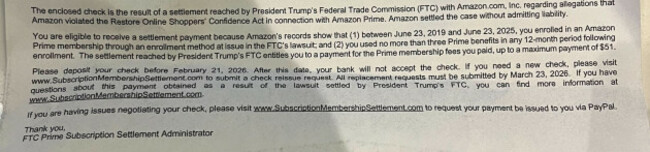
It is also possible to request the refund via PayPal.
The FTC has noted that no one from Amazon will ever ask for money to get a refund.
“Only scammers say they can get you special access or a guaranteed refund,” added the FTC.
Customers should also be cautious of any communications asking for personal information beyond what’s necessary for the claims process.
Amazon admitted no wrongdoing in the case.
In a statement at the time, Amazon said it worked “incredibly hard to make it clear and simple for customers to both sign up for or cancel their Prime membership and to offer substantial value for our many millions of loyal Prime members around the world”.
The case centered on two main allegations: that Amazon enrolled customers without clear consent through confusing checkout processes, and that it created a deliberately complex cancellation system.
The FTC alleged that Amazon’s checkout process forced customers to navigate confusing interfaces where declining Prime membership required finding small, inconspicuous links – while signing up for the service used prominent buttons.
Crucial information about Prime’s price and automatic renewal was often hidden or disclosed in fine print, the FTC also alleged.
Under the settlement, Amazon was also forced to reform its Prime enrolment and cancellation processes.
This included introducing a clear option for customers to decline Prime membership, and refraining from vague or indirect references like “no thanks, I don’t want free shipping.”
The company must also implement new disclosure requirements before charging consumers and always disclose the price and auto-renewal feature on the Prime sign-up page.
-With additional reporting from AFP 2026

To embed this post, copy the code below on your site













have your say