Sign in. It’s quick, free and it’s up to you.
An account is an optional way to support the work we do. Find out more.
Sign in. It’s quick, free and it’s up to you.
An account is an optional way to support the work we do. Find out more.
TAKING PART IN European defence initiatives and increasing the capability of a country’s security services does not impact on a State’s neutral status, the Austrian ambassador to Dublin has said.
Melitta Schubert was speaking at the launch of a report on the future of Irish defence commissioned and written by supporters of greater investment in the military. The launch was held at EU offices in Dublin.
Austria, like Ireland, defines itself as a neutral country within the European Union and is exempt from some of the mutual defence measures in European treaties.
Schubert said that Austria’s neutrality was defined when it joined the EU as being not part of a military alliance and not have any foreign troops on Austrian soil.
The ambassador said the country’s neutrality was defined by a “golden age” when its non-alignment status of the 1970s saw it at the centre of peace negotiations involving the Soviet Union.
But Schubert said that the Iraq war in the 1990s was the beginning of a change, when Austria moved from a protectionist and isolationist policy to putting the United Nations before Austria.
In 1995 Austria joined the EU and the ambassador said this moved her country further away from their non-alignment.
“The government last year reiterated this fact, that cooperation and solidarity within the EU will still guide us and continue to guide us, and that we are fully committed to participate in the common security and defence policy of the EU – maybe even going towards European defence at some point, but I think we’re still far away from that sense,” she said.
There has been some significant opposition in Ireland from Opposition parties such as Sinn Féin and People Before Profit to Ireland’s participation in so-called Pesco projects. This is a permanent structured cooperation on security projects.
This week, Sinn Féin’s Pearse Doherty criticised providing financial assistance to the Ukrainian War effort.
Polling for the Irish Times last year showed the Irish public strongly supported neutrality by a more than two to one margin, but the public was less convinced about maintaining the triple lock requiring UN troops to send Irish troops abroad on peacekeeping missions. The government is working to scrap the triple lock.
The ambassador said that her country does not see any issue with the Pesco scheme. She also said they have joined other mutual defence operations such as European Sky Shield which is a project to develop a ground-based integrated European air defence system which includes anti-ballistic missile weapons.
Schubert said that Austria has withdrawn from peacekeeping missions to bring their forces home to focus on “keeping the population and institutions safe in Austria”.
“Our Foreign Affairs minister, Beate Meinl-Reisinger, said it very clearly recently: we have to be so strong that nobody dares to attack us. That’s quite a statement for a neutral Foreign Minister, so we are investing a lot,” she added.
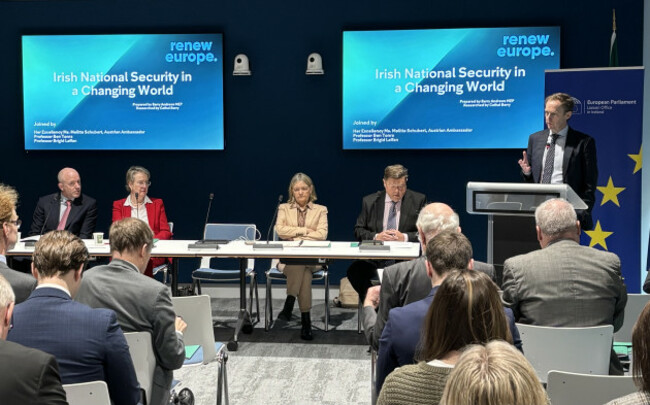
At the launch today, Irish MEP Barry Andrews, who commissioned the report written by former military officer and TD Cathal Berry, said the purpose of the study was to start a conversation about Irish commitment to preparedness.
“And also we want to be able to demonstrate to Europe that in Ireland, we’re taking this issue seriously that it’s a very live debate, and displace some of the, frankly, prejudice that’s there about Ireland’s state of preparedness and its contribution to security.
“And the central message is a neutral country’s primary obligation is to be able to defend itself, and that’s something we’re trying to have that conversation around today,” he said.
Last week, The Journal reported on remarks by General Seán Clancy, the chair of the EU Military Committee, who argued that Europe was working to build the deterrence to prevent a conflict, rather than preparing for war.
Andrews said that every threat analysis showed that Europe is living through a time when it is facing major hybrid threats against critical infrastructure that could lead to “massive interruptions in energy, massive interruptions into digital and transport infrastructure”.
“That’s the number one threat. So geography is no defence anymore, and therefore Ireland, given the digital presence, given the sea, given the undersea cables, given the uniqueness of our energy dependence on the UK, has enormous exposure, and it’s not matched by what we’re doing.
“I think that threat is experienced across the board, across Europe, and really today, we’re trying to emphasize how important this is to Ireland’s strategy in the future,” he added.

To embed this post, copy the code below on your site









have your say