We need your help now

Support from readers like you keeps The Journal open.

You are visiting us because we have something you value. Independent, unbiased news that tells the truth. Advertising revenue goes some way to support our mission, but this year it has not been enough.

If you've seen value in our reporting, please contribute what you can, so we can continue to produce accurate and meaningful journalism. For everyone who needs it.

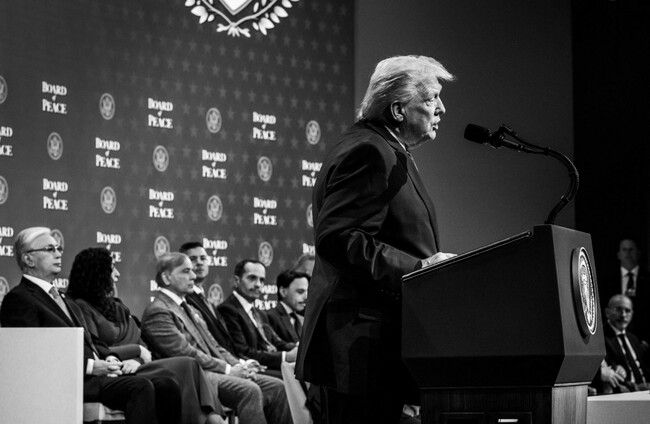
The Board of Peace Charter announcement on 22 January. Alamy Stock Photo

The view from Palestine: Is Trump's plan a runner?

Hana Salah talks to people in Gaza and the West Bank about the future of Palestine, through the lens of Donald Trump’s blueprint.

THE UNITED STATES has moved into the second phase of its plan to reshape Gaza’s postwar governance, including proposals for a transitional administration, the disarmament of Palestinian factions and an expanded international role in reconstruction.

Under Donald Trump’s plan, unveiled on 15 January, Gaza would be placed under an interim administration composed of three bodies: a Peace Council (emerging from his initial Board of Peace plan which has grown legs), a Palestinian technocratic committee responsible for civil affairs and an international stabilisation force.

Last Thursday, the 15 members of the newly formed Palestinian technocratic committee left Gaza to begin consultations abroad, travelling an indirect route arranged for them. The officials exited through the Kerem Shalom crossing, were transferred to Jordan via the King Hussein Bridge, and then flown by private plane to Cairo.

The Rafah crossing between Gaza and Egypt — the only border crossing previously
operated by Palestinian authorities under Hamas — has been closed since May 2024.

Since then, Kerem Shalom has been the sole crossing for both commercial goods and passenger movement, operating under Israeli control. The Rafah crossing reopened on Monday for the first time since its closure, following actions taken by the newly established technocratic committee.

At a meeting in Cairo on Wednesday, committee members met Nikolay Mladenov, director general of the Diplomatic Peace Council for Gaza, to discuss urgent humanitarian needs and longer-term administrative arrangements.

According to participants, the talks focused on three main areas: managing the Rafah crossing and easing Palestinian travel; preparations for an upcoming committee visit to Gaza; and coordination on humanitarian and administrative challenges.

Officials said the discussions were seen as laying the groundwork for practical stabilisation measures and drew regional and international attention because of their political and humanitarian implications.

Mladenov, a Bulgarian diplomat, previously served as the United Nations special coordinator for the Middle East peace process, where he helped mediate indirect ceasefire arrangements between Israel and Hamas and held meetings with Hamas leader Yahya Sinwar. He has now been appointed to lead the Peace Council under President Donald Trump’s Gaza plan.

The role of the technocrats

The technocratic committee (formally known as the National Committee for the Administration of Gaza) is a non-political body of 15 Palestinian national figures, headed by Ali Shaath and tasked with overseeing day-to-day civil affairs.

According to Haaretz, the committee has started limited coordination with Hamas without assuming full control on the ground, a step described as an early and uncertain phase of the broader US-backed political transition. 

The committee is one of four bodies proposed for Gaza’s transitional governance, alongside the Peace Council, a Gaza Executive Council and an international stabilisation force. These arrangements were set out in Trump’s 20-point plan endorsed by the UN Security Council in Resolution 2803, adopted on 17 November 2025.

Palestinian political observers in the West Bank and Gaza see that the committee’s
transitional role must remain linked to the push for the declaration of a Palestinian state in 2025, warning that any permanent administrative arrangement in Gaza could undermine national unity and the broader statehood project.

“We do not need international authorities to manage our affairs; our people have paid too high a price to decide their own future,” said Abdel Fattah Dawla, a spokesman for Fatah in West Bank.

“Any administrative body in Gaza must be directly linked to the legitimate Palestinian
institutions so that division is not reinforced and the separation of Gaza from the West Bank is not entrenched.”

Houssam Al-Dajani, a political analyst from Gaza, said during an online workshop hosted by the Masarat organisation in the West Bank on 25 January that the committee’s US origins give it political significance beyond its technocratic role.

“The committee was established under Trump’s initiative, which makes it, in effect, Trump’s government in Gaza and an alternative to Hamas’s rule,” Al-Dajani said.

“This undermines Prime Minister Benjamin Netanyahu’s claim that he is fighting the Hamas government in Gaza. The committee is now facing a difficult test in addressing the humanitarian situation, which remains the top priority.”

Rami Shrafit, a member of the General Secretariat of the Palestinian Journalists Syndicate, said at the same meeting that the committee’s legitimacy would be tested by its performance on the ground.

“The committee’s seriousness will be judged by what it delivers, not by how it is structured,” Shrafit said. “For people in Gaza, what matters is the fair and transparent flow of aid, the reopening of hospitals and essential facilities, and concrete steps to restore order and reduce social breakdown.”

Global unease over Peace Council

The proposed Board of Peace, initially mooted as the entity to oversee post-conflict Gaza but has morphed into something larger, has been met with scepticism from several governments.

France has declined to join, arguing that the body’s mandate could weaken the role of the United Nations and concentrate too much authority in the hands of its chairman.

Canada said it would take part but would not pay the fee required for permanent membership. Poland has signalled hesitation, citing concerns over Russia’s inclusion, while Saudi Arabia said it was still reviewing the invitation.

Russia confirmed that President Vladimir Putin had been invited and said it was seeking
clarification from Washington before responding. Other invited countries, including Germany, Britain, Turkey, Egypt and India, have not publicly announced their positions, underscoring the lack of international consensus around the initiative.

Israel rejected the executive

The formation of the Board of Peace and the technocrats committee was coordinated with Israel and approved by security authorities, but the announcement of the executive committee sparked strong opposition in Israel, particularly over the inclusion of Turkey and Qatar.

Israeli officials said Prime Minister Benjamin Netanyahu had urged President Trump to
exclude the two countries from any role in governing or rebuilding Gaza but failed to
persuade Washington.

Finance Minister Bezalel Smotrich criticised the plan for not imposing Israeli military rule, while National Security Minister Itamar Ben-Gvir said Gaza did not need a new governing body but the destruction of Hamas, and called for renewed military action.

Gaza’s future is now shaped by two competing visions: a US-led effort to embed the enclave in a broader postwar political framework, and an Israeli strategy centred on control, marked by internal division and a lack of internationally viable alternatives. The clash has exposed not only a crisis of policy, but a crisis of imagination, with profound consequences for Gaza’s civilians long after the fighting subsides.

Readers like you are keeping these stories free for everyone...
A mix of advertising and supporting contributions helps keep paywalls away from valuable information like this article. Over 5,000 readers like you have already stepped up and support us with a monthly payment or a once-off donation.

View 41 comments
Close
41 Comments
This is YOUR comments community. Stay civil, stay constructive, stay on topic. Please familiarise yourself with our comments policy here before taking part.
Leave a Comment
    Submit a report
    Please help us understand how this comment violates our community guidelines.
    Thank you for the feedback
    Your feedback has been sent to our team for review.

    Leave a commentcancel

     
    JournalTv
    News in 60 seconds