We need your help now

Support from readers like you keeps The Journal open.

You are visiting us because we have something you value. Independent, unbiased news that tells the truth. Advertising revenue goes some way to support our mission, but this year it has not been enough.

If you've seen value in our reporting, please contribute what you can, so we can continue to produce accurate and meaningful journalism. For everyone who needs it.

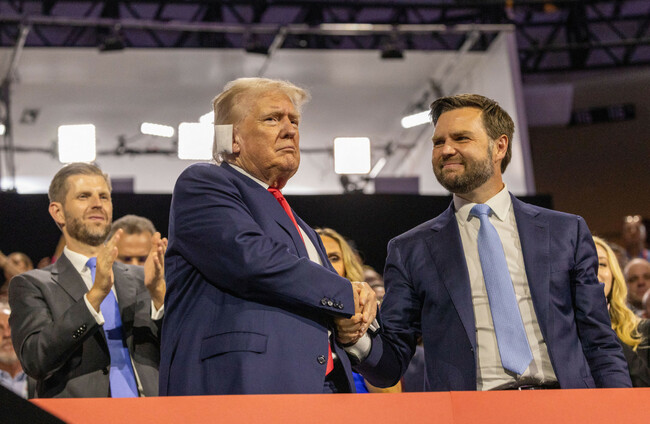
Alamy Stock Photo

Conviction in the age of chaos How to hold the centre in the Trump era

As Trump’s volatility and Putin’s aggression test the global order, Europe must assert its values, defend international law, and lead with conviction, writes Bobby McDonagh.

In a world threatened by chaos, the centre must hold
Things fall apart; the centre cannot hold;
Mere anarchy is loosed upon the world….
— W.B. Yeats

TODAY’S WORLD FACES immense and growing challenges. Trump’s impulsiveness and Putin’s aggression are contributing to a sense of global anarchy similar to that of which Yeats warned us.

Their pincer movement targets the sovereignty of states, international law and the prioritisation of diplomacy over military solutions. It threatens the complex, hard-won, imperfect order that the world struggled hard to build up since the Second World War.

Two mistakes should be avoided. First, we should avoid allowing our attention to be entirely consumed by Trump’s daily antics, deliberately designed — like the algorithms of TikTok and Facebook — to burrow their way into our heads and to take up our headspace. It’s tough to avoid, of course, as there are real-life consequences of his erratic presidency. Instead, we should focus primarily on the deeper underlying issues at stake.

Second, we should avoid surrendering to pessimism. Optimism is not a whimsical luxury. It’s a necessary policy. We have a duty to ourselves and to our children to work relentlessly to ensure that the centre can indeed hold, and with the firm conviction that our aim is achievable.

A constantly evolving series of impulsive Trump initiatives around the world insinuates itself into our consciousness on a daily basis: Iran, Venezuela, Greenland, tariffs, the “Board of Peace”, support for the far right in Europe. Today it is one, tomorrow it will be something else. The ongoing drama is further confused by Trump’s frequent U-turns and inflamed by his ongoing assault on US democracy.

But standing back for a moment, as we must, from the need to engage with the daily tantrums from the White House, there are four fundamental issues on which we in Europe should focus.

The important focus

First, it is of existential importance for all of us across Europe and crucial for the wider world that, more than ever, the European Union maintains and asserts its values. The EU, like every organisation, has its faults and weaknesses. However, today it is the most important international body capable of providing the necessary world leadership in defence of the values, norms and global institutions that are now under increasing threat.

Many people I speak to these days ask, with a degree of understandable helplessness, what we can do in the face of the international turmoil. The simple answer is that all of us — whatever our role and background — can do one simple thing. While continuing in different ways to work to shape or adjust European policies, we can support the European Union wholeheartedly, more so than ever before, in all of its diversity, complexity and imperfection. The time has long passed for game playing or posturing.

Second, we should support the European Union in deploying its influence as widely as possible and deepening its relationships across the world. The EU should work closely with like-minded countries that share its values and its support for international law.

Importantly, it should work with the United Kingdom to reestablish the trust and shared approach to the promotion of our self-evidently common interests that were damaged by the madness of Brexit.

Third, and of particular importance to the Irish economy, the EU should also deepen its relationship with all countries and organisations that support a stable and open trading environment and remain broadly supportive of international organisations, notably the UN, as well as of global cooperation in the fight against climate change.

That, of course, includes China. The EU’s recent trade deals with the Mercosur countries of Latin America and with India are of immense importance and, when implemented, will be of huge benefit to businesses and consumers in Ireland, including small and medium-sized enterprises and large parts of the agriculture sector.

The fourth thing Europe must do is to manage the Trump phenomenon, but not be entirely consumed by that challenge. The EU has many other relationships to nurture and many other fish to fry. The EU retains a great interest in a close relationship with the United States, even if Trump’s behaviour makes that increasingly difficult. That’s why Europe is right to handle the Trump administration gingerly and to hope that saner voices in America will prevail at least to some extent and on some issues. That’s why the Taoiseach is right to accept the invitation to visit the White House for St Patrick’s Day and to keep Ireland’s relationship with the United States on as even a keel as possible.

Striking the right tone

Europe, in its relationship with Trump, has to pitch its stance somewhere along the spectrum between conciliation and confrontation. Thus far, it has generally opted for conciliation, in part to avoid even greater disruption of international trade, and not least because of the importance of cajoling the US to maintain a degree of balance regarding Russia’s grotesque assault on the Ukrainian people.

Europe recently, rightly, shifted towards a somewhat more robust approach when it responded to Trump’s threats against the sovereignty of Denmark, an EU Member State. Whether Europe needs to become increasingly robust in the months ahead will depend on Trump rather than Europe.

Yeats, later in his poem, writes that “the best lack all conviction”. It’s past time for Europe and its citizens, including in Ireland, to develop and assert more true conviction about who we are, about where our interests lie and about how we can best advance those interests.

Bobby McDonagh is a former Irish Ambassador to the EU, UK and Italy. He is an executive coach and commentator on subjects around the EU and Brexit. 

Readers like you are keeping these stories free for everyone...
A mix of advertising and supporting contributions helps keep paywalls away from valuable information like this article. Over 5,000 readers like you have already stepped up and support us with a monthly payment or a once-off donation.

Close
21 Comments
This is YOUR comments community. Stay civil, stay constructive, stay on topic. Please familiarise yourself with our comments policy here before taking part.
Leave a Comment
    Submit a report
    Please help us understand how this comment violates our community guidelines.
    Thank you for the feedback
    Your feedback has been sent to our team for review.

    Leave a commentcancel

     
    JournalTv
    News in 60 seconds