We need your help now

Support from readers like you keeps The Journal open.

You are visiting us because we have something you value. Independent, unbiased news that tells the truth. Advertising revenue goes some way to support our mission, but this year it has not been enough.

If you've seen value in our reporting, please contribute what you can, so we can continue to produce accurate and meaningful journalism. For everyone who needs it.

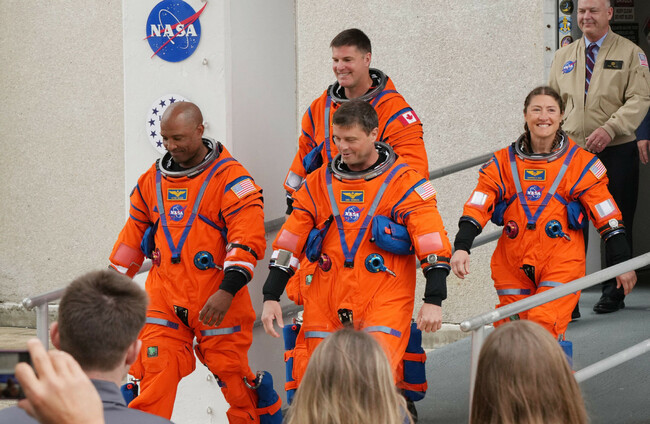
Victor Glover, Jeremy Hansen, Reid Wiseman and Christina Koch walk out before boarding the Artemis rocket at Kennedy Space Center in Florida. Alamy Stock Photo

Crowds gather as astronauts arrive at launch pad ahead of historic Moon mission

The NASA mission dubbed Artemis 2 is scheduled to take off from Florida as early as tonight at 11.24pm Irish time.

LAST UPDATE | 1 Apr

FOUR ASTRONAUTS SET to embark on the first crewed mission to the Moon since 1972 have arrived at the launch pad. 

The NASA mission dubbed Artemis 2 has been years in the making after facing repeated setbacks, but is finally scheduled to take off from Florida as early as 1 April at 6.24pm, which is 11.24pm Irish time.

The team featuring Americans Reid Wiseman, Victor Glover and Christina Koch along with Canadian Jeremy Hansen will set forth on the approximately 10-day mission and hurtle around Earth’s natural satellite without landing – much like Apollo 8 did in 1968.

The journey marks a series of historic accomplishments: it will send the first person of colour, the first woman and the first non-American on a NASA lunar mission.

It is also the inaugural crewed flight of NASA’s new lunar rocket, dubbed SLS.

The final checks to the crew’s launch suits have been completed and they will soon be strapped into their seats before the capsule’s hatch is closed before they prepare to launch. 

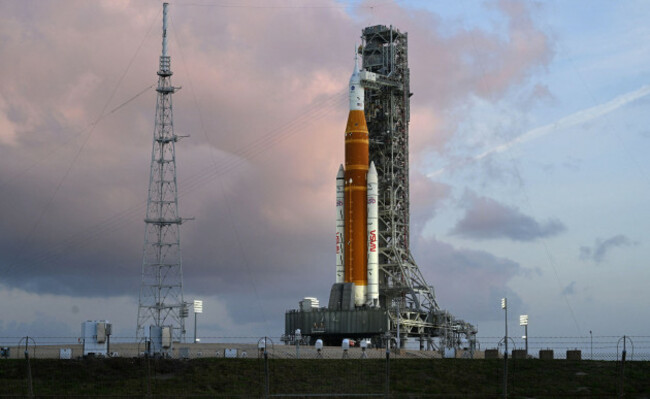
The mammoth orange-and-white rocket is designed to allow the United States to repeatedly return to the Moon in years to come, with the goal of establishing a permanent base that will offer a platform for further exploration.

“The moon is a witness plate to our entire solar system’s formation,” said astronaut Koch in a press conference over the weekend.

“It’s a stepping stone to Mars, where we might have the most likelihood of finding evidence of past life, but it’s also a Rosetta Stone for how other solar systems form.”

‘Ready’

Under bright Florida sunshine, four giant tanks on the rocket started filling with liquid hydrogen and oxygen at 8.35am (1.35pm Irish time).

A full load of fuel will boost the rocket’s weight by 1,000 tons, for a total of more than 2,600 tons.

The mission was originally due to take off as early as February.

But repeated setbacks stalled the mission and even necessitated rolling the rocket back to its hangar for analysis and repairs.

as-launch-day-nears-nasa-engineers-prepare-the-space-launch-system-sls-rocket-as-it-stands-at-complex-39b-on-tuesday-march-31-2026-nasa-has-officially-started-the-countdown-to-launch-the-orion-s The mammoth orange-and-white rocket is designed to allow the United States to repeatedly return to the Moon in years to come. Alamy Alamy

Now Amit Kshatriya, the US space agency’s associate administrator, said at a recent briefing that “the vehicle is ready, the system is ready. The crew is ready.”

As of Tuesday afternoon, NASA officials voiced confidence that engineering operations and final preparations were proceeding smoothly – and that the weather was looking promising.

If tonight’s launch is cancelled or delayed, there are more liftoff opportunities through 6 April, although weather later in the week was looking slightly less favourable, officials said.

“We’ll have to monitor those feisty cumulus clouds and potentially a few showers and breezes as well,” Mark Burger, the launch weather officer, said Tuesday.

But Burger added that even if there are a few rain showers, “none of those look particularly vigorous” and would likely be intermittent on Wednesday – “we should be able to find some clear air to launch Artemis.”

About 400,000 people were expected to watch the launch, local media reported.

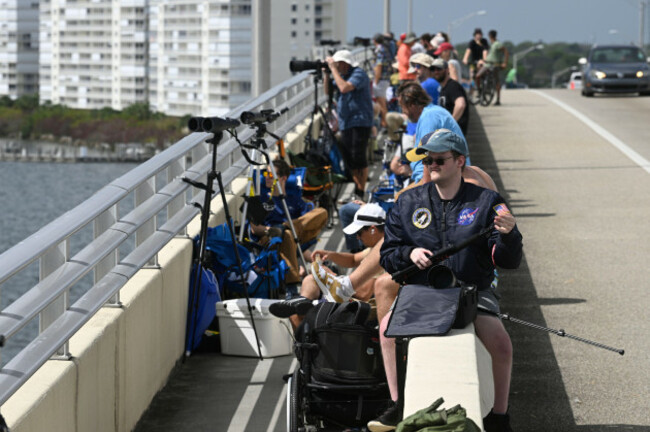
space-enthusiasts-set-up-on-the-a-max-brewer-bridge-to-view-the-nasa-artemis-ii-launch-wednesday-april-1-2026-in-titusville-fla-ap-photophelan-m-ebenhack Space enthusiasts set up to watch the launch on the A Max Brewer Bridge in Titusville, Florida. Alamy Stock Photo Alamy Stock Photo

Melinda Schuerfranz is a retiree from Ohio who ventured to Florida for the launch.

“We’re looking forward to it, we’ve never seen anything like this,” the 76-year-old swimsuit-clad beachgoer told AFP.

“The restaurant we went up to last night for supper, they were all talking about it.”

But Schuerfranz remembers the Apollo era, and thinks some of the magic might be lost in today’s more fragmented media environment: “I think it was way more exciting then,” she said. “Everybody tuned into it.”

‘Astronauts for Halloween’

The Artemis program has been plagued by delays and massive cost overruns.

And its also facing pressure from President Donald Trump, who has pushed the pace of the ambitious program that’s aiming to see boots hit the lunar surface before his second term ends in early 2029.

Artemis 2′s objectives include verifying that both the rocket and the spacecraft are in working order in the hopes of paving the way for a return and Moon landing in 2028.

That deadline has raised eyebrows among experts, in part because Washington is relying on the private sector’s technological headway.

The astronauts will require a second vehicle to descend to the moon’s surface, a lunar lander that remains under development by rival space companies owned by billionaires Elon Musk and Jeff Bezos.

This contemporary era of American lunar investment has frequently been portrayed as an effort in competition with China, which is currently aiming to land humans on the Moon by 2030.

For newly minted NASA head Jared Isaacman, it’s a multi-pronged pursuit related to scientific discovery, national security and economic opportunity – as well as some less-tangible goals.

“I guarantee after these astronauts fly around the moon, you’re going to have more kids dressing up as astronauts for Halloween,” Isaacman said during a recent television interview.

“And that’s going to inspire the next generation to take us further.”

Author
View 66 comments
Close
66 Comments
This is YOUR comments community. Stay civil, stay constructive, stay on topic. Please familiarise yourself with our comments policy here before taking part.
Leave a Comment
    Submit a report
    Please help us understand how this comment violates our community guidelines.
    Thank you for the feedback
    Your feedback has been sent to our team for review.

    Leave a commentcancel

     
    JournalTv
    News in 60 seconds